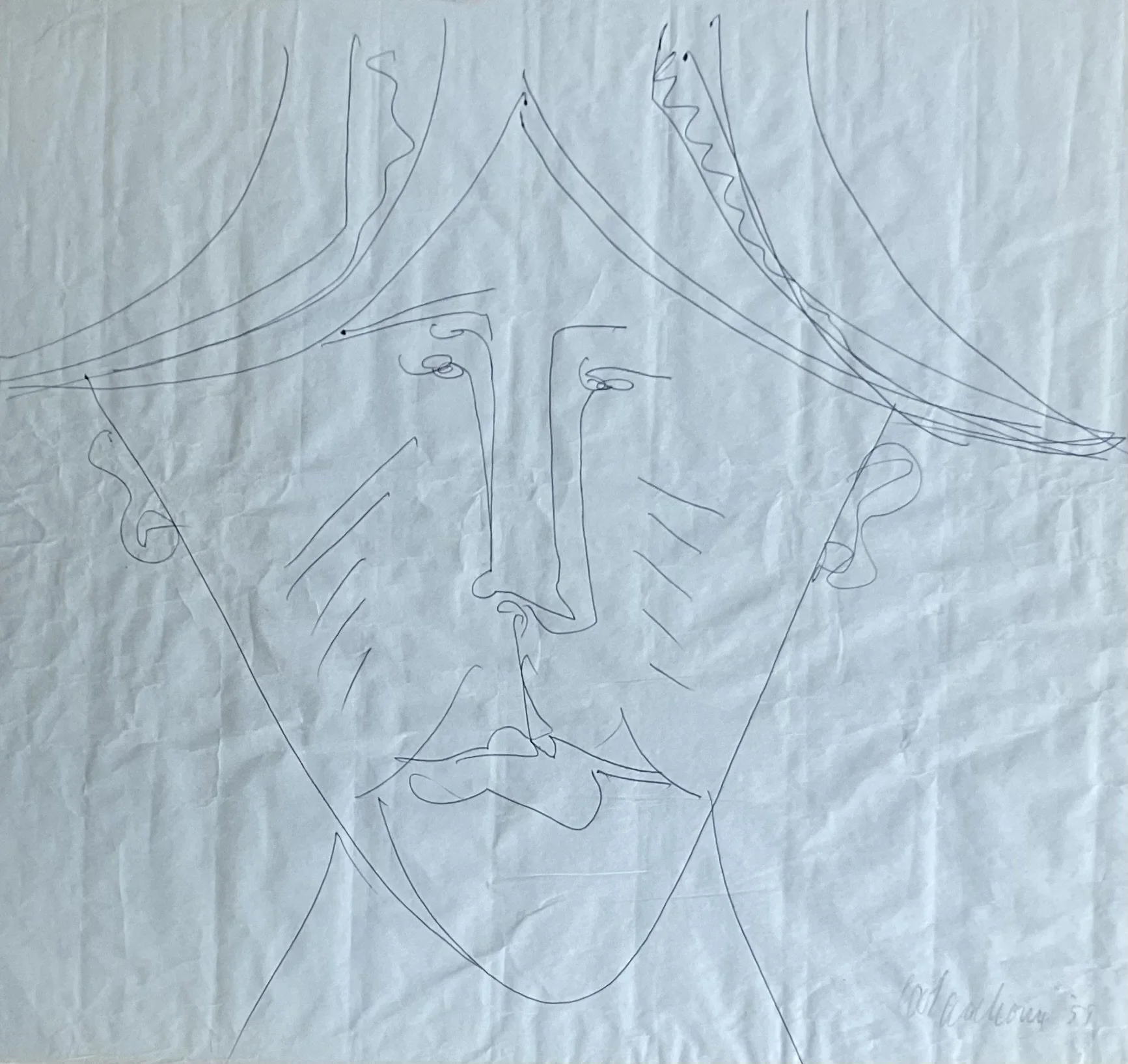


artist: Robert Colquhoun

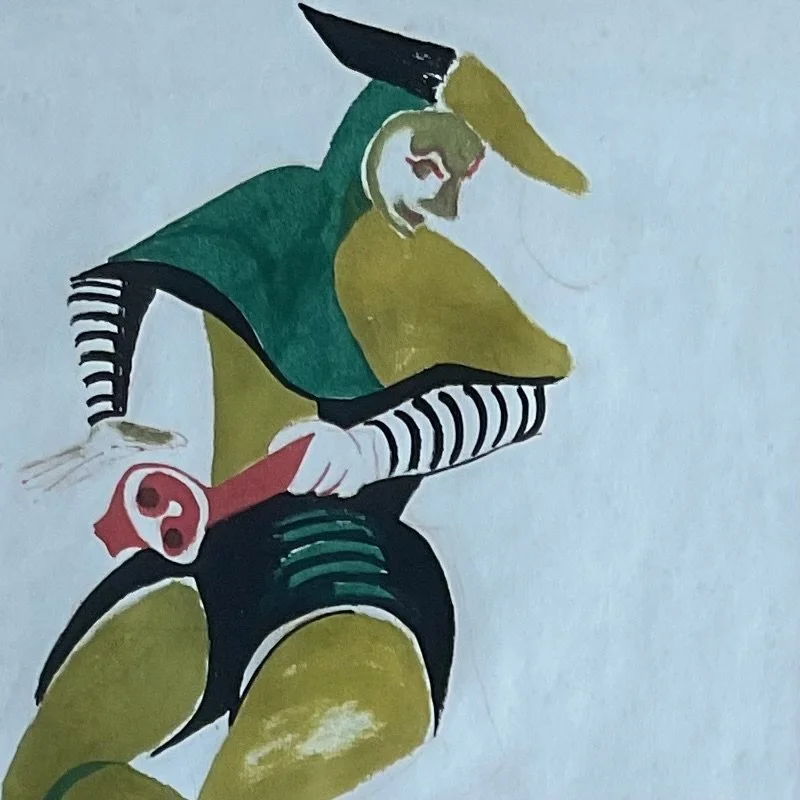
From our personal collection W/C over offset carbon transfer. "Horse & Man"series.
Robert Colquhoun: Scottish Modernist Painter, Printmaker and One of the “Two Roberts”
Robert Colquhoun (1914–1962) was one of the most distinctive Scottish artists of the British post-war period. A painter, draughtsman and highly accomplished printmaker, Colquhoun became internationally recognised during the 1940s and early 1950s for his powerful paintings of figures and his intensely expressive works on paper. Together with his lifelong partner and fellow Scottish artist Robert MacBryde, he became known as one half of “The Two Roberts”. The pair were central figures in the London art world of the 1940s, exhibiting alongside and socialising with artists including Francis Bacon, Lucian Freud and John Minton. Today, Robert Colquhoun paintings, drawings, lithographs and monotypes are increasingly sought after by collectors interested in Modern British art, Scottish art and post-war figurative painting.
Blondes Fine Art is interested in buying Robert Colquhoun paintings, drawings, monotypes and prints. If you own a work by Robert Colquhoun and are considering selling, we would be pleased to hear from you.
Who was Robert Colquhoun?
Robert Colquhoun was born in Kilmarnock, Ayrshire, in 1914. He came from a working-class Scottish background and studied at the Glasgow School of Art from 1933 to 1938. It was at Glasgow that he met Robert MacBryde, beginning a personal and artistic relationship that would remain central to both their lives. The pair became known simply as “The Two Roberts”.
Colquhoun’s early career was rooted in the Scottish landscape and in observations of rural and working life. A travelling scholarship enabled him and MacBryde to travel in Europe, broadening their experience of modern European painting. The Second World War interrupted his artistic development. Colquhoun served with the Royal Army Medical Corps as an ambulance driver but was demobilised on health grounds in 1941. He subsequently moved to London, where his artistic career developed rapidly.
Robert Colquhoun and Robert MacBryde – “The Two Roberts”
The story of Robert Colquhoun and Robert MacBryde is one of the most fascinating partnerships in British twentieth-century art. The two artists met as students at Glasgow School of Art and became lifelong companions. After moving to London they became part of the energetic artistic and literary community centred around Soho and Fitzrovia. Their circle included some of the most important names in post-war British culture, including Francis Bacon, Lucian Freud, John Minton, Dylan Thomas and George Barker. Although closely associated personally, their art was distinctive. MacBryde became particularly associated with still-life painting, while Colquhoun developed a powerful language of figurative painting, concentrating increasingly on the human figure. The Two Roberts enjoyed remarkable success during the 1940s. Their exhibitions at theLefevre Gallery in London attracted considerable attention, and their work was acquired by important institutions including Tate and the Museum of Modern Art in New York. By around 1950 they were among the best-known artists working in Britain.
The paintings of Robert Colquhoun are immediately recognisable for their monumental, simplified figures and emotionally charged atmosphere. His mature work moved away from straightforward representation towards increasingly abstracted and expressive forms. Figures can appear elongated, angular and isolated, often occupying shallow spaces rather than conventional three-dimensional environments. There is a strong sense of psychological tension in many of his paintings. Colquhoun’s figures can appear monumental yet vulnerable, conveying loneliness, uncertainty and emotional intensity. His approach was influenced by modern European art, particularly Pablo Picasso, as well as by artists such as Jankel Adler. Yet Colquhoun developed an individual visual language that places him firmly within the history of British post-war figurative painting. One of his most important paintings is Figures in a Farmyard, painted in 1953. The large composition was produced while Colquhoun and MacBryde were living at Tilty Mill in Essex and was inspired by the rural environment around them. It was subsequently acquired for the Scottish National Gallery of Modern Art.
The human figure was also at the heart of Colquhoun’s mature art. Rather than attempting conventional portraiture, he used the figure as a vehicle for exploring mood, emotion and psychological experience. His figures often have a monumental quality, with simplified anatomy, heavy outlines and carefully constructed planes of colour. This makes Colquhoun particularly interesting to collectors of British figurative art. His paintings sit within the wider story of post-war British art, linking the Neo-Romantic tradition with a more expressive and psychologically charged form of modernism.
Robert Colquhoun prints and monotypes
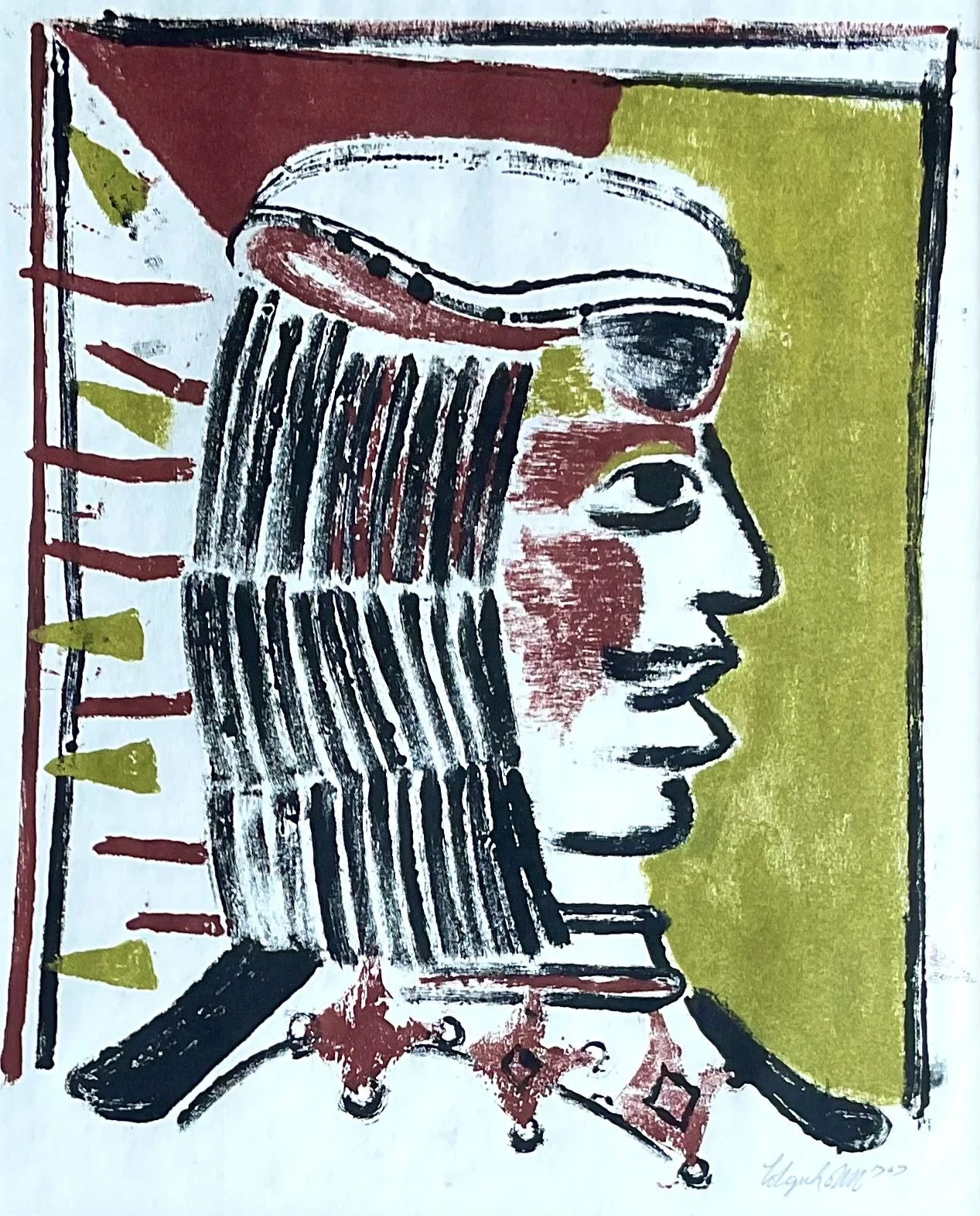
Robert Colquhoun was not only a painter. He was also an important printmaker, producing lithographs, monotypes and experimental works on paper. His monotypes are particularly interesting to collectors because they combine the spontaneity of drawing with the physical qualities of printmaking. Colquhoun experimented with transfer techniques and developed a distinctive approach to creating unique images. Unlike an editioned print, a monotype is essentially a one-off impression, making surviving examples especially appealing to collectors. The National Galleries of Scotland holds examples of Colquhoun’s monotypes, includingHead of a Woman, dated 1949, demonstrating the importance of this medium within his practice.
Robert Colquhoun in Essex
An important chapter in Colquhoun’s career connects him directly with Essex. In the early 1950s Colquhoun and MacBryde lived at Tilty Mill Farm, near Great Dunmow. This rural setting provided an important backdrop to Colquhoun’s work. The connection is particularly significant because some of his Essex studies developed into larger compositions.
Blondes Fine Art has previously handled a rare Robert Colquhoun monotype dated 1952, made during the period when he was living at Tilty Mill Farm. The work was related to the development of his major 1953 painting Figures in a Farmyard. Its provenance included acquisition directly from Colquhoun by the industrialist and patron Sir Colin Anderson. This connection between Robert Colquhoun and Essex is an important and relatively unusual aspect of his biography and is worth highlighting for collectors researching his work.
Robert Colquhoun and theatre design
Colquhoun also worked beyond painting and printmaking, designing sets and costumes for theatre and ballet.
In 1948, Colquhoun and his partner, MacBryde, were selected to design the sets and costumes for Léonide Massine’s new ballet, ‘Donald of the Burthens’. Based on an ancient Scots tale, the ballet tells the story of a woodcutter who, tired of his profession, makes a pact with Death. Colquhoun and MacBryde made over 250 collaborative designs for the ballet, using a carbon transfer technique. By inking up paper sheets and drawing on the backs, the artists could transfer a design as many times as they liked – allowing them to test a number of different colour combinations. It is thought that Colquhoun did the majority of the drawing in these designs whilst MacBryde did the colouring. In 1953 he was commissioned to design the costumes and sets for George Devine’s production of King Lear at the Shakespeare Memorial Theatre in Stratford-upon-Avon. His theatre designs demonstrate the same fascination with simplified forms, expressive figures and dramatic colour that can be seen in his paintings.
Why is Robert Colquhoun important?
Robert Colquhoun’s importance lies partly in the extraordinary position he occupied in British art during the 1940s. He was a leading figure in the generation of artists who established a powerful form of British modernism after the Second World War. At a time when artists were responding to Picasso, European modernism, the experience of war and the growing influence of abstraction, Colquhoun remained deeply committed to the expressive potential of the human figure.
Robert Colquhoun exhibitions and collections
Robert Colquhoun exhibited extensively during his lifetime, particularly during the successful period of the 1940s and early 1950s. His work has subsequently entered important public collections, including the Scottish National Gallery of Modern Art, where paintings and works on paper by Colquhoun are held. His self-portrait, dating from around 1940, is part of the collection of the Scottish National Gallery of Modern Art. Other works include Figures in a Farmyard, The Dubliners and examples of his monotypes and drawings. A major retrospective of Colquhoun and MacBryde’s work in Scotland has also encouraged a reassessment of their contribution to post-war British art.
Collecting Robert Colquhoun
For collectors, Robert Colquhoun offers an unusual combination of artistic importance, scarcity and a compelling place within British art history. His career was tragically short. He died in London in 1962 at just 47 years old. Consequently, the surviving body of work is finite, while important paintings and works on paper are already held in public and private collections. The rediscovery of The Two Roberts has also encouraged greater interest in Colquhoun’s work. His paintings and monotypes are particularly attractive to collectors who want to acquire works connected with the development of British figurative modernism.
Robert Colquhoun paintings for sale
Blondes Fine Art specialises in Modern British and twentieth-century British art and is interested in acquiring works by Robert Colquhoun.
We are particularly interested in:
Robert Colquhoun oil paintings, monotypes and Works from the Tilty Mill Farm period
If you are looking for a Robert Colquhoun painting for sale, please contact Blondes Fine Art to discuss current availability.
OR
If you are looking to sell a work - Blondes Fine Art is a UK art dealership specialising in Modern British and twentieth-century British art. We are particularly interested in acquiring important works by artists whose careers helped shape British art in the twentieth century. Robert Colquhoun is an artist we actively want to buy. If you have a Robert Colquhoun painting, drawing, monotype or print that you may be considering selling, please get in touch with Blondes Fine Art. We offer a discreet service for private collectors, estates, executors and owners looking to sell works of art.
Contact Blondes Fine Art to discuss your Robert Colquhoun artwork.
WANTED
We are currently looking to acquire work by Robert Colquhoun & Robert MacBryde -“The Two Roberts “- so do please contact us if you are considering selling.