By the late 1800’s London had over 2,000 horse buses and 25,000 horses, with stables and a small army of grooms, blacksmiths and saddlers but the last London horse bus service in London was on 4 August 1914, the day Britain declared war on Germany and became embroiled in the First World War. The horses were immediately sent to the front, most never to return.
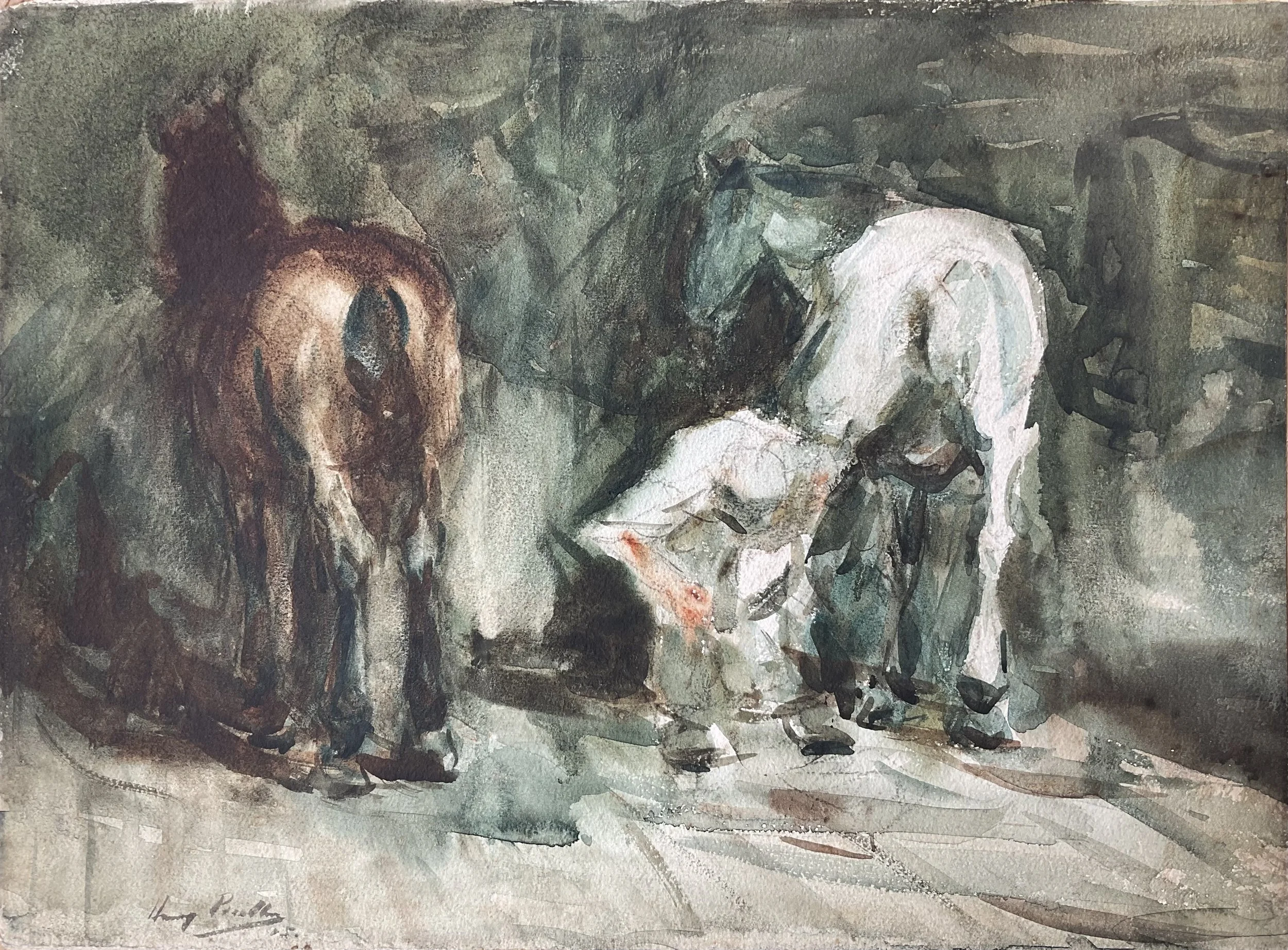
Harry Becker has been ‘claimed’ as one of their own by the county of Suffolk thanks to the Loftus family who have championed his work for some three generations.
Becker was actually born to German parents in Colchester, Essex, trained in Antwerp before enrolling in the Bushey School of art in Hertfordshire, from where he moved to Paris to train with Carolus Duran. In 1894 he set up his art practice in West London and remained there until 1912 when he finally moved to Suffolk.
Harry Becker became one of the London set of artist noted for his rural and agricultural themed work, a master print maker he was friends with Frank Brangwyn, Nevinson and Augustus John and became a founder member of the Senefelder Club, established to promote lithography.
However, there were four defining incidents that eventually made him decide to move to Suffolk. Firstly, his young son died in 1909, followed by his father in 1910 and then the collapse of a commission with Selfridges store and finally the loss of a high profile court case. But, what he did leave behind for us from that decade in London are a series of paintings of the stables, the working bus horses and those farriers and stable lads that worked there ensuring these animals were in as good as condition as possible.
Very recently I was chatting about Becker to a lady who had lived in Suffolk all of her life. She was knowledgeable about Becker and his work but when I showed her a painting of one of his London bus horses she questioned if I was correct, having no idea that he had spent time there before living in Suffolk. This prompted me to write this short piece about this series of work.
We hold a large watercolour from this series in our own personal collection together with a wonderful etching he produced from the same period of one of the horses stood in the stables. Becker lived close to one of the stables in London and seems to have been driven to record the final days of the use of horses in London just as he was later driven to record the last days of the working horses in Suffolk just prior to the introduction of motorised equipment.
The artist lived near to West Kensington Station which was also close to one of the bus horses stables which housed the working horses that he has become most famous for depicting. It is also interesting to note at this point that the other great painter of heavy horses was Lucy Kemp-Welch who was a contemporary of Becker’s at the Bushey School of Art in the 1990’s. They share an ability to depict these animals in a way that no one else has ever managed.
The Bus Horse series was a small series of work but it showed his free style and use of minimal palette to produce the most evocative images. These works feature a pair of horses, a chestnut and a grey, and are shown both in their stalls feeding or being checked by the farrier which was a daily event to ensure their feet had not been damaged during the days work. Becker seems to have been very pleased with the series and turned one image into an etching - the one we have in our collection - and titled it ‘The last London bus horse’ . He also actually produced a few proofs in red, which I have never seen, giving one copy to the art expert Campbell Dodgson according to the historian and Becker expert David Thompson.
The bus horse series was small and I am only personally aware of 6 works but would love to know of any others in existence, so do please contact us if you have any in your collection.