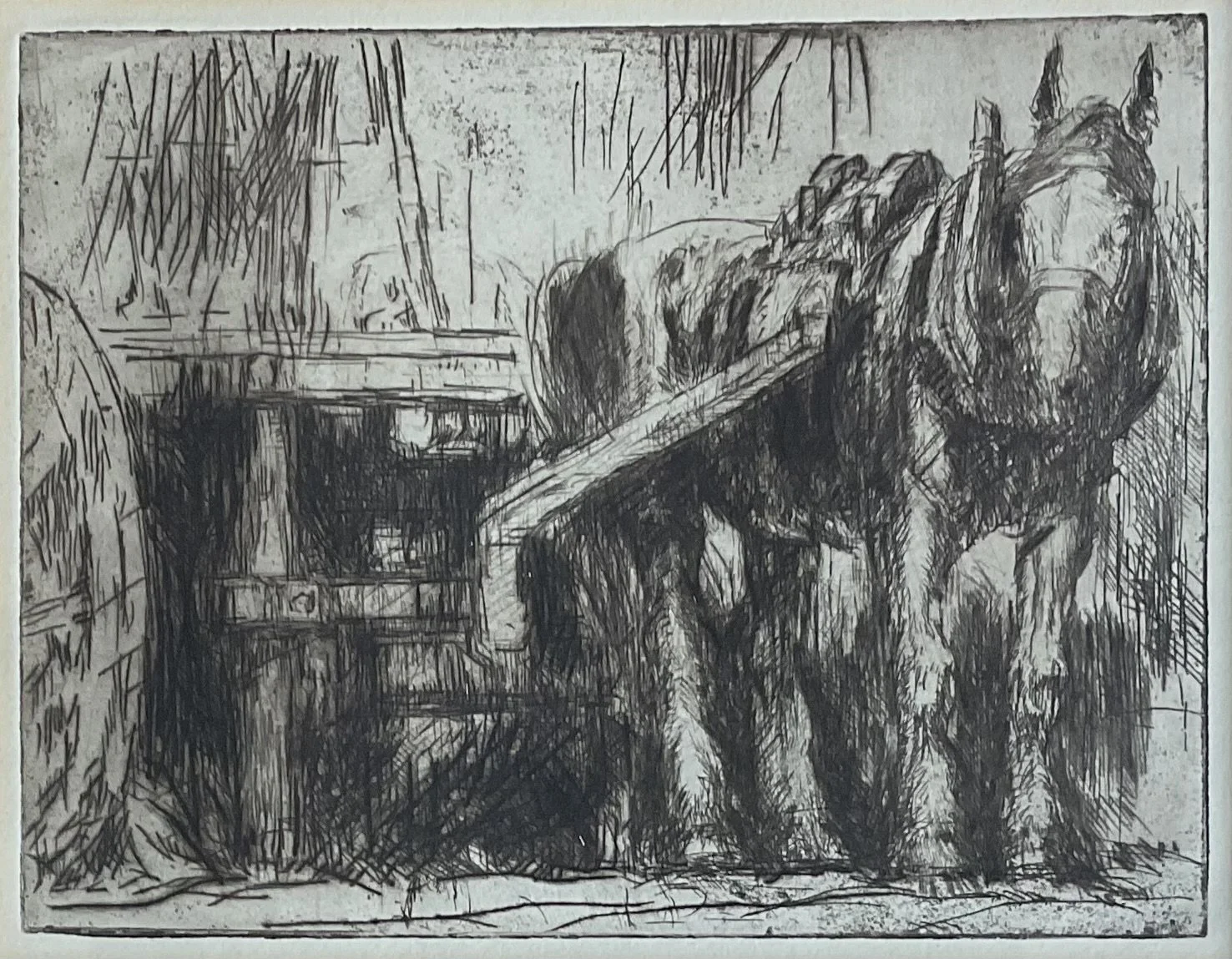
The etching below manages to transmit a feeling of depth and you can almost ‘smell’ the scene.
Harry Becker’s only real financial success during his time in London was as a result of his lithographs. When he held his first solo exhibition at the Baillie Gallery in Notting Hill Gate he devoted it entirely to lithographs and it was so successful that he did so again in 1909 and 1910.
The print expert at that time in the British museum was Campbell Dodgson who was so impressed that he acquired over 50 examples for the museum collection. Indeed, Becker submitted his lithographs to a number of exhibitions in the early 1900’s and for the 1906 Liverpool Autumn exhibition only submitted lithographs and when he sent one to the international exhibition in Milan he won a Bronze prize. Becker was a founding member of the Senefelder Club which was devoted to exhibiting lithographs, showing at Goupil Gallery in London and also Leicester Galleries. Many of these early work show a likeness to his drawings, seemingly done with speed yet managing to still be accurate and delicate.
David Thompson, in one of his essays about Becker said
“ they are often at there most daring in the placing of accents and passages of the densest black against a wild scribble which glitters with movement and light. And the figures, even in some of the earliest, tend towards one revealing Becker characteristic. They are often drawn with that touch of expressive distortion which not only looks very ‘twentieth century’ but feels not particularly English, and certainly not French, but if anything - inasmuch as such qualities are identifiable at all - slightly German: it first became apparent in the 1909 sequence of potato-gathering. “
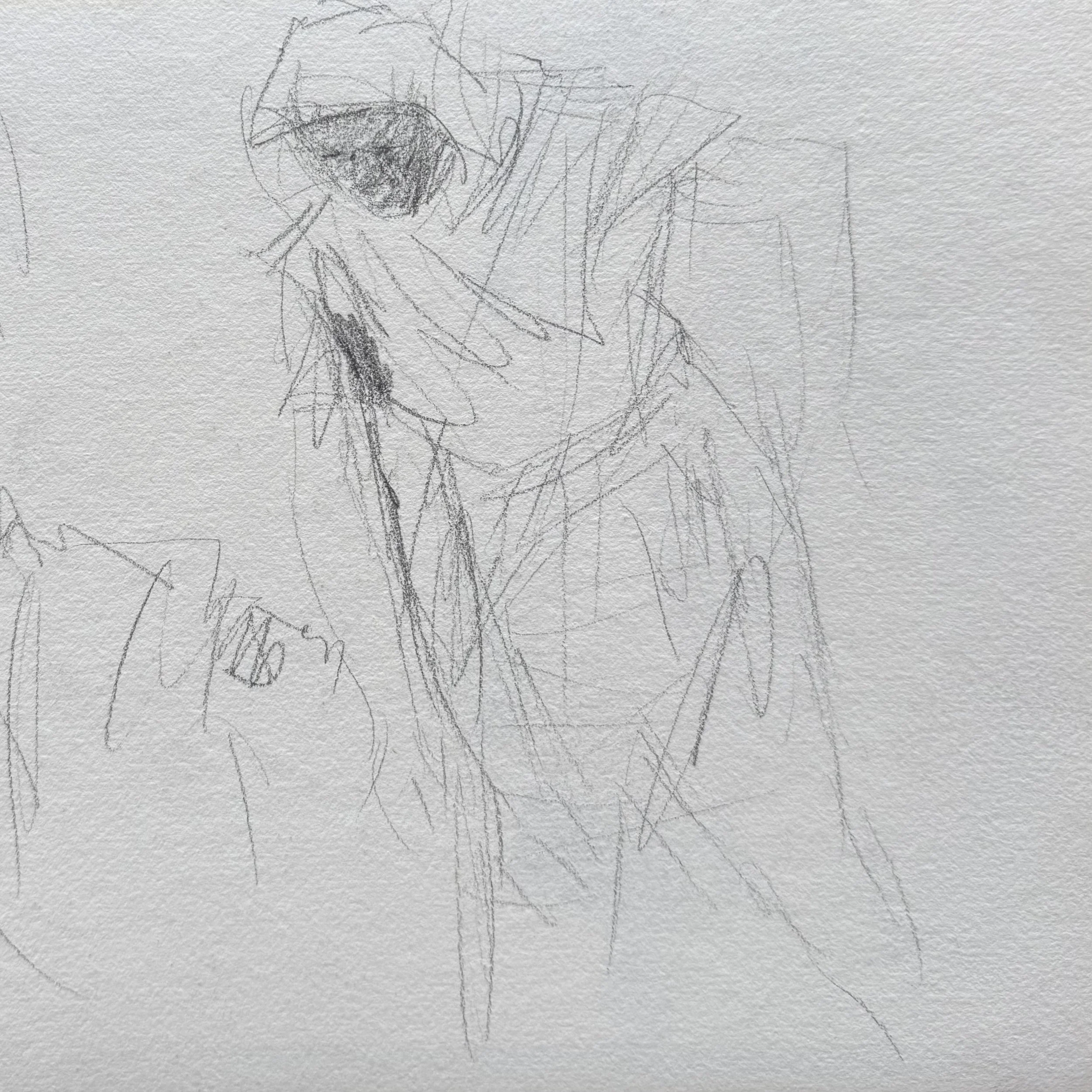
We also currently have in stock a number of drawings from a sketchbook of Becker that has a series of drawings used for the development of these potato gathering lithographs.
Becker’s last big lithograph was made in 1923 when his wife, Georgina, lost her role as art teacher at St Felix School in Southwold. They were short of money again and he hoped to sell it to London transport as a poster but sadly it was rejected, the 10 examples he reputedly made remained unsold and passed to the Loftus family collection after the death of Georgina. We have handled 3 examples of this wonderful image and know of the whereabouts of 9 from the 10 made. We currently have one available which can be seen on our Harry Becker page.
The etchings were never exhibited as widely as the lithographs but their quality meant that they held their own during these years of the ‘etching revival’ . He began making the copper plates in about 1895. He used the dry point technique and made innumerable progess-proofs through which many of these plates were passed, and on which there were anything from small changes to wholesale reworking. Becker also used chalk, pencil and paint to augment the etching and aid the reworking. Several images gained complete figures or additional features from one state to the next and this freewheeling technique is actually rather similar to Degas.
Becker continued to return to certain motifs and images within his thematic material and experimented to the end.
Here at Blondes Fine Art in Hertfordshire we are pleased to be able to offer a number of etchings by Becker that have come from a single owner collection in the North of England and have been owned for a number of decades by the same individual. Do contact us if you would like additional information or take a few moments to look through the Harry Becker page on our website.