Who was Roy Turner Durrant and where does he fit into the Modern British Art jigsaw puzzle?
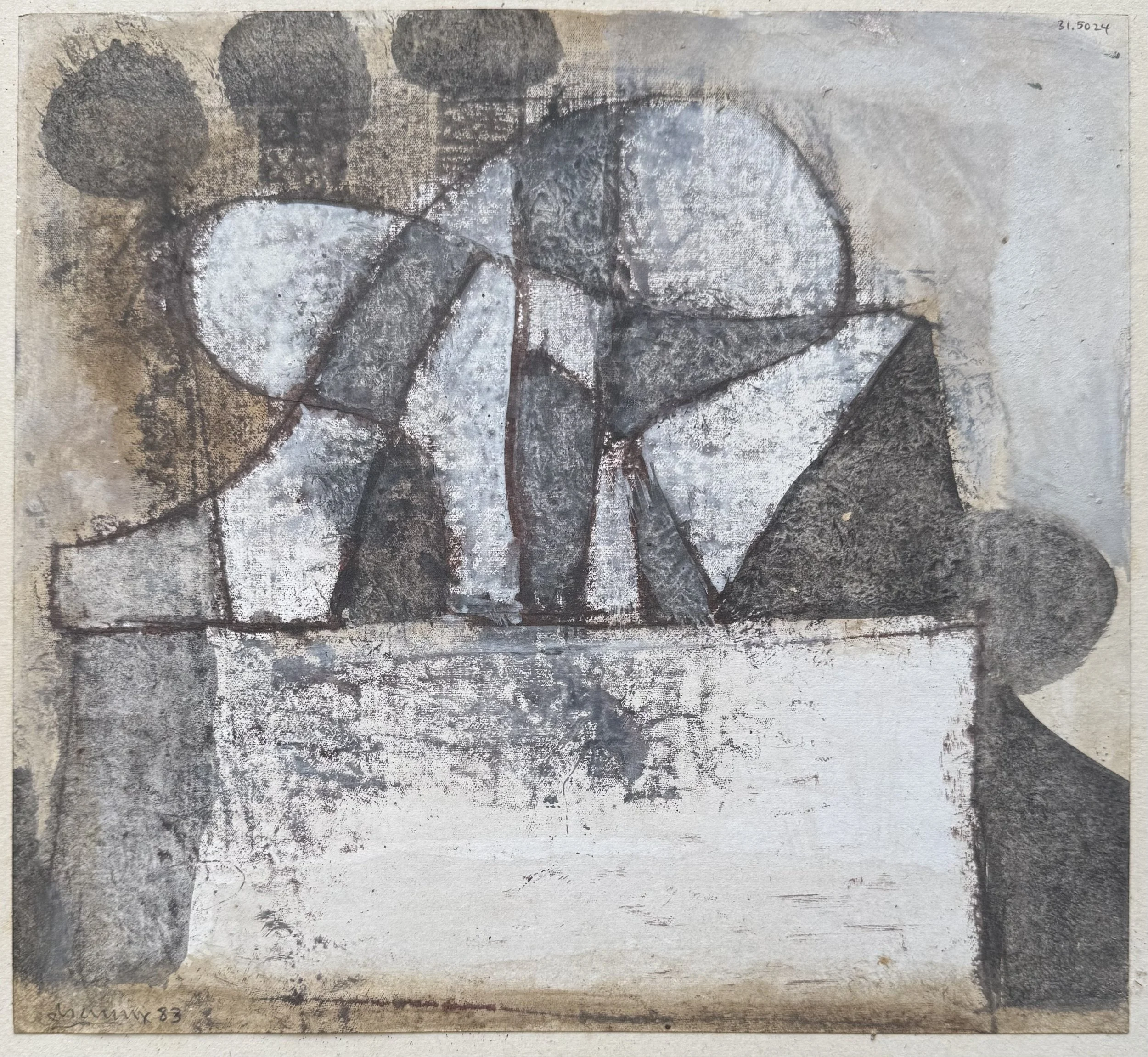
Roy Turner Durrant occupies an interesting and increasingly important position within Modern British art history. Although he never achieved the household-name status of artists such as Ben Nicholson, Patrick Heron, or Terry Frost, he is regarded by many specialists as a significant contributor to the development of post-war British abstraction.
A Bridge Between Landscape and Abstraction
Born in Suffolk in 1925, Roy Turner Durrant belonged to the generation of artists that emerged after the Second World War when British art was undergoing profound change.
Many artists of his generation were moving away from traditional representational painting and exploring abstraction, colour relationships and constructed space.
Durrant's work sits within this movement, but unlike some of the more radical abstract artists of the period, his paintings often retained a subtle connection to landscape and the natural world.
This places him somewhere between the geometric abstraction of Victor Pasmore, the landscape-based abstraction of Peter Lanyon and the colour abstraction of Patrick Heron.
The East Anglian Connection
One reason Durrant is important historically is his role within the East Anglian art scene.
While much attention in British art history focuses on London and St Ives, East Anglia developed its own vibrant artistic culture after the war. Alan Reynolds is another example of of an East Anglian artist from this period who also hailed from the rural parts of Suffolk.
Durrant became one of the region's most individual voices, producing work that reflected both modernist ideals and a strong sense of place. Today, he is often discussed alongside other artists associated with East Anglian Modernism rather than the more widely known St Ives School.
I think it is always interesting to review the factors that impact on an artist as it helps us understand their output.
Roy Turner Durrant was the son of a Cobbler in Lavenham, Suffolk a market town with wonderful timber framed buildings, but it was the landscapes around the town that first influenced the work of Durrant rather than the buildings themselves. His generic early neo-romantic landscapes possessed a magical association with ‘place’ and often indulged his facination with the contraptions reminiscent of Leonardo da Vinci.
In fact his first preoccupation was with these mechanical flying machines which supported his youthful ideas of joining the RAF. He would scribble these flying machines all day long and they can be seen in his early work produced when he attended Camberwell School of Art between 1949 - 1952.
His main tutors were Keith Vaughan, John Minton and Michael Rothenstein and it is the later who was encouraging of Durrant’s flying machines and his influence can be seen in these early works.
He continued to be profoundly influenced by the out doors and by the landscape around his native Suffolk for much of the 1950’s.
The late 1950’s - Modern British Art & Poetry
The late 50’s was a significant time in the development of Modern British Art and Durrant was very much involved in the London Art scene at that time, having works in the Royal Academy summer exhibitions and in 1957 two significant solo exhibitions. In 1959 he was selected for inclusion in the prestigious John Moores Liverpool exhibition this was no small achievement with the main prize going to Patrick Heron.
He continued to enjoy a London based life for the remainder of the decade and was increasingly immersed in poetry. He gleaned a lot from Beckett, Joyce and Dylan Thomas while a recurring theme of Inscape started to enter his world and feature in the titles of his paintings.
He said about ‘Inscape’
’I think it is indefinable . Its significance is spiritual. I do not paint places as such. Rather I try to paint the spirit of a place’.
Durrant married in 1959 and had 4 sons which meant that he had to look for a day job to pay the bills working for Vickers, the aircraft firm, before taking a roll as director of Heffers Gallery - Cambridge , from 1963 - 1976.
The development of collage and the Inscape forms.
During the 1970’s his work began to change again . His studio was in a shed at the bottom of his garden and he would disappear there for hours. He produced some very interesting collage work but the artists ‘inner eye’ was always focused on his native Suffolk.
During the late 70’s into the 80’s it was the blue -grey ground, muted colouring and atmospheric feel of his abstract paintings that have proved to be some of his most sought after work. In 2008 Fine Art Society London held a one man show of his work from this period, which proved to be commercially very successful.
Why His Reputation Is Growing
In recent years there has been a significant re-evaluation of lesser-known post-war British artists.
Collectors and museums have increasingly recognised that British abstraction was far broader than the handful of artists traditionally featured in survey books.
As a result, interest has grown in:
Regional Modernism
East Anglian artists
Post-war geometric abstraction
Artists working outside London
Roy Turner Durrant fits perfectly into this reassessment.
His work now appeals to collectors seeking artists who were genuinely involved in the development of British Modernism but remain undervalued compared with their more famous contemporaries.