Frank Beanland: The British Abstract Artist and His Extraordinary Spot Paintings
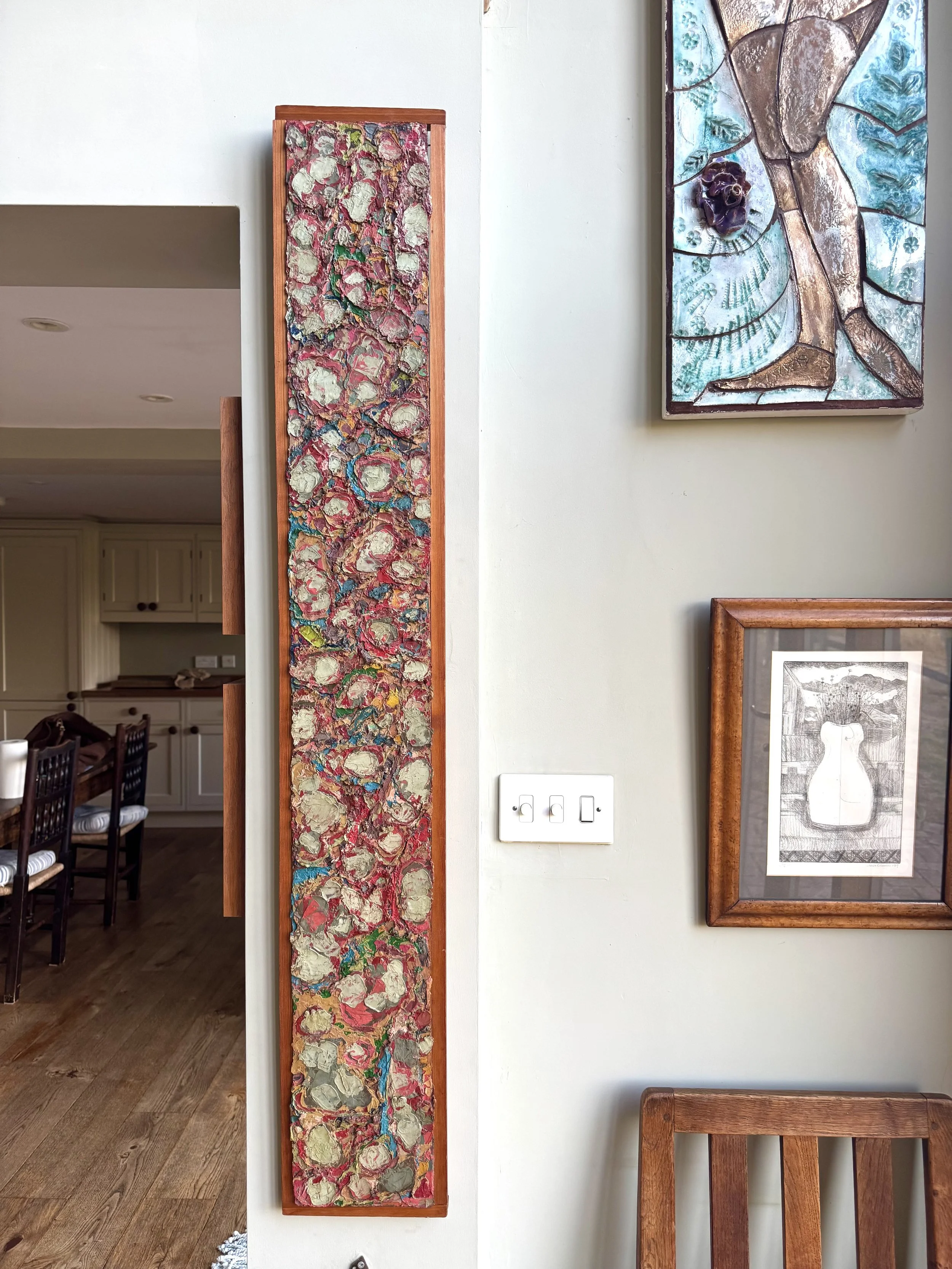
Frank Beanland (1936–2019) was a distinctive British abstract artist whose paintings are characterised by colour, rhythm, repetition and an extraordinary sensitivity to light. Best known for his spot paintings of the 1960s and 1970s, Beanland developed a highly individual visual language that placed him firmly within the story of post-war British abstraction.
Although his work is sometimes described simply as abstract painting, there is much more to Frank Beanland's art. His paintings grew from his experience of landscape, particularly during his important years in Cornwall, yet he gradually moved away from conventional representation towards a more universal language of colour, shape and mark-making.
For collectors of 20th-century British abstract art, Frank Beanland is an artist whose work deserves much wider recognition.
Who was Frank Beanland?
Frank Beanland was born in Bridlington, Yorkshire, in 1936. He studied at Hull College of Art before continuing his education at the Slade School of Fine Art in London, where he studied from 1959 to 1961. His teachers included important figures in British modern art, including Claude Rogers and Ceri Richards.
Beanland subsequently won a scholarship which took him to Stockholm, broadening his experience of European art before he returned to Britain.
His career was shaped particularly strongly by his time in Porthleven, Cornwall, during the early 1960s. There he became associated with the Porthleven Group, a group of artists working around the harbour and responding to the Cornish landscape. It was in Cornwall that Beanland's approach to painting changed dramatically. His earlier landscapes became increasingly fragmented, with marks and layers of paint gradually replacing conventional descriptions of the landscape.
Frank Beanland and the Porthleven Group
Porthleven played an important role in the development of British modernism, providing artists with an environment in which they could work directly from the landscape while experimenting with abstraction.
The Porthleven Group in the 1960s was an art collective and group of painters connected to a summer painting school and exhibition space in Cornwall. The group was centered around the artist and curator Michael Canney, who ran the quayside Porthleven Gallery in an old china-clay warehouse. Beanland arrived in Porthleven in 1962 and painted alongside other artists associated with the group.
The experience proved transformative. Rather than attempting to reproduce exactly what he saw, Beanland began breaking the landscape down into its fundamental elements: colour, light, texture and movement. This was the beginning of the artistic journey that would lead to his celebrated spot paintings and the works he produced in Porthleven during the summer of 1963 formed the body of work for his first ever solo exhibition which took place in November of that year at Drian Gallery in London.
His relationship with landscape never disappeared completely. Instead, it became more deeply embedded within the structure of the paintings. The landscape was no longer something to be depicted literally; it became an experience that could be translated into colour and form.
Frank Beanland's Spot Paintings
Perhaps the most recognisable works by Frank Beanland are his spot paintings, which began to emerge during the 1960s. Initially they were heavily painted oils on board. They had layer upon layer of different colour built up where the lower colours showed through the edges of the top layers. They were more irregular in form than his spot paintings of the 1970’s which were much more calculated and painted with less thicker oils and by this time using canvas not board.
At first glance, these paintings can appear deceptively simple. The viewer encounters repeated circular or disc-like forms arranged across the surface of the canvas. Yet the effect is remarkably sophisticated. Beanland placed areas of colour within and alongside one another, creating paintings that seem to shimmer and move. The individual marks become less important than the overall sensation created by the accumulation of colour.
The paintings have sometimes been compared with the visual energy of Abstract Expressionism, particularly because of their all-over compositions. Art critic Guy Brett observed in The Times that Beanland's crowded compositions possessed a force reminiscent of Jackson Pollock, while other commentators have noted their relationship to the experience of looking at flowers, light and landscape.
Beanland himself referred to some of the forms as resembling flower heads. The connection is significant because his paintings occupy an intriguing position between the natural world and pure abstraction. They are not paintings of flowers in the traditional sense. Instead, they capture something of the experience of seeing them: colour, repetition, density, light and energy.
Colour, nature and the experience of landscape
One of the most compelling aspects of Frank Beanland's work is the relationship between abstraction and nature. His paintings can initially seem entirely non-representational, yet they often retain a strong sense of the natural world. The repeated circular forms can suggest stones, flowers, planets or particles of light, while the colour relationships evoke the atmosphere of particular places.
This helps explain why Beanland's paintings can feel both modern and timeless. There is no need to identify a particular landscape or object. Instead, the viewer is encouraged to experience the painting through its colour and rhythm.
This quality is particularly evident in works from his spot-painting period, where seemingly simple arrangements of coloured discs create an almost infinite variety of visual effects.
Frank Beanland and the influence of Abstract Expressionism
Frank Beanland developed his mature abstract language at a time when international modernism was transforming the British art scene.
American Abstract Expressionism had a considerable influence on artists working in Britain during the post-war period. Beanland's paintings share with Abstract Expressionism an interest in the physical act of painting and in compositions that extend across the entire picture surface. However, Beanland was never simply an imitator of American abstraction. His work remained rooted in his own experience of the British landscape. The carefully controlled placement of colour, repeated forms and interest in natural rhythms gave his paintings a distinctive identity.
His work therefore sits comfortably within the broader history of British post-war abstraction, while remaining recognisably his own.
Exhibitions and recognition
Beanland began exhibiting professionally in the early 1960s, including appearances in the Young Contemporaries exhibitions and shows at the Drian Gallery in London. His first solo exhibitions at the Drian Gallery took place in 1963 and 1965. His spot paintings were subsequently shown at the Grabowski Gallery in London in 1967, where they attracted attention.
Beanland developed an important relationship with the respected London dealer Arthur Tooth & Sons, exhibiting there in 1969, 1971 and 1974. He also exhibited in France and elsewhere internationally,including exhibitions in Venice , New York and Paris.
His exhibiting career demonstrates that he was not a peripheral figure within British abstraction. During the 1960s and 1970s, his work was being shown by established galleries alongside the work of other significant modern British artists.
From Cornwall to Suffolk
After his important period in Cornwall, Beanland moved to East Anglia, where he continued to live and work for many years. The change of location did not mean the end of his engagement with abstraction. Instead, his workcontinued to evolve. Later paintings became increasingly varied, with Beanland experimenting with different materials, surfaces and approaches. His work included paintings on paper and, in his later years, acrylic paintings made on newspaper.
This willingness to experiment is an important part of understanding Beanland as an artist. He was not simply recreating the style that had brought him recognition in the 1960s. He continued to question the possibilities of abstraction throughout his career.
Why are Frank Beanland's paintings so interesting to collectors?
For collectors, Frank Beanland offers an appealing combination of colour, modernism, individuality and art-historical importance. To be fair to this artist he was the first to paint in this very bold distinctive way and the works are instantly recognisable as being by him. Damien Hirst has, in a similar way, taken the learning from Beanland’s painting and developed it into a hugely commercial business where abstraction, colour and repetition of the natural world - butterflies, flowers and spots- are used to great effect.
His best paintings have an immediate visual impact. They can brighten a room, but they also reward prolonged looking. The longer you spend with a Beanland painting, the more the individual marks, colour relationships and subtle variations begin to reveal themselves.
There is also a fascinating historical dimension.
Beanland belongs to a generation of British artists who responded to the dramatic changes taking place in art after the Second World War. His career connects the British landscape tradition with international abstraction, while his spot paintings provide an unmistakable personal contribution.
Today, his work can appeal both to established collectors of British modern art and to people discovering his paintings for the first time. His work is hugely undervalued in the current market and it is only in the last 12 months or so that we have seen a serious re adjustment in pricing and interest which now seems set on an upward trajectory.
Do you have a painting you are looking to sell?
At Blondes Fine Art, we are particularly interested in Beanland's spot paintings and are keen to hear from owners who may be considering selling an original Frank Beanland painting or other artist from the Modern British era.
If you own a Frank Beanland painting and would like to discuss its provenance, value or possible sale, Blondes Fine Art would be pleased to hear from you.
Buying a Frank Beanland painting at Blondes Fine Art
Blondes Fine Art has a particular interest in Frank Beanland's original paintings, including his celebrated spot paintings.
We currently feature examples of his work and are interested in acquiring further paintings for our clients and collection. You can link to our Frank Beanland Webpage to the available work we have HERE
About Blondes Fine Art
Blondes Fine Art is a UK art dealer specialising in 20th-century British and modern British art. We buy and sell original paintings by established British artists and are always interested to hear fromcollectors, private owners and families who may have artwork they are considering selling.
If you have a Frank Beanland painting to sell, we would be delighted to hear from you.