Aubrey Williams: The Important Guyanese-British Artist and Pioneer of Post-War Abstraction
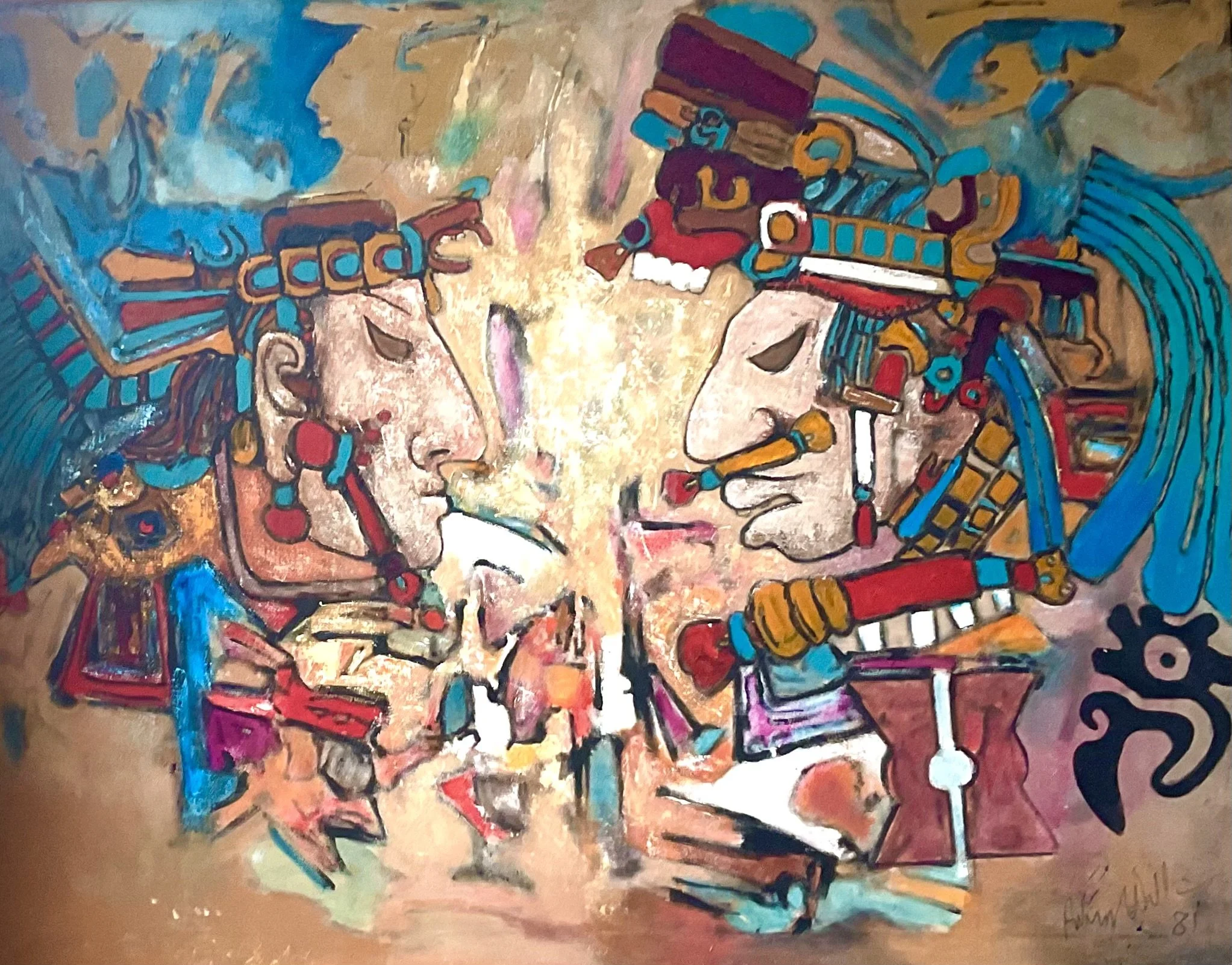
Aubrey Williams (1926–1990) was one of the most important and distinctive artists to emerge from the post-war British art scene. Born in Georgetown, Guyana, Williams developed a remarkable form of abstract painting that brought together Caribbean experience, Indigenous cultures, ecology, music, science and international modernism. Today, Aubrey Williams is increasingly recognised as a major figure in British post-war abstractionand Caribbean-British art. His large, powerful paintings have entered important public collections, including Tate, and his reputation has grown significantly in recent years.
At Blondes Fine Art, we have a particular interest in Aubrey Williams paintings and are actively looking to buy original works by the artist. You can link to our Frank Beanland Webpage to the available work we have HERE
Who was Aubrey Williams?
Aubrey Williams was born in Georgetown, British Guiana, in 1926. He showed an extraordinary interest in drawing and painting from a very young age and attended the Working People's Art Class in Georgetown. He later trained as an agronomist and worked as an Agricultural Field Officer in Guyana. This period of his life proved enormously important to his development as an artist. Williams worked in the remote north-western region of Guyana, where he encountered the Indigenous Wara(u)/Warrau people. His experiences of the rainforest and Indigenous culture had a profound effect on his imagination and would remain a significant influence on his paintings throughout his career.
In 1952, Williams left Guyana and travelled to Britain. He briefly studied at St Martin's School of Art in London, while simultaneously immersing himself in the European and American modern art that was transforming the post-war art world.
Aubrey Williams and British abstract art
Williams arrived in Britain at an exciting moment for modern art.
The influence of Abstract Expressionism was becoming increasingly important in Britain, and exhibitions of American artists such as Jackson Pollock, Mark Rothko and Arshile Gorky had a significant impact on Williams. Yet Williams cannot simply be described as a British Abstract Expressionist. His paintings were built from a much broader range of influences.The natural environment of Guyana, Indigenous visual culture, pre-Columbian civilisations, Caribbean experience, music, astronomy and ecological concerns all became part of his artistic vocabulary.
This combination makes Williams particularly important in the history of post-war British painting. He took the language of international abstraction and transformed it through his own experiences of Guyana, the Caribbean and the wider Atlantic world.
Aubrey Williams and the Caribbean Artists Movement
Aubrey Williams was a founding figure in the Caribbean Artists Movement (CAM), established in London in 1966. The movement brought together Caribbean artists, writers and intellectuals and became an important centre for cultural and political discussion during a period of decolonisation and social change. Williams played an influential role alongside figures including Kamau Brathwaite, John La Rose and Andrew Salkey. The Caribbean Artists Movement was significant because it helped create a space in which Caribbean artists could discuss their work on their own terms. For Williams, this was particularly important. His paintings did not fit comfortably into conventional categories of British, Caribbean or American art. Instead, they occupied a more complicated territory in which different histories, cultures and ideas could exist together. This is one reason why Aubrey Williams remains such a fascinating artist today.
What makes Aubrey Williams paintings distinctive?
Williams's paintings are often large in scale and visually powerful. At first glance, they may appear to belong to the tradition of Abstract Expressionism, with energetic brushwork, intense colour and compositions that spread across the canvas. But there is usually much more happening beneath the surface. Williams often incorporated shapes and motifs inspired by pre-Columbian and Indigenous cultures, while also responding to natural phenomena, ecological destruction, music and cosmology. His abstraction is therefore not purely formal. It is often a way of thinking about the world. Rather than painting a recognisable landscape or object, Williams could translate his response to a place, sound, culture or ecological event into colour, gesture and form.
The result is an extraordinarily personal form of abstraction.
Guyana and the influence of the rainforest
The landscape and cultures of Guyana remained fundamental to Williams's art. His work as an agricultural officer brought him into close contact with the country's interior and the Indigenous Wara(u) communities. These experiences gave him a deep awareness of the relationship between human beings and the natural environment. This connection can be seen throughout his paintings. Williams was interested in earth, fire, vegetation, birds, water, climate and cosmic forces. His paintings can therefore feel elemental. They are not straightforward pictures of nature. Instead, they attempt to convey the energy and complexity of natural systems. This aspect of his work feels particularly relevant to contemporary audiences, given the growing interest in climate change, ecology and the environmental concerns that were already present in his work decades ago.
Aubrey Williams and pre-Columbian art
One of the defining characteristics of Williams's work is his fascination with the ancient cultures of the Americas. His experiences in Guyana first introduced him to Indigenous cultures, while his later research and travels deepened his interest in pre-Columbian art and civilisation. This eventually became central to major bodies of work such as the Olmec-Maya and Now series.
Williams did not simply reproduce ancient symbols. Instead, he absorbed ideas, forms and visual rhythms and translated them into his own abstract language. The result is a meeting between ancient and modern: Indigenous history and contemporary abstraction, Guyana and London, the Caribbean and Europe.
The Shostakovich paintings
Music was another major source of inspiration for Aubrey Williams. One of his most important bodies of work is the Shostakovich series, inspired by the music of Russian composer Dmitri Shostakovich. Williams responded to the structure, rhythm and emotional intensity of Shostakovich's compositions through paint. The paintings do not attempt to illustrate individual pieces of music. Instead, colour and gesture become a visual equivalent of sound. This idea of translating music into painting is part of a much longer history of abstraction, but Williams's Shostakovich paintings are particularly powerful because of their scale and emotional intensity. The series is now regarded as one of the major achievements of his career.
The Olmec-Maya and Now series
Another major achievement was Williams's Olmec-Maya and Now series, produced during the early 1980s. These paintings demonstrate his fascination with the ancient civilisations of Mesoamerica and his belief that the past could have a direct relationship with the present. Rather than treating history as something static, Williams brought ancient visual ideas into dialogue with modern abstraction. This approach is particularly important to understanding his work. His paintings are not simply abstract compositions. They are places where different histories and cultures meet.
The Cosmos paintings
During the later part of his career, Williams increasingly explored ideas connected with cosmology, astronomy and the universe. The resulting Cosmos series represents another significant development in his work. Here, Williams's interest in natural forces moved beyond the earthly environment towards the immense scale of space and time. The paintings can appear almost planetary, with swirling forms, intense colours and complex layers of paint. They demonstrate the extraordinary breadth of Williams's imagination.
Aubrey Williams and Jamaica and Florida
Although Williams lived in London for much of his life, his artistic development was not confined to Britain. From the 1970s onwards he worked for extended periods in Jamaica and Florida, while maintaining his connections with London. The different light and environments of these places had a significant effect on his painting. This transatlantic aspect of his life is essential to understanding his work. Williams's paintings resist being assigned to a single national tradition. He was a Guyanese artist who became an important figure in British art, while maintaining strong connections with the Caribbean and drawing upon Indigenous and pre-Columbian histories. His work is therefore often discussed in relation to diaspora, migration and cross-culturalmodernism.
Aubrey Williams and The Other Story
In 1989, Williams was included in The Other Story: Afro-Asian Artists in Post-War Britain, an important exhibition at the Hayward Gallery in London. The exhibition helped bring greater attention to artists who had been marginalised from conventional accounts of British post-war art. Williams's inclusion was an important recognition of his place within the history of British modernism. His reputation continued to grow after his death in 1990. A major retrospective was held at the Whitechapel Art Gallery in 1998, while his work has subsequently been shown by major institutions in Britain and internationally.
Aubrey Williams at Tate Britain
The renewed recognition of Aubrey Williams has been particularly significant in recent years. In 2023–24, Tate Britain presented a dedicated room of his work, including paintings from his cosmological period. This was an important moment in the reassessment of Williams's contribution to British art. Tate's collection also includes works by Williams, demonstrating his growing position within the established history of British modern and contemporary art. The renewed institutional attention is helping introduce Williams to a new generation of collectors and art lovers.
Why is Aubrey Williams important?
Aubrey Williams occupies a unique position in 20th-century art.
He connected several artistic traditions that had previously been considered separately:
British post-war abstraction
Abstract Expressionism
Caribbean art
Guyanese art
Indigenous and pre-Columbian visual culture
Ecological and environmental thinking
Music and abstraction
Cosmology and science
Rather than choosing one tradition, Williams brought them together. This makes his paintings particularly rich and rewarding for collectors and museums.As the art historian Kobena Mercer has argued, Williams's work needs to be understood in relation to diaspora and cross-cultural modernism rather than being confined to a conventional narrative of British abstraction.
Aubrey Williams paintings for sale
Interest in Aubrey Williams paintings has increased considerably as museums, galleries and collectors have reassessed his importance. His original paintings can vary considerably in appearance depending on the period in which they wereproduced. Early works, Shostakovich paintings, Olmec-Maya works, bird paintings and later Cosmos works each offer a different insight into his artistic development.
For collectors, this makes acquiring an original Aubrey Williams particularly rewarding. A painting is not simply an example of post-war abstraction; it can represent a particular stage in Williams's lifelong exploration of culture, nature, history and the human imagination.
Blondes Fine Art wants to buy Aubrey Williams paintings
At Blondes Fine Art, we have a particular interest in Aubrey Williams and are actively looking to buy original Aubrey Williams paintings. We are interested in hearing from private collectors, families, estates and owners who may have an Aubrey Williams painting that they are considering selling.
We can discuss the artwork, provenance and condition and provide an informal assessment of its potential value and suitability for sale.
If you own an Aubrey Williams original painting and are thinking about selling, please contact Blondes Fine Art.
Collecting Aubrey Williams
For collectors of Modern British art, post-war abstraction and Caribbean-British art, Aubrey Williams represents a particularly compelling opportunity.
His reputation has changed considerably since his death. Once difficult to place within the conventional categories of British art history, Williams is now increasingly recognised as an artist who anticipated many of the concerns that have become central to contemporary discussions of art: migration, colonialism, cultural identity, environmental change and the relationship between different histories.
The publication in 2024 of Aubrey Williams: Art, Histories, Futures — described by the Paul Mellon Centre as the first comprehensive exploration of his art — is another indication of the depth of current scholarship surrounding his work.
Aubrey Williams: a major figure in British modern art
Today, Aubrey Williams is increasingly recognised as a key figure in post-war British painting, and his work is held in important collections around the world.
For collectors, his paintings offer not only extraordinary visual power but also a fascinating connection to one of the most important and increasingly appreciated chapters in British art history.
Aubrey Williams at Blondes Fine Art
Blondes Fine Art specialises in Modern British and 20th-century British art, with a particular interest in important original paintings by established artists.
We are actively looking to buy Aubrey Williams paintings.
If you have an Aubrey Williams painting, drawing or work on paper that you are considering selling, please contact us for a confidential discussion.
We are always interested to hear from owners, collectors, estates and families with originalAubrey Williams artwork.