John Elwyn paintings for sale

We are delighted to have recently acquired some lovely work by John Elwyn. This self exiled Welsh artist is one of our firm favourites and his work has a great collectors following. John Elwyn was greatly admired by his contemporary native artists such as Sir Kyffin Williams RA who said , 'the work of John Elwyn will always stand out and be admired'. he was , of course, correct and he has , in recent years, come out from the shadows and is now rightly regarded as one of the greats.

Titled ' Welsh Farm'

Titled ' Welsh Farm'

John Elwyn trained at the RCA in London and was encouraged to stay in London by his friend and artist Ceri Richards , who put him in touch with various London galleries. By the end of the 1940's he was exhibiting regularly with the Royal Academy and in 1948 he moved to Hampshire where he lived until his death in 1997. His move out of London, was to take up a post at Portsmouth College of Art followed by one at Winchester College of Art . He lived at 5, Compton Road, Winchester ,  a lovely period town Villa and a photograph is shown below.

John Elwyn's home in Wichester

John Elwyn's home in Wichester

By the start of the 1950's his paintings were widely acclaimed , particularly in Wales where his figurative 'Chapel' and 'Miners returning home' paintings were much loved . By the end of the 1950's his figurative work had increasingly given way to pure landscapes which were more often than not depictions of Welsh rural scenes taken from his memories of Cardiganshire. The work we have available here at Blondes Fine Art is an example of such a landscape showing his characteristic geometric and patterned landscapes. All of which are executed in the vibrant colours that he loved to use. Vivid green, yellow and orange sunlit fields, imposing skies, white - washed barns , hedgerows, stone walls and a lane winding away into the distance. These were the recurrent themes in John Elwyn's later work and he painted many variations on the same theme with titles such as Welsh farm, Dyfed Landscape and Upland farm occurring numerous times.

John Elwyn left Winchester Art College in 1976 to become a full time artist and he worked from memory and sketch books. Often, he was not sure what they would look like at the beginning and inspiration might emerge during the painting, from perhaps poetry or the weather conditions. Like so many artist he had a love of gardening and painted plants at different times of the day and in all seasons so it, perhaps , could not be more fitting that it was in his beloved garden when he fell and sustained an injury that caused his passing on 13th November 1997.

During his life time he had multiple exhibitions and his work is held by private and public collections throughout the country. We are always interested in hearing from anyone who is considering selling work by John Elwyn.

Tom Merrifield - Sculptor, Artist and Dancer.

I first became aware of Tom Merrifield in 1990 when I recovered a stolen edition of his sculpture , Marion Tait " Fantasy" which had been stolen by means of Burglary from a North London house. I visited Tom in his Hampstead home where he was able to identify the sculpture and provide the details of the victim of the crime, thus allowing me to reunite it with the lawful owners. He was the most helpful and engaging of men who made time to tell me about his work and career.

I remember his house was full of his work with paintings and sculptures of dancers filling the rooms. He was keen to tell me about each work and I was fascinated by his story. Tom had been a dancer initially in his native Australia and later in shows, films and ballet in London. This made a great deal of sense to me because the bronzes had  a wonderful sense of movement that could only have been understood by someone who had intimate understanding of dance. The other thing I learnt was that Tom had never had any formal training in drawing , panting or sculpture which I found hard to believe looking at his work. He exuded a passion for dance , sculpture, drawing and indeed for his cats which were also a regular feature of his drawings. He also explained how he had been commissioned to produce the Society of West end theatre award which was a lovely bronze of a naked dancer.

 It was a privelede to meet him and when some many years later I had the opportunity to purchase an early bronze from a small edition in the late 1980's I jumped at it. The work we have on offer is " Lisa " 23 cm in height and an edition of 8. The work is actually depicted in the catalouge that Tom gave me when I met him all those years ago. The ballerina herself is none other than Lisa  Macuja-Elizalde who was  Prima Ballerina. In 1984, she became the first Filipina prima ballerina, and first foreign soloist to ever join the Kirov Ballet.

This is just one of a long list of the most famous ballerinas and dancers that have been sculpted by Tom Merrifield because they know that he knows how to ensure the work is accurate. In his early career he danced with the Borovansky Ballet in Australia and when the Biography of Borovanskywas written, some years ago now, Tom merrifield was described thus" His ws the most rarest of all qualities, the dancer's persona, the innate quality that attracts an audiences attention from the moment of entrance" 


Alberto Morrocco and his Mural Paintings

Alberto Morrocco was born into an Italian family who had very much adopted Scotland as their home. His mother was 3 years old when she arrived in Aberdeen and was raised speaking Scottish and, as Alberto recalled,  rarely speaking Italian to his father, who had arrived in Aberdeen in 1912.

One of my very favourite stories to tell any prospective Morrocco buyer is the fact that Alberto Morrocco was not his correct name . His father opened a shop in Aberdeen, an Ice-Creamery, but when he came to Scotland did not speak the language particularly well. So, Mr D MARROCCO, asked a sign writer to make a sign for the shop. Instead of spelling it with an  "A " the sign writer spelt the name incorrectly with an "O" and the rest his history. His father accepted the sign and from then on the family name has been spelt with an "O". Alberto Morrocco had a birth certificate spelt Marrocco but as for the generations thereafter I have no idea. Leon and Jack both spell their names with the "o" but I know not if they ever formally changed the surname. Perhaps you do - I would be interested to know!

It was the mid 1960's when Morrocco's stylistic approach to still-life and his Italian subject matter began to crystallise into his recognisable style. He had become well known and elected a member of the Royal Scottish Academy in 1962 and it was this that became the catalyst for him being commissioned to paint a number of murals by Sir Anthony Wheeler. Morrocco trained at the Grays School of Art in Aberdeen under James Cowie and Robert Sivell and it is perhaps the later who influenced his murals. While still a student Morrocco had assisted Robert Sivell on a large mural which is still to be found in the Students Union in Aberdeen. He went on to produce two huge murals in his own right during the mid 1960's. The first was Christ carrying the Cross for St Columba's Church in Glenrothes followed by two large murals for Liff Hospital in Dundee. In these works he was able to consolidate is work with Sivell in Aberdeen and produce his own style in a medium he had always been interested in through his link to Italian Renaissance art.

We are delighted to have two designs for murals for sale from the personal collection of Sir Anthony Wheeler , who was the commissioning Architect. One is by David McClure, a close friend of Morrocco, and was produced for the staff room at St Andrews University and the other is the original design by Alberto Morrocco, for the mural at St Columba's Church (Click Link to see the work) Both are in fantastic original condition and kept by Sir Anthony ,only becoming available when he passed away a few years ago. 

In 1983 Sir Anthony Wheeler became President of the Royal Scottish Academy and, as tradition has it, his portrait was painted at the end of his term of office - in the early 1990's. So who else did he choose for this but none other than, his friend, Alberto Morrocco. He had already painted a portrait of Lord Cameron for the University of Edinburgh in 1972 but the painting of Wheeler is painted more within the style of his still-life work of that 1990 period. His handling of the paint is very similar although the colour not as high in concession to the fact that it was a commission and needed to be recognisable. It was painted from life inside the RSA building under artificial light and what is resulted is a a warm friendly painting which seems to sit between a painting of a family member and a more formal work like that of Lord Cameron. 

Alberto Morrocco painting of Anthony Wheeler

Vincent Haddelsey - Yorkshire artist - painting for sale

Vincent Haddelsey comes from a family of painters, at least both of his grandmothers were gifted painters , and when he was eight his maternal grandmother gave him his own paint box, brushes and palette. He was born into a privileged upbringing attending Ampleforth School and hunting and beagling in the holidays. His father and his father and grandfather were all lawyers and Vincent was expected to follow suit. In fact, his parents did not encourage him to paint but actively discouraged him, since painting was not an activity they thought likely to provide a secure future. So Vincent learnt to draw by himself without any formal lessons recording the countryside in the area surrounding his home.

One skill he did learn from his upbringing was his horsemanship, which was to further develop over his lifetime and become the main feature of his art. At the age of 18 years he emigrated to Canada and became fascinated by the native Indians and their collective folk art. He developed this interest with trips to Mexico and the Indians living there before moving to Paris where he made his name as an artist and in 1969  won the International Grand Prix for naif painters.

Vincent Haddelsey has a nieve style and a simplicity of approach which are bound together with a warmth of colour that creates a complexity for the viewer. The background details are just as important to him as the main subject and this is the case in the work that we currently have for sale here at Blondes fine Art. " The Polo Match at Belvoir Castle " has Rooks alighting from the trees and a pair of hawks in the sky, it also has a group of onlookers to the right and a goal official by the posts, not to forget the distant Castle nestled in the trees. Another feature of his work is the attention to the detail of the patterns of leaves and grass which also evident in this painting but, the main subject of his painting is, of course , the horse and the horsemen. Whatever the scene these are usually central to the work and this is the case in this picture shown below.

Vincent Haddelsey Oil Painting " Polo Match"

Vincent Haddelsey Oil Painting " Polo Match"

Haddelsey played a lot of polo when he was in Canada , though never in England where he set this scene. He always played with number 2 on his back and that is a feature of all of his polo paintings and here number 2 is placed left of the painting.There is wonderful form and life like realism in the equine movement that shows his intimate knowledge of the horse. This expertise in painting all forms of horsemanship comes from having that experience himself. He not only rode in polo matches but show jumping, broncos, quarter horses, steeplechasing, and fox hunting, so he was a highly competent horseman.

The painting on offer is in excellent condition signed with initials  and again verso, it came from the studio sale of his work so has fantastic provenance and is great value. Please contact us for more information to arrange a viewing or to make an offer.

Sheila Robinson - Artist, Printer & Teacher

Sheila Robinson was a marvellous artist and member of the Great Bardfield group. Her lino cut print of 'The cat' from 1961 is full of colour and design that makes it unmistakably "Bardfield". Indeed the background to the work is in fact printed from one of her own wall paper print blocks.

One of the interesting things about Sheila Robinson is her acquired  love of gardening. This is something that she had in common with both Edward Bawden and John Aldridge who in turn were great friends with other artists sharing the same passion, such as Cedric Morris and John Nash,  who both lived nearby. I am a fan of all of these artists and there must be something in the eye of an artist and gardener that shares an ability to work with colour to produce beauty and balance to the viewer. She also had a love of cats which again Bawden and Aldridge shared  with each producing many images with the creatures centre stage.

However , it was Bawden that she was closest and this stems from a similar nature both quiet,reserved, hard working and with a  high sense of moral code. Neither thought themselves better than the other and despite their generational difference in age maintained a close relationship for over 40 years, not just professionally but as friends, Bawden would look after Sheila when she was unwell and ensure that she had food to eat delivering it to her door. She had originally been an outstanding student , progresssed to being his assistant and then onto a professional  equal. Certainly her work is of equal to Bawden and I think her lino cuts possibly better. She used Japanese paper and her printing was done without a press as her cottage was too small. She would stand on the blocks and walk up and down to produce an image on the paper. The technique was so time consuming that the editions were small and done in batches. She was also highly skilled in other printing methods including the use of cardboard cut out to produce the picture and used this in conjunction with lino print to build up an image.

Sheila Robinson was also a fine illustrator and was commissioned to produce work for the BBC and in then 1975 an edition of the book 'sons and lovers' . Like Bawden and Aldridge she was able to share her skills and ability with the next generation of art students when in the early 1960s she taught at Walthamstow  College of Art where she also experimented with more abstract printing and a few years later she took a post at the RCA teaching in the illustration department until her death.

So she was a talented artist , role model to her children , and loyal friend to Bawden. Sheila Robinson does not get enough recognition for her amazing work and we here at Blondes Fine Art rate her very highly indeed. If you happen to have one of her prints or indeed anything that she produced we would love to hear from you and to acquire a larger representative collection of her work , so drop us an email .

Work by Sheila Robinson is always WANTED by Blondes Fine Art !

Mark Hearld & Emily Sutton - Art & Design a way of life.

I have only met and chatted to Mark Hearld on four occasions and Emily Sutton twice, but it is clear from their home , their work and their love of all things design that Art for them is simply a way of life . It does not stop with a sketch , a water colour or oil on board put permeates every conceivable medium and oozes out of every corner of their home in York. Mark is a self confessed collector and fan of such greats as John Piper, Edward Bawden, Julian Trevelyan along with Vanessa Bell and Duncan Grant , another two great artists who had an eye for colour and design.

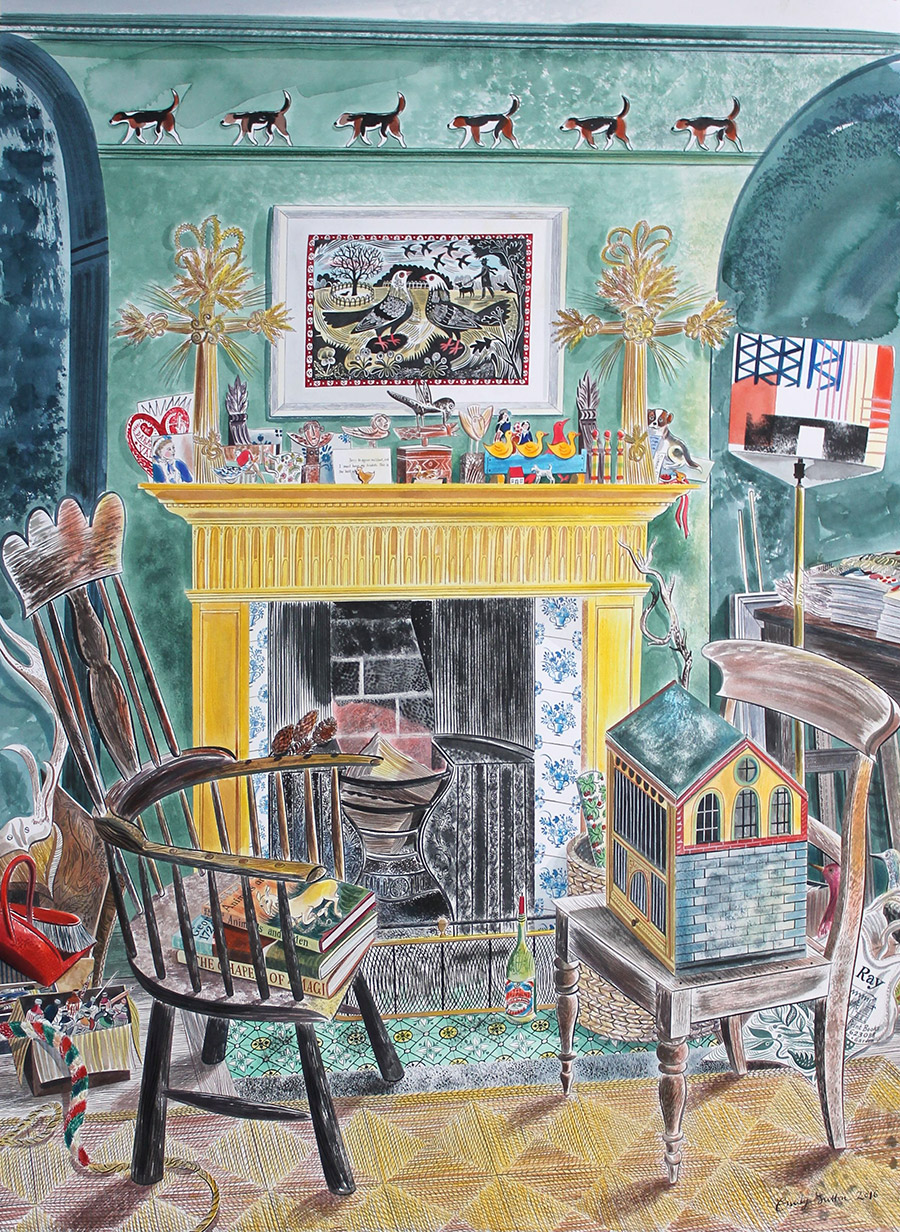
We visited the house in York last weekend when Mark and Emily held an open studio and I was fascinated by, not only the quite wonderful art for sale but also, the eclectic collections of toys , corn dollies, Staffordshire china dogs, and folk art in its widest sense. In fact , I was so taken with it that I felt an overwhelming urge to buy a large water colour by Emily of the Yellow fireplace in the front room of their house. It has every detail in fabulous colour tones and shows Emily's work at its best. It is yet to be delivered by Mark but I just cannot wait to hang it in our home to add to our own very eclectic art collection. Mark will also be delivering our other purchases a ceramic horse and a fantastic collage of a pigeon called "Bo" and two Silkie chickens. It is not just ourselves who are fans of Hearld and Sutton, we arrived at the open studio only 15 minutes after it opened finding the house full of people and Mark  rushing around sticking red dots on work as quickly as physically possible. I could not help but reflect on the Great Bardfield open houses in the 1950's which were such a great success and helped put the art and design of those talented artists such as Bawden, Aldridge, Rothenstein ,Cheese, and Robinson firmly in the minds of the post war generation.

I am loath to link the work of either Mark or Emily to any one or two greats from the past but there is clearly a Ravilious influence in the shop fronts produced by Emily which are reminiscent of the High Street illustrations for the 1938 book by that title, and more than a touch of Piper and Bawden in the Collage and Lino cuts produced by  Mark. But it is impossible to categorise their work, and why would you want to, they are unique in their variety and thirst for new ways of expressing themselves in art and design.We feel privileged to have added their work to our own personal collection and find it both uplifting and colourful which is all one can ask for in a work of art and design. 

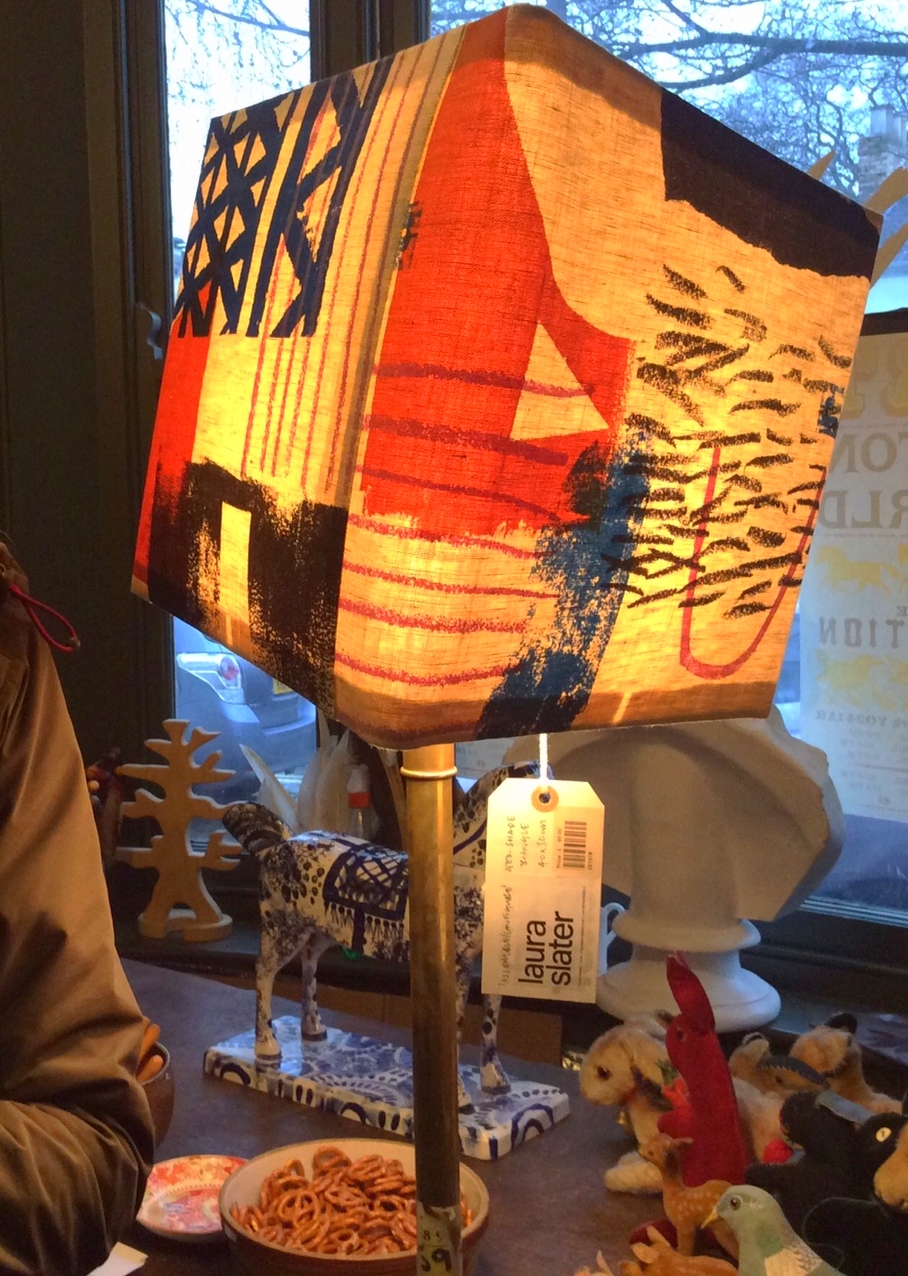
Mark Hearld & Emily Sutton Open Studio

Mark Hearld & Emily Sutton Open Studio

A few months ago we attended an evening talk by Mark in Saffron Walden , and he gave a fantastic insight to his work and his inspirations . It was there that ,for the first time, I became aware of his ceramic figurative work. I was aware of his collaboration with the master potter Terry Shone producing some," to die for",platters and tiles but not of his ceramic horses which he had used when he curated his display in The Lumber Room at York Art Gallery. He explained how he had been on a weekend to Berlin, Germany and had found an old wooden horse in a flea market. He purchased it and on his return to York decided to use it to cast ceramic horses with the assistance of a low volume ceramics manufacturer in Stoke on Trent. Since the day of his talk we have coveted one, so it was great to find that Mark had produced another batch of 9 for his open studio and it took only a few minutes for the decision to be made and a red dot to be applied to the chosen one. They are, colourful, simple, and a new 21st century spin on an old traditional form of decorative art. His work is alive as is that of Emily's and the combination of influence from the greats of the past with the design needs of today, produces this fusion of  folk art,craft and tradition which still resonates with the modern world as some of us try to hang on to the "make do and mend" philosophy of the past.

To say we are fans of Emily and Mark would be an understatement , but do not just listen to my views go and seek out their work , it ranges from a few hundred pounds for a limited edition print, so is accessible to all . Their work makes me smile and feel better about the day ahead and that is a wonderful skill to possess and I can not wait to see what new work they produce in the coming months .  

Rose Hilton - Art, Painting, Exhibitions and the 1980's

Rose Hilton has been painting and exhibiting since  1988 . Her late husband, Roger Hilton, died in 1975 and it took her some 13 years to come to terms with the changes . She had a wonderful group of friends, who all helped to support her through this difficult time, such as Dudley Sutton , the actor , who in 1979 sent tickets for her and the boys to fly to the West Indies for 6 weeks while he was making a film with Michael Caine. Patrick Heron helped by providing a reference for a studio and in the early 80's she started painting with more purpose. This was coupled with her holiday to see Matisse's work in the Hermitage in 1983 and visits to see the Raoul Dufy show at the Hayward in 1984. It seems as if Rose was trying to find herself again and once she decided to keep her married name Rose Hilton, the new artist starts to emerge.

Times were still tough and she had little money, borrowing from the bank to get by, she took teaching jobs at Bristol and Falmouth. She stretched all her own canvases to save funds but then  started to show at the Newlyn and Penwith annual shows. That was the very start of her journey , her personal struggle and emergence as one of the finest and well collected Artist of the late 20th centuary. In 1987 she had her first one man show at the Newlyn Gallery.

These early works were generally decorative in nature and often set in the house at Botallack. The pastel blues and dreamy textures are to be seen in one of the two works currently offered by us at Blondes Fine Art. Titled "Afternoon Dreams" this bears a Michael Parkin Gallery label verso from 1988, and was purchased by the Artist John Pawle , for his own private collection. Talking to Diana Parkin recently she recalls the sale and at that time John Pawle was represented by their gallery . Rose  Hilton also had a show in Oxford that year and the following year she agreed to let Messums represent her work and has had countless successful shows there ever since, the most recent being in 2014. I can remember going to this show and seeing her large work "Red Studio" for the first time ,it was an interior design statement piece that was later exhibited at the RA and sold for £20,000. (See our previous blog dated September 18th 2015 for more details and link to the RA Summer exhibition). The show also had some paintings that had more than a nod to the work from the 1980's and one in particular took my eye as it reminded me of Afternoon Dreams it was a large canvas 120 x 190 called "Summer repast" in delicate blues , orange and white it had a calming magical feeling. Unfortunately, I could not manage the £28,500 asking price!

We are great fans of Rose Hilton's work and currently hold two works by her. They are great value , so if you are also a fan and would like to view them please contact us to arrange a viewing either by appointment in our private Hertfordshire Gallery or in your own home .

Richard Bawden - His life and work

It is no secret that, here in our corner of rural Hertfordshire , Blondes Fine Art are great supporters of The Fry Public Gallery. With only a 20 minute drive to one of the most active and friendly galleries in the country, we hardly need an excuse to go for a visit or view whatever exhibition is current. So I was delighted when, a few weeks ago, we received an invitation to a preview and book launch for "Richard Bawden at 80". 

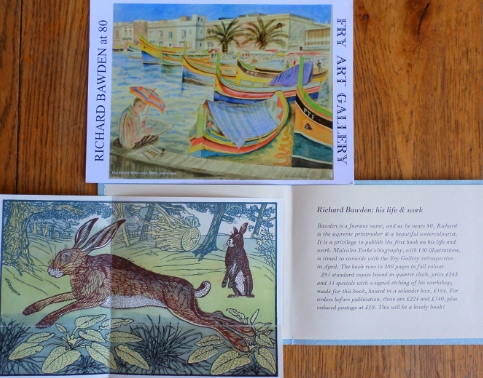
A very nicely prepared flyer promoted the title of the book, "Richard Bawden his life and work" proclaiming it to be a major new book by Malcolm Yorke, to be published in March 2016 by Fleece press.Attached was a reproduction of a rather splendid linocut of a Hare and the details of the book and price.(see below)

"Bawden is a famous name, and as he nears 80, Richard is the supreme printmaker and  beautiful watercolourist. It is a privilege to publish the first book on his life and work. Malcolm Yorke's biography, with illustrations, is timed to coincide with the Fry Gallery retrospective in April. The book runs to 200 pages in full colour." The standard copy is £242 and  55 specials with a signed etching , housed in a solander box for £364.

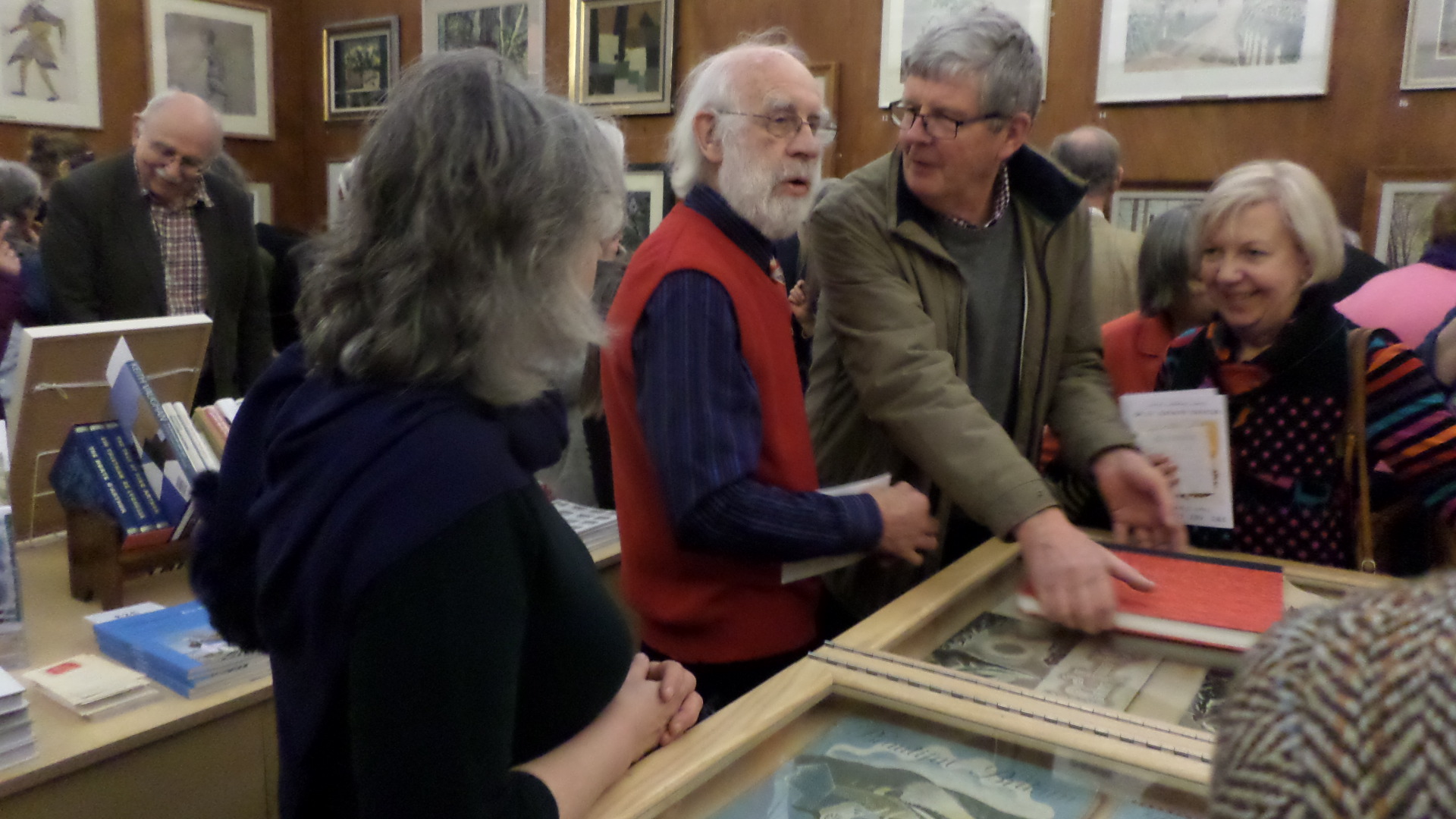
The launch of the book coincided with the opening preview of Richard Bawden's work which will run until 18th June 2016 and is Free Admission. I was unable to resist so set off to Saffron Walden for the 11am opening. Anyone who has been to The Fry will know that it is a small building and a squeeze at the best of times and this event was no different. It seemed that everyone had come to see Richard Bawden to wish him a happy birthday. The event was super busy and once inside I could see that both Richard Bawden and Malcolm Yorke were already hard at work signing the new book for those lucky purchasers.The book really does look fantastic and a must for any fan of Bawden's work. It was great to catch up with a few people such as David Oleman , gallery chairman, and Diana Parkin who was there to plant a big birthday kiss on Richards cheek. 

Richard Bawden signing his new book.

Richard Bawden signing his new book.

I also managed to get a few minutes to chat to the super talented, and huge supporter of the Fry , Mark Hearld . He has a exhibition in the form of an open studio at his home in York in two weeks time and is another , not to be missed, event for those who love his collage and new ceramic work. We will be there and look forward to seeing what Mark Hearld and Emily Sutton have on offer . We were lucky to purchase the collage that Mark Hearld produced to help raise funds for the Fry Gallery  leasehold  and it has pride of place in our home , and is not for sale.

I was also pleased to purchase a lovely little watercolour by Richard Bawden depicting one of his much loved cats in an equally regularly painted chair. The work is titled "darling on her chair" and will remain exhibited at The gallery until  June,  so pop along and have a look it is well worth a day out and features Richard Bawden's watercolours, Etchings and Lino Cut, all of which are for sale. A real must......... 

richard bawden watercolour

Well done Fry gallery a great event and wonderful exhibition.


Click this link.......For more details about events at The fry Gallery this coming year.

"Flower Watercolour painting" by Elizabeth Blackadder.

Elizabeth Blackadder was a tutor at the Edinburgh College of Art and it was during this time that she introduced a course of Botanical Drawing from plants which were at the Botanical Gardens in Edinburgh. She has a real passion for the flower and her depictions of Iris's, Poppies and Orchid are perhaps her most collected and sought after works.

During her earlier years both John Houston and Elizabeth travelled widely and painted many wonderful landscapes in Scotland, Spain , Portugal, France and Italy - to name but a few of their favourite places. Indeed we, here in Hertfordshire at Blondes Fine Art, have a number of these early works for sale and find their loose form and simplicity particularly engaging. But as fate would have it , it was the poor health of Elizabeth in the late 1970's that resulted in a slight change in direction.

She had always had a love of flowers and she turned once again to their beauty , colour and form using specimens she could source both herself and from the Botanical community in Edinburgh. So it was to be that during much of the 1980's and 90's Elizabeth Blackadder was to produce so many of these much loved and admired watercolours of flowers, many of which were exhibited and sold at The Mercury Gallery in London and Edinburgh.

It is perhaps interesting to examine the structure of these paintings. Blackadder used pencil to outline the form but leaves the background unpainted to give a vibrant white to offset the colour of the flowers. Additionally, it is the paper that she uses - a non absorbent, hot pressed paper, that allows the paint to dry in a way that it retains the strong vibrant colours of the botanical specimen. The result is a riot of colour joined together by the complex structures of the petals and stems to produce a "stand out" watercolour.

 I can recall the first time I saw one of these works in a neighbours hallway. A large work purchased directly from the artist, it depicted a group of orchids, and with a number of " real " orchid plants growing in pots nearby to mirror the work, it really showed her ability as arguably the best botanical painter of the 20th century. I know she has continued to produce watercolours of flowers but it is those from the 80's and 90's that are , in our opinion , the best of this genre. 

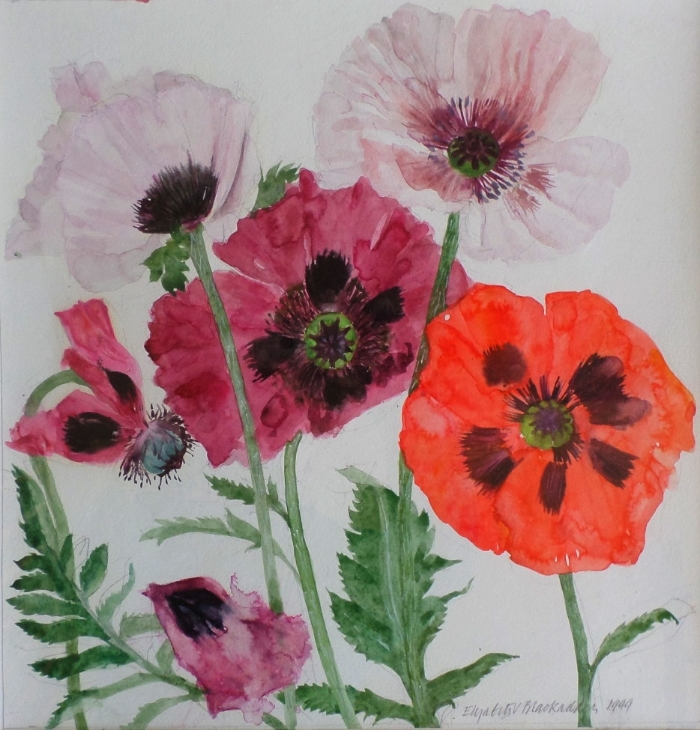
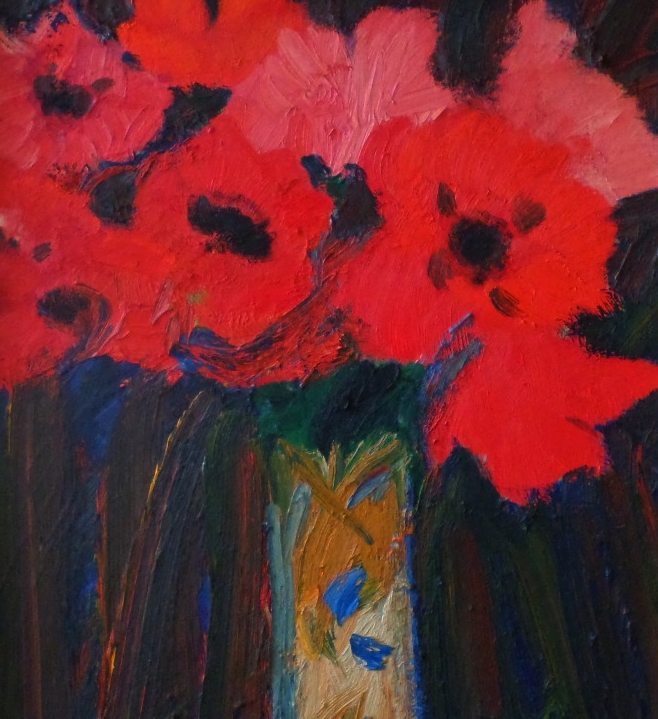
A recent acquisition to our Elizabeth Blackadder collection is a wonderful watercolour of "Oriental Poppies" from the 1990's  and interestingly this bears a Mercury Gallery label verso, as did a work of the same subject by her husband John Houston that we sold a few months ago. Both paintings are shown above and show how equally gifted they both were - Elizabeth in watercolour and John in oil.

Blondes Fine Art are always looking to purchase new work by both Elizabeth Blackadder and John Houston so please do contact us if you are looking to sell a work by either artist.

"War Horse" - Lucy Kemp-Welch

Lucy Kemp-Welch was painting in Cocking, located in the Sussex Downs , when WW1 broke out in August 1914. She had been busy painting some wonderful rural scenes such as "The passing train", "The return from the fields",  and "The Waterway" all of which were exhibited and sold at the Royal Academy summer exhibitions between 1912 and 1914. These fine works depicted the heavy horse "plodding" home after a hard days work. The war brought change for horses. Although the Army were on the brink of mechanisation the horse was still in use for transportation and the hauling of guns and many of those farm animals were commandeered by the War Office.

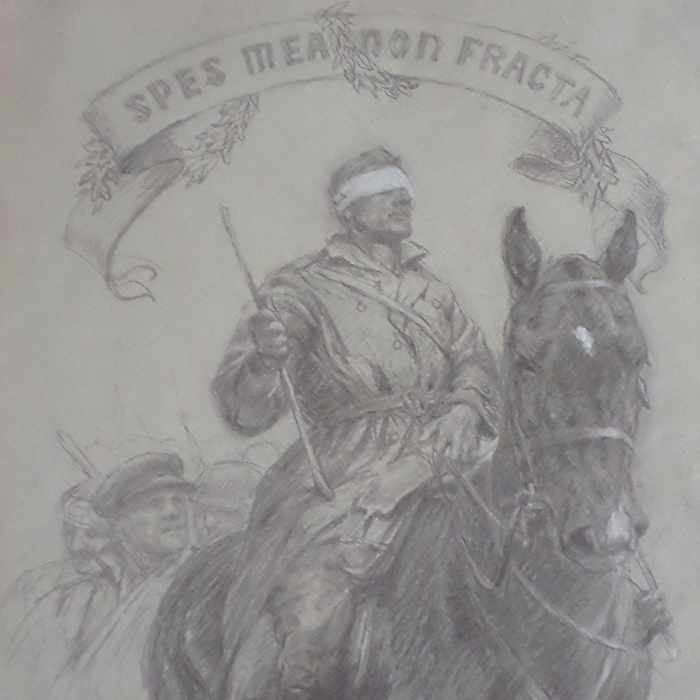
It was early in the war , and as a result of her famed depictions of working horses , that she was approached by the Parliamentary Recruiting Committee to produce a picture of a cavalryman charging straight at the viewer. The artist , and friend, Rowland Wheelwright posed as the rider and Lucy's own horse Black Prince was the study for the horse. This recruiting poster is today still perhaps the most well known and iconic image produced by Kemp-Welch. But it was to " The Front" that Lucy wished to go to capture the "War Horse " in battle but she was constantly thwarted. She offered her services at Whitehall, contacted The Graphic and enrolled on a first aid course all in an effort to be allowed to work in the front line but was constantly refused. To her frustration, it was Munnings and Algernon Talmage who were recruited as Official War Artists while she had to make do with painting the artillery in training.

She found assistance in the form of Colonel Yorke , who gave her access to the horse field gun teams as they trained on Sailsbury Plain. In thanks she painted the Colonel's horse . Lucy Kemp-Welch's painting "Forward the Guns " was produced from the sketches that she had made thanks to Colonel Yorke and it was acquired for the Tate. Yorke informed Lucy that the men in his brigade were delighted with the painting. While the officer was happy the rest of the Art world got embroiled in an argument over the Chantrey Bequest Fund and their purchase of the painting for the Tate. Lucy was angry and distressed. She did, however, carry on painting images of the War Horse despite again being refused by Whitehall to paint at "The Front" in France. Interestingly page 127 of "The spirit of the horse" by Laura Wortley has two images depicted that are almost identical to the image we, here at Blondes Fine Art , currently have for sale. They are charcoal with highlights and are dated 1918.

Lucy Kemp-Welch had helped to convert both the horse and women into heroes and in 1918 women over 30, with the appropriate property qualifications, voted for the first time in a general election. Just pause for one moment and consider that fact a little longer .

It is still less than 100 years ago that women got the vote!


Jacob Kramer -Leeds or Whitechapel Boy ?

Jacob Kramer is a very well collected artist who ,having initially settled in the Leeds Jewish Ghetto when his family came over from Ukraine, moved to London and studied at the Slade . This period at the Slade was to become perhaps its most acclaimed,  as it nurtured some of the greatest talent of the day including Stanley Spencer, Paul Nash, William Roberts, CRW Nevinson along side Isaac Rosenberg, Mark Gertler and David Bomberg. Indeed, the Slade had a significant presence of Jewish emigre students, starting with Mark Gertler in 1908. Soon after Bomberg and Clare Winsten became students, followed by three more of the artist group " The Whitechapel Boys",  Meninsky, Goldstein and Jacob Kramer, born , like Meninsky in the Ukraine and raised in Leeds. All were set apart from the other students by their extreme poverty, walking in together to Gower street from the East End , to save money.

In Isaac Rosenberg's last term he formed a brief ,unlikely friendship with Kramer who, at over 6 foot tall, towered over Rosenberg. Formidably bulky and well known for his boxing, Kramer once rescued Rosenberg from an anti-Semitic bully. Kramer admired Rosenberg's poetry and in return he dedicated a work to Kramer to mark their friendship.

He also came into contact with the Vorticists who were to influence his early work, and he exhibited with then in their 1915 exhibition when still only 23. The Vorticists were the British manifestation of Futurism, and were led by Wyndham Lewis who outlined their ideas in the short lived magazine , BLAST, published in 1914 when Kramer was in London. Although Vorticism never really took off as a coherent movement, several artists (such as Kramer) were influenced by it - eg Epstein ( The Rock Drill), Bomberg (The Mud Bath in the Tate) and most especially Nevinson who produced in some of his war paintings and etchings, some of the very best Vorticists work.  

 In the early 1920's Jacob Kramer returned to Leeds, where he became something of  local artistic celebrity . One of his major patrons was Sir Michael Sadler , one of the most discerning collectors of the day, and later became the Master of University College Oxford. Sadler was President of the ultra modernist Leeds Art Club which provided a meeting place for radical young artists such as Kramer. Sadler himself collected works by Gauguin and Kandinsky as well as the German Expressionists, so it was quite an achievement for Kramer to be included in his collection. In Leeds he also developed a reputation as a fine portraitist through which he was able to subsidise his other work. However, as time moved on , he lived in utter poverty and alcoholism, often in these later years producing poor quality portraits of local figures to pay for his drinks. He died in 1962 aged 70 years.


Never elected to the R.A. on the grounds of being a woman - Lucy Kemp-Welch

When Lucy Kemp-Welch was asked why she did not paint the thoroughbred horse she replied,  " But this other type is always interesting - I mean, the natural type, fashioned by nature and not by man - full of faults, variable, beautiful and lovable beyond words." It was her preference for working horses that has set her apart from other animal painters but when it comes to the art of the horse she has to be mentioned alongside Munnings and Stubbs. Although these other two artists targeted the more aristocratic owners, we at Blondes Fine Art believe that it is Lucy Kemp-Welch who has the more emotional feel of this noble animal. Her ability to capture the strength , boldness and quasi-human emotion of the horse has meant that her work still resonates with horse lovers today.

When her studio was sold by David Messum in the mid 1970's her work was in great demand , as it still is today. Indeed, one of the great collectors of her work - Elizabeth Blaxter- had a collection of over 50 of Kemp-Welch's pencil sketches and when Blaxter died the collection was sold and the proceeds given to horse charities. One of these images ,number 44 in the catalogue, has now returned to Hertfordshire and is now for sale here at Blondes Fine Art.  

From Elizabeth Blaxter

From Elizabeth Blaxter

Lucy kemp-Welch began her formal training with Sir Hubert von Herkomer's painting school at Bushy in Hertfordshire in 1891, although her ability had been nurtured by her father from a young age. Lucy was born in Bournemouth and her father was a keen amateur naturalist so with the New Forest on their doorstep  they would go out on expeditions when she would draw the specimens they collected. She sold her first picture at the age of 16 - a horses head - and from 1895 she was exhibiting regularly at the  Royal Academy.

So why why was she not elected to the R.A ? Simply, on the grounds that she was a woman!

While the male dominated society restricted her membership to the R.A. the quality of her work could not be ignored and her 1897 work Colt Hunting in the New Forest was purchased by the Chantry Bequest for the Tate, and became one of the first paintings by a woman, they had ever purchased. Between 1895 and 1949 Lucy exhibited and submitted 76 works for the R.A. Summer exhibitions of which 40 were hung.

Perhaps the most famous work by Kemp-Welch was 'Black Beauty'. In 1915 she was commissioned by J.M. Dent to illustrate Anna Sewell's classic 'Black Beauty'. She used 'Black Prince' as the model , a horse given to her by Robert Baden-Powell. It has been said that this commission allowed her to draw parallels from her own life to the book , with her independence, sense of duty, hopes and disappointments all featuring in the classic tale.

The years of WW1 were a difficult time for all and the time during which she made her most renowned images -Forward to Victory-Enlist Now, poster among many others . This aspect of her life is particularly interesting, how she was given unfettered access to the Cavalry horses in training and how she persistently attempted to find ways to get out to the front to paint the War Horse. This will be the topic of another specific blog in the coming months.

" From Essex Tractor to Abstract"

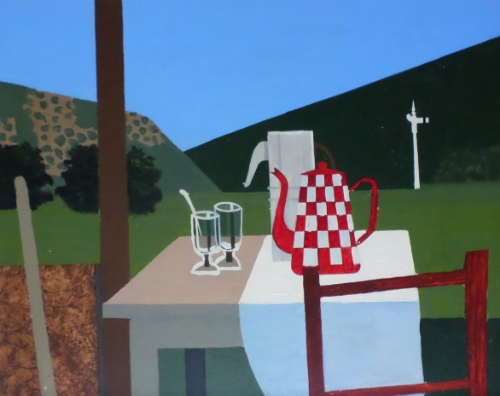
Kenneth Rowentree was a pacifist from a Quaker family and a conscientious objector, as such he was exempt from military service, so in 1940 he was one of the artists involved in the recording Britain project. In 1941 he moved with his wife , Diana,  to live in Great Bardfield Essex. He went on to contribute 12 pictures of rural Essex for the project and then moved, in 1943, out of Great Bardfield to a nearby village while still retaining strong links to the friends and fellow artists he had left behind. The Towner Gallery in Eastbourne currently has an exhibition of work form the Recording Britain project in which there are several works by Rowntree. The exhibition runs until May 2016.

 In 1945 Kenneth Rowntree together with other artist involved in the Recording Britain Project, most notably Michael Rothenstein ,was asked to design a lithograph for School Prints Ltd. He chose an image that would have been most familiar to him and  "Essex Tractor" is certainly familiar to me, as well as many other children, recalling the images in their classrooms during the 1950's and 60's.  It was a simple flat image , uncomplicated with great visual impact. Interestingly, it was the following year ,1946, that Rowntree had his first magor show at the Leicester Gallery in London. Three years later he was offered the job of tutor of mural painting at the RCA where he remained for nearly 10 years. 


Shown above is a subject that  Kenneth Rowntree did several times - see No.25 in the retrospective exhibition at the Fry Gallery (2015) and No. 42 in J. Milner's monograph (1992), where the same signal post appears in the background. He was also quite accustomed to using the same props in many of his paintings- a popular one was the French enamel coffee pot that he bought in France c. 1939 and kept all his life. It was in fact sold as part of his studio sale in 2009,  Lot 15.  This image shown here is from the mid 1950's when he was tutor at the RCA and is titled 'Open air still life - levisham' . The town of Levisham is located next to the North Yorks Moor railway line .

The best of Rowntree's  work manifests a strong sense of design , with, as here, a marked use of geometric pattern making and a flattening out of space. he is a master of pictorial composition, and this is evident from the beginning of his career, and not surprisingly eventually leads to complete abstraction in some of his later work.


David Hockney R.A. - Retrospective at Tate Britain.

Blondes have recently acquired David Hockney Illustrations for 14 poems by C.P.Cavafy. 1966. There are 12 etchings bound in book form from the A edition, signed and numbered by the artist 134/500. (The individual etching are not signed.) Published by Editions Alecto on handmade Barcham Green wove paper. The etchings bound as published in the cerise silk covered boards with black silk slip case. All in mint condition.

Published in 1966, it was these etchings , amongst the best produced in the 60s, that made Hockney's name. It was quite a daring venture for we must realise that homosexuality was still a criminal offence at this time. They were described by the eminent critic Edward Lucie Smith as "not only the best work I have seen by the artist, but probably the finest prints produced in England since the war."

Cavafy's homoerotic poems had been published in the 1920s, and he, like Walt Whitman (another gay poet), was a source of great inspiration to Hockney. They were not intended to be literal illustrations to the poems which had been set in Alexandria, but more an attempt to capture the both the spirit and furtive nature of homosexual love at that time. A great many of the albums have been broken up over the years, and the prints individually framed, so it's a great pleasure to be able to offer this set of 12 etchings in their original published form, with each etching accompanied on the facing page by Cavafy's poem.


Eileen Cooper - "A female perspective"

It seems quite obvious  that the varied, yet figurative, work of Eileen Cooper has a strong female perspective. Regardless of the imagery it is firmly rooted in what one might call an autobiographical core. With prominent themes including sexuality, birth and relationships her work has tracked her life, to form a powerful body that speaks to both men and women alike, albeit interpreted slightly differently by each of the sexes.

Original watercolour dated 2007

Original watercolour dated 2007

I was personally drawn to her work  from the 1980's which is rich in colour , Gauguin  like in its symbolism  -emotional  and imaginative- with recurring themes that appear to tell the story of life. She is a " journey woman" whose work is rather like visual poetry, cataloguing love, family life, working while balancing motherhood (she is the mother of two boys) , and  the changes both in her life and in a wider social context as she has matured.

Indeed, her work is worthy of an essay but this is not the place for that and in fact much has been written about her, particularly since she became the first female Keeper of the RA in 2010.It says a lot about Art in general that it has been so male dominated and we, here at Blondes Fine Art, find it refreshing that such a great female artist is now in such a influential position. Let us hope that she is able, through teaching and indirectly through exhibition, to act as a role model to young female artists of today. She understands the issue well having  personally been very much a lone female figure among many men, when she moved to London to study at Goldsmiths in 1971.

Eileen Cooper is a woman of today ,and her work has always been relevant and unique. In the last decade the imagery has become toned down in colour; it is less primal and more embedded in the real world; her work has changed and matured with her, yet retains a quirky edge that makes one think and add interpretation . Whether it is the images of dance or trapeze , tigers, horses or tortoises there are always figures in Cooper's work to remind us that we are the centre of our own world. She is one of our finest contemporary artists and one that we look forward to watching as she continues on her artistic journey.


Works on Paper Art Fair 11-14 February 2016

In 5 weeks time we will be exhibiting at the Works on Paper Art Fair , which this year is being held at the Royal Geographic Society located in Exhibition Road, London.

We have just started to prepare for the event and have an eclectic range of work from such contemporary greats as Elizabeth Blackadder, Simon Palmer, Eileen Cooper, and Richard Bawden. Additionally, there will be plenty to keep you interested if you are a collector of Harry Becker, John Knapp-Fisher, or  Josef Herman. Indeed, it is hard to select one or two to choose to highlight here, but I think worthy of note are works at opposite poles in terms of price. The first are a collection of 1940s/50's original fashion illustrations in watercolour, and  originating from Heddon Fashions in Regent St . These stylish works include a sample swatch of material intended to be used in the design. Fashion illustrations are are great way to start collecting original art and these are really not to be missed. They would look Fab in either a bedroom , dressing room or lounge and are amazingly good value at less than £200.

The  other item is a  work by the great Scottish artist Alberto Morrocco who was a talented , flamboyant and versatile artist born in Aberdeen in 1917 of Italian parents. He is perhaps most widely known for is colourful still life melons , clowns, and the Italian beach scenes usually in oil on canvas, but the work on offer here is Tempera on paper. It is the original drawing for his 1962-64 mural for St Columba's Church , Glenrothes and was commissioned by his great friend and architect Sir Anthony Wheeler. Alberto Morrocco had just been elected member of the RSA and was asked by Wheeler to produce this mural for a church that he was designing.  The mural itself was produced and can be seen in the St Columba's Church today, indeed Morrocco went on to produce another mural in the years following for Liff hospital in Dundee where he was also Head of Painting at Duncan of Jordanstone collage art school.

This original design is in original condition , squared off for transfer and was kept by Wheeler in his personal art collection until his death . It is titled "the way of the cross" and depicts Christ's journey  to his death in three distinct scenes within one painting. This really is a magnificent work in sombre pastel yet rich shades of reds, white and purple. Morrocco was a fine artist with an international reputation and this work would grace any collection .

Come along between 11-14 February and see us together with  the works mentioned here and  many more.