Frank Auerbach - The 1954 Drypoints - Five for £5!

The early drypoint emerged from Frank Auerbach’s student work and they have a real sense of creative tension arising from reworking the plate and never being fully comfortable with the image . Indeed the artist himself acknowledges this as being a positive in his work and said

‘Most things I’ve done that might have any quality have been chewed up, worked over and redone; although I would not manufacture it, I quite like to see the traces of effort in things ‘

Well these early drypoints from 1954 are a case in point and were completed when he was still a student at the Royal college of Art. They are based on six life drawings chosen from several hundred that he made over the preceding years and they were executed by the most direct means possible . One ‘ Reclining nude’ is known to be based on the original drawing of 1952 in the collection of Leon Kossoff ; ‘seated nude with hands above her head’ is based on the drawing of January 1951 in the collection of Garda Boehm; ‘nude in a folding chair ’ is based on a drawing of November 1953 in the collection of Philip Holmes ; while ‘ nude in profile ‘ a 1953 drawing in the collection of Keith Critchlow.

When asked about the set the artist said

‘ These were all based on drawings at the Royal College of Art or Borough Polytechnic. I chose six drawings which were fairly fresh in my mind, out of several hundred…….These drypoint were scratched on to alloy six inches square , bought from Romany’s of Camden High Street for 6d. Each. They were all done with a nail, set into a pen holder with sealing wax, and printed by rubbing the back of a spoon over the back of the dampened paper. It was very laborious; there was a lot of burnishing. There was never a formal edition . I think there may be a dozen complete sets , they belong mostly to friends, often painters ‘

The marks of rubbing with a spoon are clearly visible on the backgrounds on the images , they were all achieved by trial and error with much polishing to polish away unwanted lines and in some places the actual prints have suffered cuts from the pressure of the spoon on the rough burred edges of the scratched line. There is also variation between sets as some prints exist in different states and Auerbach made up some sets with earlier proofs that he had made before burnishing away or adding to the plate.

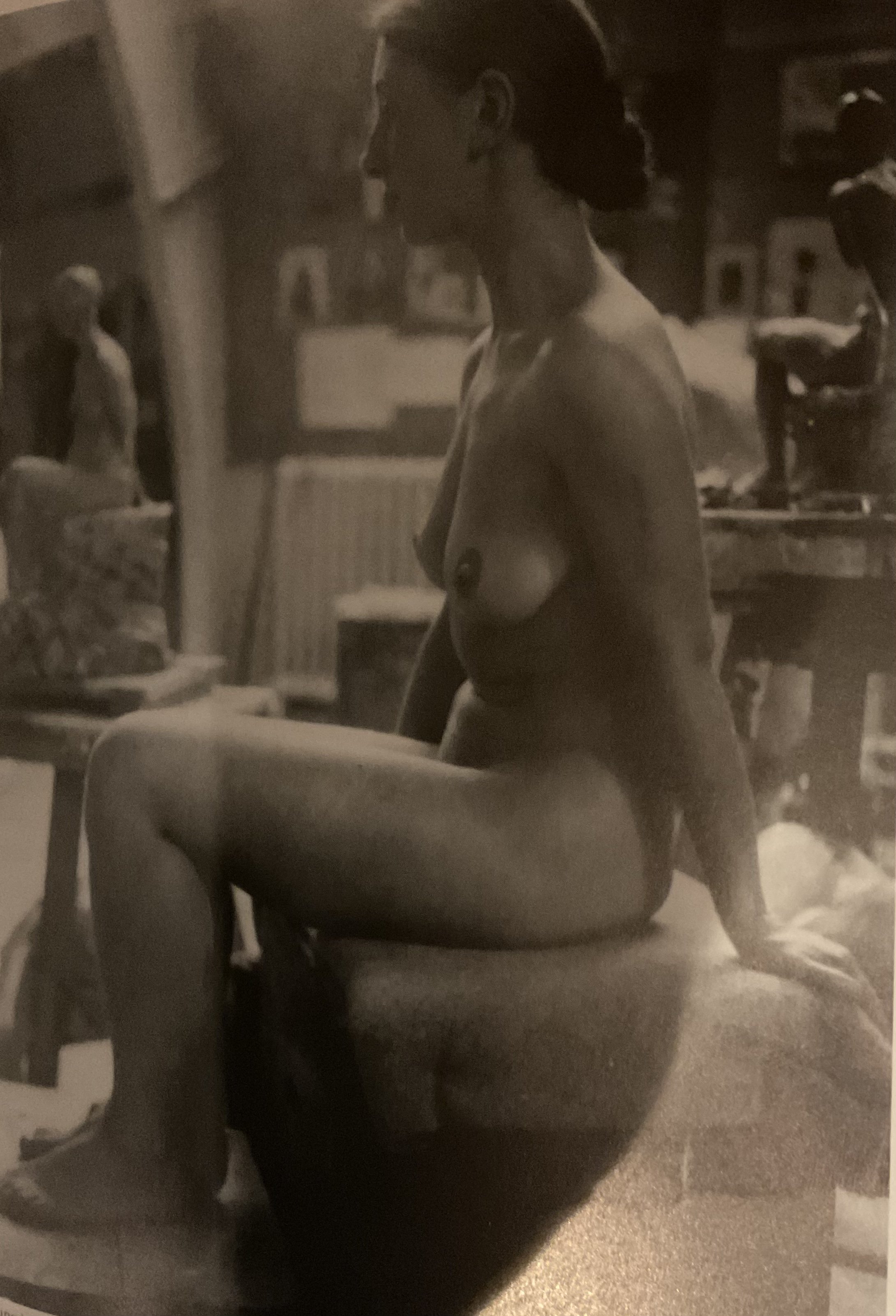
So who had these sets gifted to them , who were the friends ? Well we do not know where all of them are, but we do know that James Kirkham had a set of six , which are now with the Fitzwilliam Museum, Cambridge, as did Leon Kossoff and R. B. Kitaj . We can speculate who the other friends were but I am unaware of a record of exactly who had them and how they came to be gifted to them. However we do know about the set of 5 that we hold in our personal collection . These were gifted to the beautiful life model June Furlong and this is her story of how she came to own a set of 5 drypoints as shown below .

June came from a wealthy family in Liverpool and was born in 1930. She came to London in the 1950’s and modelled at the RA and RCA for many famous artists . In her book ‘June - a life study’ she explains how she was a close friend of Lucien Freud, but first met Frank Auerbach at the RCA in a life class. They became closer over the following months after a night in the Studio Club in Swallow Street, off Piccadilly.

June recalls his studio as being ‘a bit of a dump, the floor squelched as you walked as it had paint all over it’. She explains how Frank never had much money and she always kept an eye on him as they were good friends.

June was such a beauty that she was a well known to all sections of the London scene including the more criminal element . She recalls being given a box of £5 notes to look after by a ‘car dealer’ and told she could spend whatever she wanted . She said it paid for her rent and Harrods shopping!

“Frank Auerbach saw all this money constantly carried around by me in a brown bag for emergencies. I offered him £5 to help him out, a lot of money then. He said he could not possibly take it, so I quickly offered to buy some of his etchings as a fair exchange. Frank agreed that he could accept the £5 in return for his work, so I got the (5) etchings and he got the £5. He went straight out to buy bread, tea and more paint! I went off with the etchings and had them all identically framed at the Royal Academy where I was working and have cherished them ever since.”

Well we still cherish them and they have pride of place in our collection . They have retained the original frames and still look as beautiful as June did when she sat for the artist.

Thank you June for ensuring the story of these 5 etchings will not be forgotten !

June Furlong (3 June 1930 – 20 November 2020)
Harry Becker - Going Dutch.

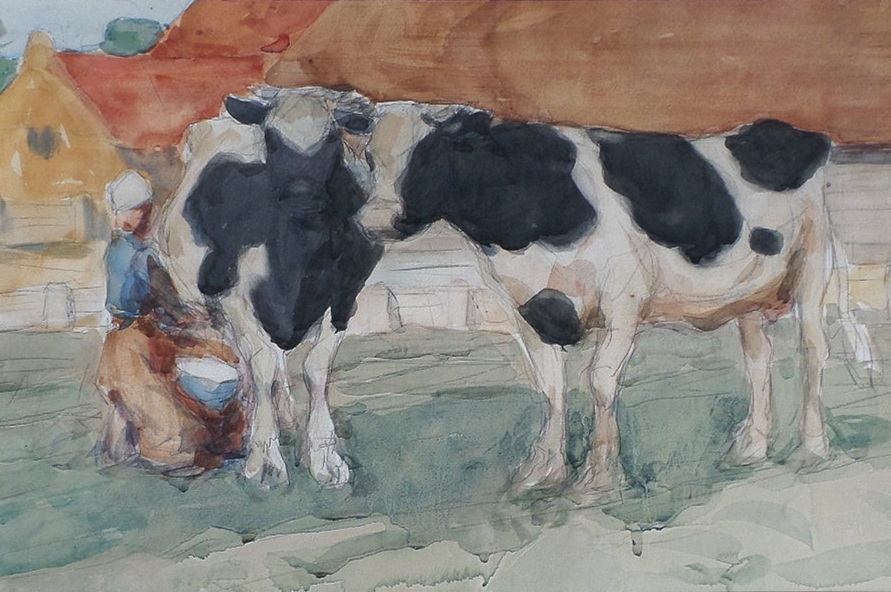
Harry Becker was actually christened Henry Otto Becker but interestingly enrolled in the 3 year course at Antwerps national Academy as Hendrick Becker when he was just 14 years old. It was his time in Antwerp that seems to have instilled a love of the Dutch and particularly the farm labourer , and this was a theme he returned to time and time again in the following years. Becker completed his formal art training with a period at Bushey School of Art in Hertfordshire and an apprenticeship at the studio of Carolus Duran in Paris, before returning home for a period in Colchester where his family lived. It was this period in the late 1880’s that he started to make a name for himself and had work accepted for the R.A . In 1894 Becker moved to London but continued to make excursions to rural areas to paint. Time and time again he returned particularly to Holland in the late 1890’s and early 1900’s. He concentrated on the field work of the potato picking and bean harvest undertaken by women as well as men and captured a time when a national dress still existed with aprons , bonnets and clogs the attire of the day for the women.

Becker’s love affair with the Dutch matured his work and inspired a series of lithographs and a cluster of successful exhibitions and appearances at the Royal Academy summer exhibition. He completed a series of lithographs depicting Dutch farming scenes in 1908 and 1909 and exhibited them that same year in his London studio and the commercial gallery at Queens Gate . At the end of the year Becker held another exhibition in his studio titled ‘Field labour in Holland’ and comprised of 33 watercolours which were greeted with acclaim by the Illustrated London News. They welcomed Becker as “a rare painter “ and they said of the subject “new to watercolour, the austere figures of young women a-field, full of vital angularity and splendidly fresh and unexpected beauty. “

It is interesting that when I showed the watercolour shown below to a very good friend she commented on how it had something of the ‘Soviet realism’ style about it and while I had not considered that myself I have to agree with her view .

So here at Blondes Fine Art we are delighted to have acquired one of those 33 watercolours - illustrated above- painted on Milburn board - a favourite of Becker - the watercolour wash is over pencil giving a wonderful feeling of fluidity and movement.

Further research has resulted in even more interesting facts about this painting . We are privileged to be the custodians of the personal archive of art historian David Thompson, who was the author of the definitive book about Becker , and tucked away in an old photo album we found an annotated image which shows the preliminary sketches for this watercolour . Interestingly , David does not reference the watercolour but does reference the fact that the work became an oil painting that was exhibited the year after Beckers watercolour exhibition at the Royal Academy summer exhibition in 1911. We can not find an image of the work but it was exhibition number 380 and titled Dutch peasant women gathering potatoes. Shown below are the page from the R.A. Exhibition and the notes from David Thompson’s archive .

So it is interesting to see the genesis of the work and how it was scaled up and developed into our watercolour and finally became a exhibited oil painting . If you have this oil or know where it is we would love to see it so do please get in contact with us here at Blondes Fine Art.

Jo Brocklehurst

Jo Brocklehurst and The Jo Brocklehurst Prize

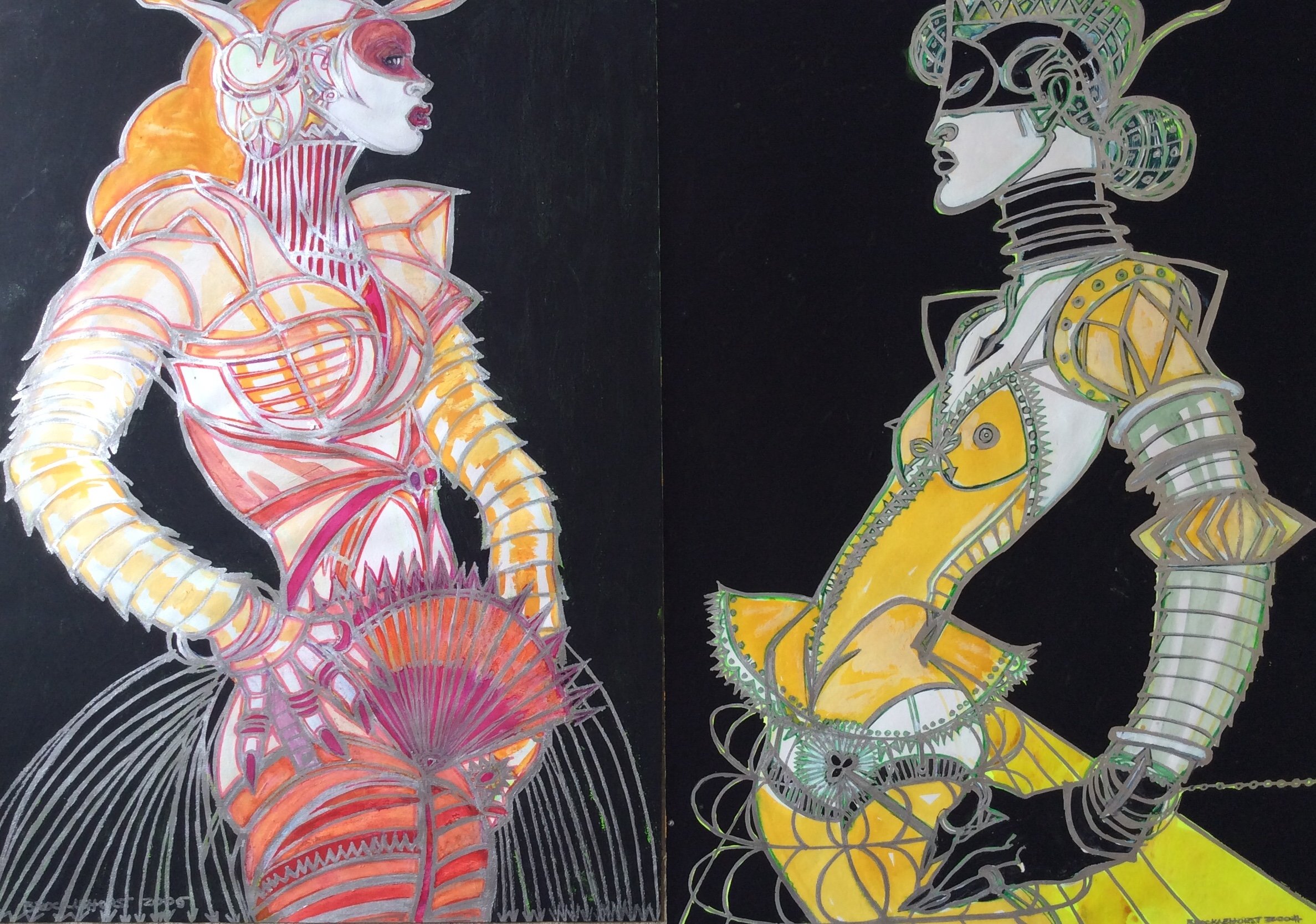
Jo Brocklehurst is an artist of amazing talent, who was born to draw . She was compelled to draw on a daily basis and she has left us with an amazing record of the social history of the 1970’s - 2000’s.

She is best known for the Punk drawings she made of the occupants of a squat close to where she lived in West Hampstead . These images were exhibited in London , Amsterdam and New York and have become iconic, highly sought after works that visually articulate the subversion of the time . But Jo spent a period of time in New York drawing those frequenting the night clubs and capturing them using fluorescent pens to enable her to see her mark making in the dark surroundings . She used the same technique in England when she became a regular at Torture Garden in the early days of the fetish club scene , where she was to be found in the corner of the club with her drawing paraphernalia capturing the fashion students in their recent creations . This has become an iconic record of the time and Jo Brocklehurst is starting to become known to the wider collecting fraternity .

By way of recognition for the amazing work that Jo produced we here at Blondes Fine Art are proud to support Central St Martins in London by funding a prize in the name of Jo Brocklehurst

We are delighted to confirm the inaugural winner of the Jo Brocklehurst prize for 2021 is Maryam ADAM . Programme Director for Graphic Communication Design, Rebecca Ross, chose Maryam for the following reasons:
The panel of academic staff felt that Maryam’s Unit 10 projects, “From My Mother’s Hands” and “Where Are You Really from?” demonstrated an exciting present-day development of Brocklehurst’s interest in identity, and counter-culture, particularly for the way Maryam used the exploration of Gujarati craft-based processes to challenge dominant hierarchies and narratives of South Asian craft. Brocklehurst’s interest in subversion is seen in the way Maryam has recorded and illustrated environments and personal stories which encourage people to question Design boundaries and challenge empires.You can take a look at Maryam’s graduating work here in the online showcase:

https://graduateshowcase.arts.ac.uk/projects/269312/cover

We hope to be able to exhibit Jo’s work in the coming years and while the last 2 years have proved challenging to us all we are determined to continue to highlight the work of the great artist .

We are also interested in purchasing work by Jo Brocklehurst so do contact us is you are considering selling .

Mark & Melanie

Blondes Fine Art

William Gear - The art of nature

William Gear is one of the most recognisable artists but one that few understand well . His work is rooted in his humble beginnings , influenced by his times in Paris and working with the Cobra group, but above all his output needs to be seen as he intended ………

‘statements of kinship with the natural world’.

Summer morning 1952 - Please Equire

William Gear was born into a mining family in Scotland , studied together with Wilhelmina Barns-Graham and Margaret Mellis at Edinburgh College of Art in the 1930’s before travelling to Paris to work with Fernand Leger . He also attended a summer school with ‘The Two Roberts’ so really was at the heart of the Modern Scottish Art movement of the pre war years .

He was called up for military service serving in the Middle and Far East where he met the artist Merlyn Evans and at the end of the war became one of ‘The Monument Men’ being signed up to the Allied Forces’ Monuments, Fine Arts and Archives (MFAA) section, during and immediately after the war. The group of approximately 400 service members and civilians worked with military forces to safeguard historic and cultural monuments from war damage, and as the conflict came to a close, to find and return works of art and other items of cultural importance that had been stolen by the Nazis or hidden for safekeeping. Some of them are portrayed and honored in the 2014 film The monuments men .
Post war Gear became heavily involved in the Cobra group and was one of just two British artists accepted into the group. Gear was invited by Constant and Jorn to exhibit at CoBrA shows in Amsterdam and Copenhagen in 1949, alongside Corneille and Appel. In the same year, he exhibited alongside Jackson Pollock at Betty Parson’s Gallery in New York. So lets be honest at this point Gear has some of the very best credentials in the Modern British and Avant Garde Art groups of the post war world.

The 1950’s

Gear moved back to the UK from Paris in 1950 . He was living with his young family in Loosley Row near Princess Risborough , Bucks and said about his work

‘There was always a link with nature, I never denied nature really. Even in those extreme abstract themes we have been looking at, there is an equivalence to, observable form.

I don’t say nature in the naturalistic sense but of observable forms. They may be telegraph poles or stakes or trees or structures or, as I am looking out the window now, I mean, I can see, I can see my painting in two or three different ways.

There is the severe architectural modern structure over there and at the same time trees and foliage and blossom and light through the tree. I mean, there is my painting you see. This is where it comes from. I don’t necessarily sit down and paint that, but I am aware of it.’

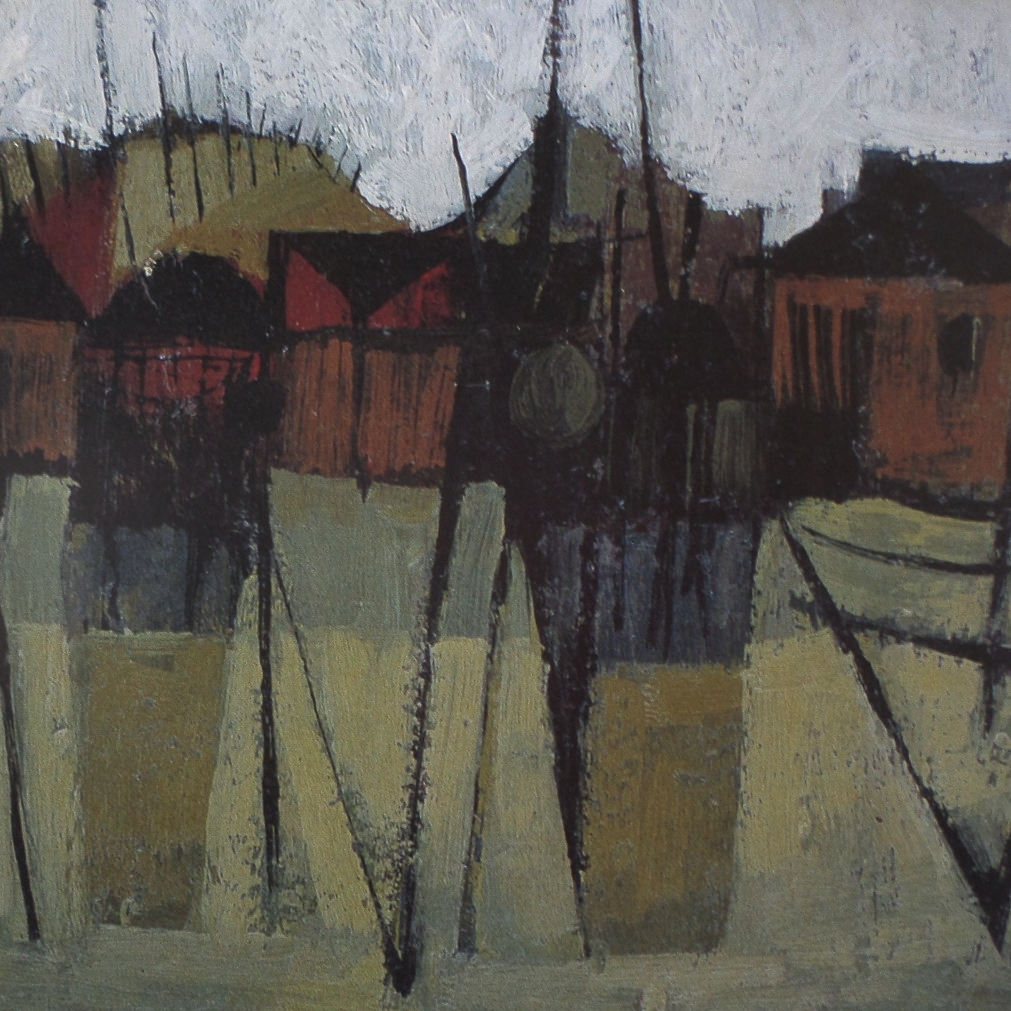
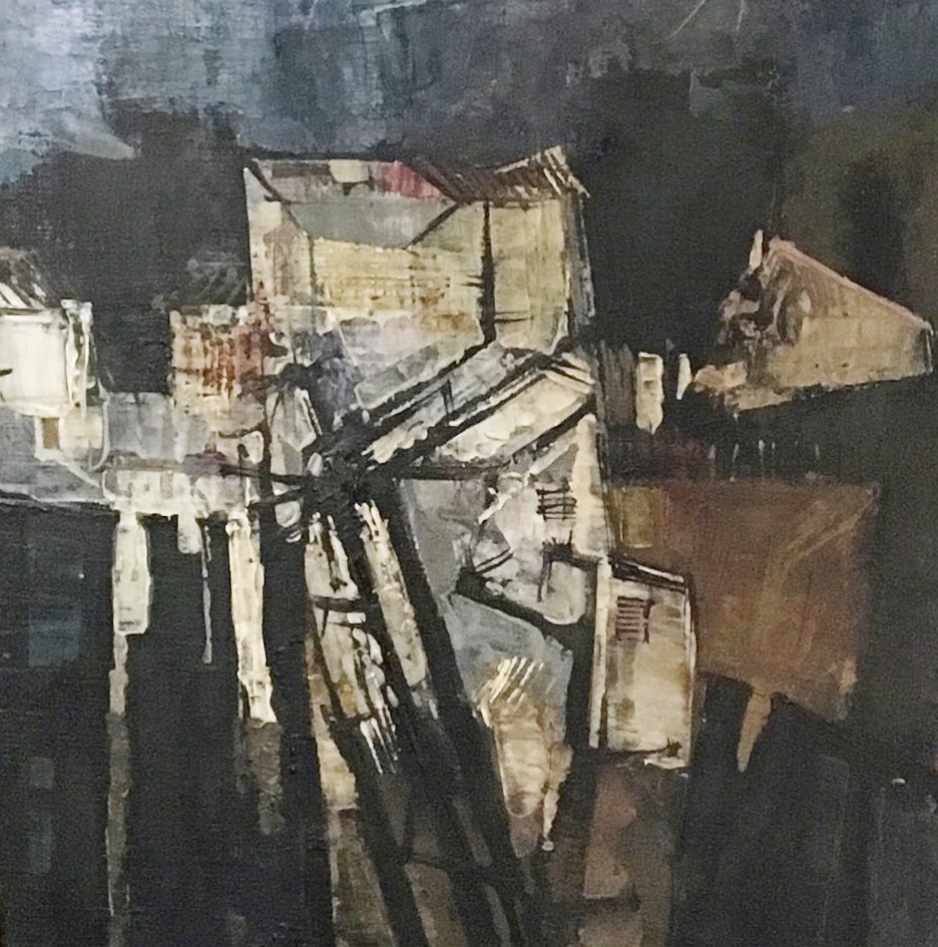
We only have to look at the titles of his works from this period to see that they are deeply rooted in nature and the seasons much like the work of Alan Reynolds from the same time. The two works pictured within this blog are companion works from 1952 and titled Summer morning ( shown above )and Summer afternoon (shown below). A close examination shows the exact same palette being used in varying proportions . The colours are vibrant but the morning work has more of a subtle subdued feel about it . Summer Afternoon sold a few years ago at Christies but Summer Morning is currently available here at Blondes Fine Art in Hertfordshire, so do get in touch if you would like to view the work.

The Festival of Britain

The festival of Britain was a national exhibition and fair that attracted millions of visitors throughout the United Kingdom in the summer of 1951. Historian Kenneth O. Morgan claimed that the Festival was a “triumphant success” during which people, “flocked to the South Bank site (in London).

As part of the event the Arts Council of Great Britain organised an exhibition, “60 Paintings for ‘51”, showing from 1st January to 1st December 1951 at the Suffolk Galleries, Suffolk Street, London W1. They invited 60 important contemporary painters to exhibit, even providing some with canvases for them to paint on as art materials were in short supply after the war. It was stipulated that paintings were to be not less than 45 x 60 inches (114 x 152 cms). It was an opportune moment for Gear who, out of sixty artists invited to submit, was one of five artists awarded a Festival of Britain Purchase Prize. Gear’s painting was a huge canvas – Autumn Landscape – and the only abstract work selected. The Arts Council purchased the five prize-winning paintings for £500 each, a considerable sum in the 1950s. The winners were Lucian Freud, William Gear, Ivon Hitchens , Robert Medley and Claude Rogers .

Only three paintings in the entire exhibition were abstracts, those by Peter Lanyon, Victor Pasmore and William Gear. Gear’s prize-winning abstract “Autumn Landscape” caused quite a furore and some of the narrow minded British press led a call for all of its readers to challenge the decision with local Members of Parliament. Gear was undeterred and continued to paint his abstract work and to challenge the traditional art world . I think that his output from this period is some of his very , very best . Innovative , bold and new . The use of vibrant colour was to show the way forward for many of the Modern British Art greats that we love to collect and appreciate today .

Gear was amongst the pioneers in Britain to produce prints using the silk screen technique. He moved to Littlebourne in Kent (1953), was elected a member of the London Group and began receiving commissions for fabric and wallpaper designs in the same way that Alan Reynolds also did with Edinburgh Weavers. Gear producing about 100 designs over the following nine years.

He was curator of the Towner Gallery in Eastbourne from 1958 to 1964, and then head of the Faculty of Fine Art at Birmingham collage of Art , a post from which he retired in 1975. It was while he was at the Towner that he managed to change the local authority’s collection policy from Victorian and local views to securing them the foundation of a major collection of post-war British art. He was still happy to ‘rock the boat’ and while in this role famously curated the first solo exhibition of Mockford's work in 1959 and also bought Mockford's 1958 painting, Eastbourne, for the gallery, a decision that caused another public outcry at the time. The painting was considered politically subversive and became the subject of a council meeting about why the gallery had paid for such a thing.
The Eastbourne painting features an aerial view of the town with line drawn houses surrounded by chalk and the Long Man, a giant emerging from the chalk, seemingly about to step on the town. Its a fabulous work and well worth viewing if you are ever in Eastbourne . It is now considered to be the star of the collection , how times change !

It really shows how our world needs people to stand up for what they truly believe and be prepared to turn a back on the well trodden path to seek a new way to walk .

Summer afternoon 1952

Summer morning 1952 ( the image at the top of this post ) is completely original , signed and dated , in its original frame and is 40 x 28 inches in dimensions . It is simply the best work by William Gear that I have personally seen . Its only on very few occasions that a piece of art comes into our possession that feels very, very special and this is one of those .

You are welcome to view the work in our gallery by appointment .

Mark & Mel

Blondes Fine Art

Robert Colquhoun and Fred urquhart

Robert Colquhoun was one half of ‘The Two Roberts’. He was well known in Soho and Fitzrovia for his hard drinking and relationships with many other Bohemians stranded in London during World War II. But, who is Fred Urquhart I hear you ask and how does he fit in ?

Its a very good question, and one that I would have been unable to answer until quite recently. I purchased a wonderful oil monotype of a head which was signed and dated but incorrectly attributed to a work that post dated this particular piece, so I began to research it. The frame, and the frame of a second work, was in poor condition but had removal company labels verso with two surnames hand written on them . The only other clue I had was that they were from a house clearance in Musselburgh, Scotland and found in a pile of other ‘worthless’ paintings. I began by doing my usual checks without much luck until I pursued the surname Urquhart and the story began to unravel.

Fred Urquhart had died in Musselburgh in 1995 , having moved back to Scotland from East Sussex, but the question was how did his surname come to be on the back of the artwork , what was the correct title of the work and how does he link to Robert Colquhoun? This is what my research revealed .

Frederick Burrows Urquhart was born on 12 July 1912 in Edinburgh. He became a writer and he wrote a number of novels. Fred Urquhart's strength was the short story in which his characters did the talking. He had an ear for all forms of accent and dialect and took ungrammatical yet creative liberties with the language. Although he spent many years in southern England after the war, his creative impulses were rooted in Lowland Scotland: on the Firth of Forth and Clydeside; in coastal Wigtownshire where he was at school for a while; and on Tayside, where he also spent some of his childhood . His stories generally dealt with the lives of ordinary people, and the cruelty and violence of such lives was a constant theme. He was particularly sensitive to the violence dealt out to women, and was able to portray the female psyche with insight and tenderness. The ugliness of war (he was a pacifist) was an extension of these concerns. On leaving school at the age of fifteen he worked for some years in a bookshop in Edinburgh. At the same time he began to write, and from the early 1930s onwards had stories published in periodicals as well as broadcast on the radio. He left the bookshop in 1935 to concentrate on writing. His first published novel was Time Will Knit (1938), the story of working-class Edinburgh life. When war came in 1939 Urquhart, as a declared conscientious objector, was sent to work on the land. It was at this point that his first collection of short stories appeared, I fell for a Sailor (1940).

In 1944 Urquhart was working in England at Woburn Abbey, the estate of the Duke of Bedford, which made a good base for contacting artistic and literary circles in London. It was as a result of working there that Fred was introduced to the Roberts by the Scottish poet Tom Scott during one of his weekend trips from Woburn to London and I gather that he also met George Orwell because of a connection to the magazine "Tribune". He became part of the Scottish contingent of painters, poets and novelist who would erupted into Soho and Fitzrovia on binge drinking evenings at The Wheatsheaf pub in Rathbone place . I am told by his friend Colin Affleck that Fred often reminisced about the Roberts and other figures from his Soho days. Others included W.S. Graham , the Two Roberts, David Archer , Julian Orde and Robert Frame. After the war Urquart lived with his lover and companion, the dancer Peter Wyndham Allen, and had moved into a house in Ashdown Forest in East Sussex in 1958, but when Wyndham Allen died in 1990 Urquhart moved back to Scotland and settled in Musselburgh where he died a few years later.

So that had solved part of my question as to how Urquhart and Colquhoun were linked but I then wanted to find out the true identity of the artwork I had purchased . Working on the presumption that Urquhart had been gifted or purchased the work in the 1940’s I started to trawl the exhibitions . After a good deal of research I was able to track down the exact title ‘Man’s Head’ and dimensions of the piece and the fact that it was lent by Fred Urquhart for the major exhibition of Colquhoun work at The Whitechapel Gallery March - May 1958 and is number 232 in the catalogue .I love the social history wrapped up in the artists lives and the artwork themselves as they are integrally linked , it was a joy to find out the true identity of the artwork and to understand how treasured it must have been as Urquhart had it in every home he lived until the day he died.

The artwork is now looking very well indeed housed in its original period frame but with a new none acidic mount so that it can be enjoyed for another 75 years , or more!

Adrian george

Adrian George 1944-2021 , was a fine artist and illustrator who sadly died in his London studio earlier this year. He was essentially a London lad living above is fathers chemist shop in North West London , schooled at the local grammar school and took evening classes at Harrow Art School . As a teenager he hitchhiked across Europe and from that point on he was a wondering soul, travelling and living across the world for most of his life .

His more formal art training began when at 19 he attended the Royal College of art studying illustration, where he took particularly to Peter Blake, then just beginning to make his way as a pioneer of Pop Art. Perhaps his early, hedonistic life in the swinging 60’s and kaleidoscopic 70’s is best left to his own account below.

‘I think it was the artist, Peter Blake, who first introduced me to the enchantments of Notting Hill in the 1960's. He had taught me at Harrow Art School and he used to meet with his friends like Patrick Caulfield and Derek Boshier in a pub on the Portobello Road on Saturdays. When I went to the Royal College of Art in 1964, Notting Hill was an obvious place to live. In those sensual days shades of grey were brightly illuminated by an unusual combination of time and place and people. I seemed to spend my time in Rolls Royces being driven to slum basements. In 1967 I made some drawings in Tangier, which were published in Queen magazine, Kit Lambert, the manager, involved in a 'Who' record sleeve, I worked on a film for 20th Century Fox. There were drawings for magazines like the Sunday Times under Harold Evans and Nova for Molly Parkin and also 'underground' magazines like Oz through Felix Dennis and also radical theatre with Philip Prowse at the Glasgow Citizens. Everything seemed to happen at once. And then there was travel, always when there was enough money; travels in Europe and travels around America.

The 1960's kaleidoscoped into the 1970's my indistinct memories reveal gangsters and fey pop stars, Joe Boyd a record producer of Jimi Hendrix, playing games of poker with people on the run. Fashion designers and boutiques, Zandra Rhodes and her sponsor Vanessa Redgrave, embryonic pop stars like Mark Bolan or Brian Ferry or Nick Drake always seemed to be in the corners of rooms at parties and night clubs. The best night club was Mo McDermotts. It was an entirely amateur affair. Mo was David Hockney's assistant and occupied the basement flat underneath Hockney's studio in Powis Terrace. Through a Baudelairian haze I can see Mo as a master of ceremonies to a nocturnal parade of artists, designers, musicians, models, hustlers, minor aristrocrats and major talents. There people who should have known better and some who had known a lot worse, met and drank and danced the night away. Some I still know, many are dead. Here a Beatle, there a Rolling Stone. The lovely orchidacious Patrick Proctor and amongst the catamites and their masters, pretty girls like sweet Marinka and the charming Celia Birtwell. There was forbidden fruit for every taste and much work to be done.’

George’s illustrations of Hockney (sold at Christies in 2008) and Bowie ( Christies 2018) are amount his best known together with that on Lady Diana. He also produced a number of stamps for the post office and worked extensively for Times and Telegraph newspapers being send round the world to illustrate and write .

He has exhibited extensively around the world and had many solo exhibitions in London, at Francis Kyle Gallery and at Chris Beetles Gallery in 2005. ‘ George’s work is included in important private collections worldwide and is also represented in both the National Portrait Gallery and V& A. We are delighted that we are able to offer 3 large works by Adrian George so do contact us if you are interested in his work and would like more details .

Connect Art Fair - Boutique Art Fairs & 10 years of Blondes Fine Art

Connect Art Fair runs from 29th January - 2nd February 2020 and it is now in its second year . Here at Blondes Fine Art in Hertfordshire we are proud to be celebrating 10 years of trading this year and just as proud to have a strong association with this boutique fair.

Mark Hearld - Connect Art Fair

Over the past 10 years we have mainly operated from our website with the additional bonus of having a large gallery open by appointment - this was converted from a stable block in the grounds of our home. Over the years we have taken various stands at a number of fairs including ones in provincial and central London locations, with 20/21 International at Royal College of Art and Works on Paper in Knightsbridge to name but two. We have also maintained strong links with public galleries and schools of art sourcing rare works for the Ben Uri collection and we are currently working closely with Central St Martins School of Art and Design on a new project for later this year.

So, there is always something going on here at Blondes Fine Art but Melanie and I are delighted to be making final preparations for Connect Art Fair . I was recently asked by another gallery owner why we like Connect so much and having given him an answer I thought I would blog it so that everyone can read why.

Lets start with the facts first

Fairs are not cheap to attend with central London high profile events costing upwards from £10,000 for 5 days depending on the size of the stand, so it is an expensive outlay for any business. Additionally, there are the logistics, with a great deal of time, expense and effort going into the planning, transport and manning of the stand.

So why do we like Connect Art Fair so much ? This is most easily answered by referring to comments from last years visitors .

‘I have never been to a more friendly fair , and I go to all the London events’
’ There is such a great range of paintings I could buy them all ‘
’ Everything is such good value , and the galleries are genuinely friendly’
’ I came to see what a fair would be like here at Mall Galleries as I was not sure how it would look . I have to say it is wonderful’
’ Love the venue, love the galleries, love the space - I do hope this becomes a regular event ‘

These are actual comments from a few people that attended the 2019 fair and we would have to agree with them all. It really is a Boutique fair , where you will find something to suit every collectors interest and every budget . Connect Art Fair is unique in that it is run by the dealers with no other organisation taking a profit from the event - like a cooperative . This means overheads are low and these savings can be passed onto the collectors. If collectors keep attending then I am sure it will be around for many years to come as I hope Blondes Fine Art is too. We look forward to the next 10 years and to meeting lots of new and existing clients at this years event .

The event is at Mall Galleries in London 29th January - 2nd February 2020 and if you need tickets just ask.

For up to date information about Blondes Fine Art follow us on Instagram or sign up to our mailing list .


Source: Connect Art Fair

Lucy Kemp-Welch - "In honour of Captain Elidyr Herbert V.C."

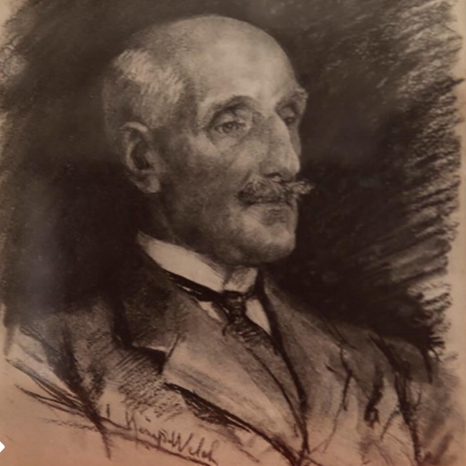
Lucy Kemp-Welch is one of our finest equine artists and her work much sought after by both collectors and horse lovers. She was refused permission to travel to the battle fields of WW1 but such was her determination she found other ways to become a self imposed unofficial war artist.

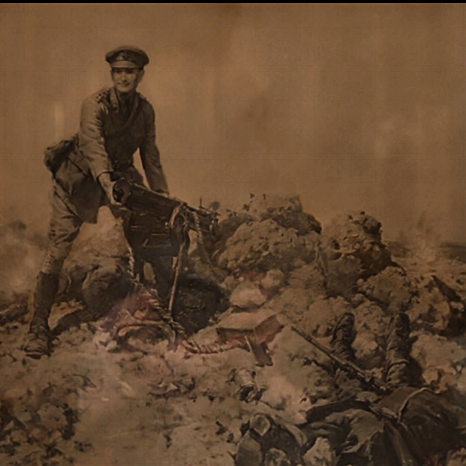
One of her most moving tributes to the brave men that fell in action was to honour the deeds of Captain Elidyr Herbert Victoria Cross who fell in action on 12th November 1917. He was described by one of his men as ‘one of the most popular officers in the brigade’, who was ‘sincerely mourned’. Captain Herbert was buried in Gaza City military cemetery. His headstone bears Latin inscriptions meaning ‘The inn of a pilgrim travelling to Jerusalem’ and ‘Eternal rest grant unto him oh Lord’.

His death was widely mourned in Monmouthshire and in 1923 tenants from the Herbert Estates presented his parents, Lord and Lady Treowen with a painting by Lucy Kemp-Welch showing Captain Herbert with the Turkish machine gun. His family gave over part of the Llanover estate for a ‘garden settlement’, Tre Elidyr, in memory of their son and the 17 other men connected with the estate who lost their lives in the Great War.

So Tre Elidyr was built in 1925 with Llanover Primary School at its heart.

Captain Herbert was the son of Sir Ivor Herbert, who had recently been elevated to the Peerage as Lord Treowen. Until joining the House of Lords he had been Liberal MP for South Monmouthshire and, as Lord Lieutenant of Monmouthshire, had been responsible for recruiting throughout the county at the start of the war. He later became director of recruiting for the whole of Wales.

Elidyr was born in 1881. He went to King’s College, Cambridge, graduating in 1902. After qualifying as a solicitor he returned to Monmouthshire, living with his parents at Llanarth Court. He served as a Justice of the Peace and became a County Councillor.

In 1913 he joined the Royal Gloucestershire Hussars (RGH), part of the Territorial Force. When war broke out in 1914, as a 2nd Lieutenant, he summoned the Monmouthshire Squadron of the RGH to Llanover for mobilisation.

In April 1915 the RGH were sent to Egypt and subsequently to Gallipoli, landing at Suvla Bay, where he served as machine gun officer. They remained in Gallipoli until the campaign was abandoned in November and suffered heavy losses. After a brief spell in Egypt, where Lieutenant Herbert was promoted to Captain, he was sent with the RGH to the Sinai Desert and thence into Palestine.

As the British forces advanced through Palestine towards Jerusalem, they met fierce resistance from Turkish troops

Third Battle of Gaza which was part of the Sinai and Palestine campaign. Here the Egyptian Expeditionary Force (EEF) pursued the Turks and their allies through Southern Palestine and eventually captured Jerusalem a month later.

By November 1917, Elidyr Herbert saw action at about nine miles north-east of Gaza where he would show great bravery but which was to prove fateful for him.

The Charge at Huj (8 November 1917), saw the forces of the EEF made up of British and Australian forces, face the Ottoman Turkish Empire’s Yildirim Army Group.

The charge was carried out by units of the 5th Mounted Brigade, against a German, Austrian and Turkish artillery and infantry. The attack was successful and the British captured the position, seventy prisoners, eleven pieces of artillery and four machine guns. But the British suffered heavy casualties. Of the 170 men taking part, twenty-six were killed and forty wounded. They also had 100 horses killed. One can not help wondering if the fact that it was a mounted brigade and that so many horses we lost would have influenced Lucy Kemp-Welch to take on this commission .

One of the few officers to escape uninjured was Lieutenant Mercer of the Worcestershire Yeomanry. He described the charge:

“Machine guns and rifles opened up on us the moment we topped the rise behind which we had formed up. I remember thinking that the sound of crackling bullets was just like hailstorm on an iron-roofed building, so you may guess what the fusillade was....A whole heap of men and horses went down twenty or thirty yards from the muzzles of the guns. The squadron broke into a few scattered horsemen at the guns and seemed to melt away completely. For a time I, at any rate, had the impression that I was the only man left alive. I was amazed to discover we were the victors”.

The action is claimed to be one of the last British cavalry charges and was pictured in a watercolour painting by the British artist by Elizabeth Southerden Thompson.

After a Turkish counter attack had been repelled Captain Herbert, noticing that the Turks were regrouping and preparing to attack again, rushed forward ahead of his men to grab an abandoned Turkish machine gun and turn it on the enemy. It is this act of bravery that Kemp-Welch captures in her finished oil painting . We currently have the preliminary charcoal drawing for this oil and it if for sale here in Hertfordshire with Blondes Fine Art.

Charcoal drawing for oil painting available for sale . Please ask for details.

Charcoal drawing for oil painting available for sale . Please ask for details.

In the war diary of the Warwickshire Yeomanry, Elidyr Herbert is mentioned, as “a captain of the Gloucester Hussars [who] had arrived on the scene [where the Warwickshires were pinned down] and used one of the four captured machine-guns to cause havoc amongst the Turkish infantry”.


Robert Colquhoun - Art at Tilty Mill, Essex.

Robert Colquhoun was part of the Bohemian group of artists, many of whom where gay, living in the Fitzrovia area of central  London during and immediately after the war. He and his partner Robert MacBryde, were friends with Minton, Bacon, Vaughan, Sutherland, Adler, Wirth-Miller and many more who frequented the pubs and drinking clubs of Soho at that time. There are many recorded tales about the drinking antics of "The Two Roberts" who Colquhoun and MacBryde became known, so it is all the more amazing that they were employed as surrogate parents for 4 children living in Tilty Mill in Essex during the early 50's.

Colquhoun's friendship group in London included many writers such and Dylan Thomas , George Barker and his lover Elizabeth Smart and it was the later who decided that it would be a good idea to have " The Two Roberts" take care of her children . In 1947 she began living at Tilty Mill which is located near Great Dunmow and her role as features editor on House & Garden magazine was taking her away from home so after employing a number of house keepers came to an agreement with the Roberts that they would become Surrogate parents.

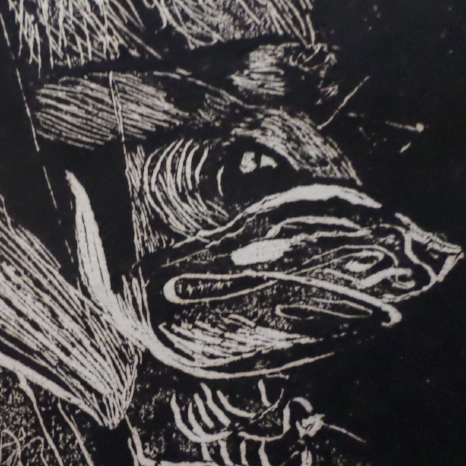
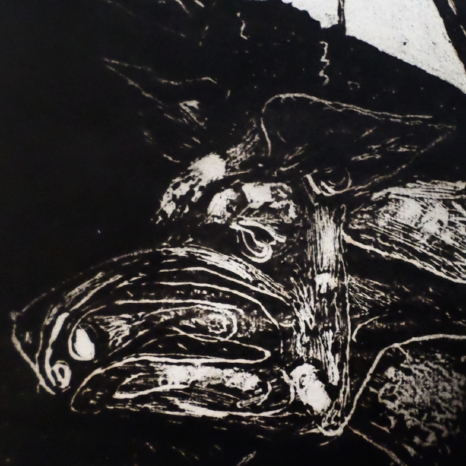
This unlikely role seems to have worked well for all and the children had great fun with the Roberts only being admonished a couple of times for their drunken exploits and all settled into a domestic routine. Both of the Roberts were poor at this point in time and Colquhoun produced few paintings at this time preferring to work on monotypes and offset drawings as both were less demanding in terms of materials , cost and time. The subject matter for this body of work was taken directly from the rural surroundings and many have a farming theme depicting horses and particular pigs as the farm was in close proximity to a pig farm and to a gypsy camp.

In 1953 Colquhoun produced a most impressive painting for the Contemporary Art Society exhibition titled  Figures in their setting. It was to be the biggest and most accomplished work that Robert Colquhoun was to produce and measured 185 x 143 cm  titled Figures in a Farmyard and is set in the courtyard at Tilty Mill.

SAM_2318.JPG

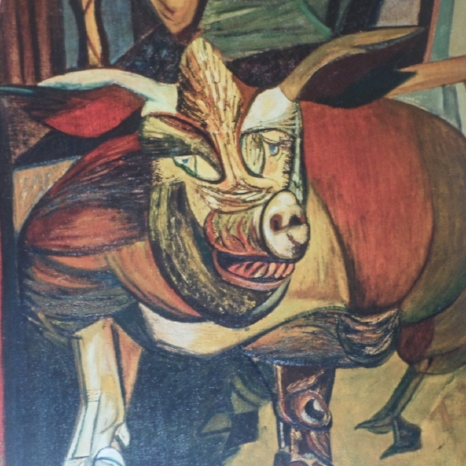
As can been seen from the image above the painting depicts three subjects , a young girl with a long plait ; a seated man holding a stick and a grotesque pig depicted in a more formalised way. The pig is stialised in an expressive Cubist way which emphasises the aggressive sinister hostility. It is not only the influences of Picasso and Cubism that can be seen here but also those of the German Expressionist Max Beckmann and Francis Bacon.

The collection of Robert Colquhoun's work available here at Blondes Fine Art , in Hertfordshire are all from the same period and two of the monoprints we have most notably provide an insight as to where the origins of the pig, in this large exhibition oil comes from . Two of the work from 1952 shown below are  clearly similar to the final image in the 1954 oil.

In 1954 some 38 works were exhibited at the Redfern gallery which was the only major show of Colquhouns work during the Tilty Mill period. A few works were also included in the 1958 retrospective at the Whitecapel Gallery which suggests that many of the ones in the earlier exhibition did sell. However, in recent times there have been a appearance of a few more works from local Essex farmers and shopkeepers placing them up for sale which seems to indicate that they may well have been produced by Colquhoun as a form of currency to pay for food and alcohol when living in Tilty Mill.

The collection for sale here at Blondes Fine Art , located just 20 miles away from Tilty Mill are from the private collection of Sir Colin Anderson  and are all in unframed excellent condition. Please do enquire for further details .


Walter Hoyle, John Aldridge , Great Bardfield and Cow Parsley.

Walter Hoyle Gouache painting for sale

Walter Hoyle was a prominent member of the artist community of Great Bardfield , Essex and whilst he is perhaps most well known for his printing and teaching there is no doubt that his original work is of the highest quality, quite rare and much sought after. He studied at the RCA where he first met Edward Bawden and they clearly had a great deal of respect and admiration for each other and their respective work. Bawden invited Walter Hoyle to help him with a mural for the Festival of Britain and in 1951 they went on a painting holiday together in Sicily. The watercolours and gouache's that Hoyle produced on this trip are particularly good and some are held in the Fry Gallery collection in Saffron Walden and another fine example was in the Cambridge County Council art collection until sold in May 2017 at Cheffins auctions, where it realised £2,400 with commissions. So these rare works are not only hard to find but command a reasonable market value.

Clearly Bawden influenced Walter Hoyle but so did John Aldridge, who was the most traditional style painter of the village artists, painting landscapes which had a similarity to those of Stanley Spencer. He was often to be seen with his portable easel around the village and in his garden. Indeed the wonderful landscape that we have here at Blondes Fine Art depicting 'The Moors' at Great Bardfield, was one of his best known and iconic work which featured in a centre spread of the July edition of Modern Artist in 1955. (see below - top left.)

John Aldridge artist painting for sale

John Aldridge's garden was much admired by many of the residents as he was a keen and knowledgeable horticulturist who was described by his friend , the poet John Betjeman  as 'the gardeners artist'. Aldridge had some wonderful plant specimens which included the Giant Hogweed and it was this bi-annual along with its smaller cousin of the same family - Cow Parsley - that became somewhat emblematic of the Bardfield artists and appear in many images and gardens. 

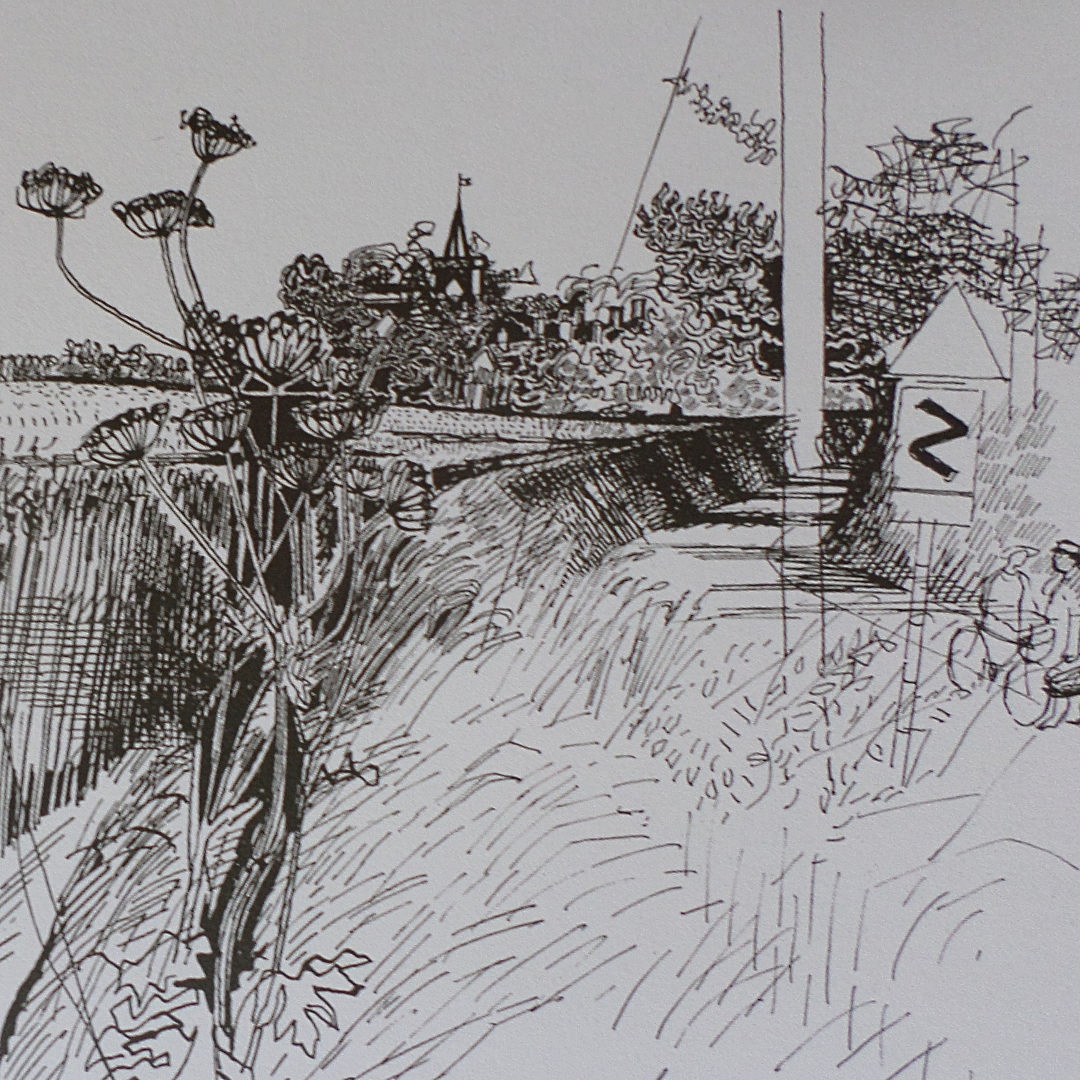
Walter Hoyle was particularly fond of these plants and at certain times of the year they covered the roadside verges in the Essex villages. He depicts them in many of his work and the image at the top of this page is a great example that has only recently come to light,  it has Cow Parsley in the foreground of this lovely gouache depicting an Essex Barn. Signed lower right it would be a great addition to any collection. Please do contact us for more information should you be interested in acquiring the work.

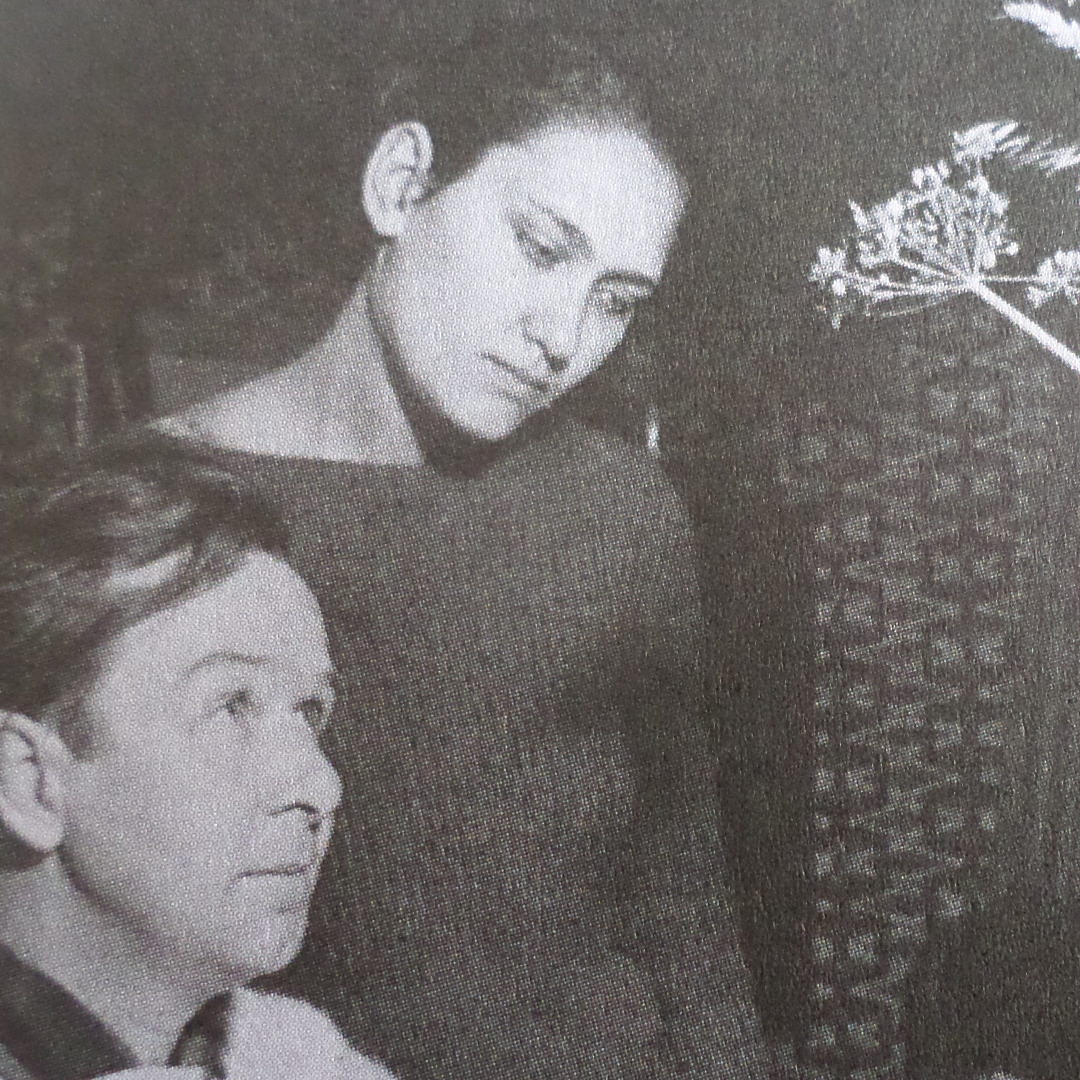
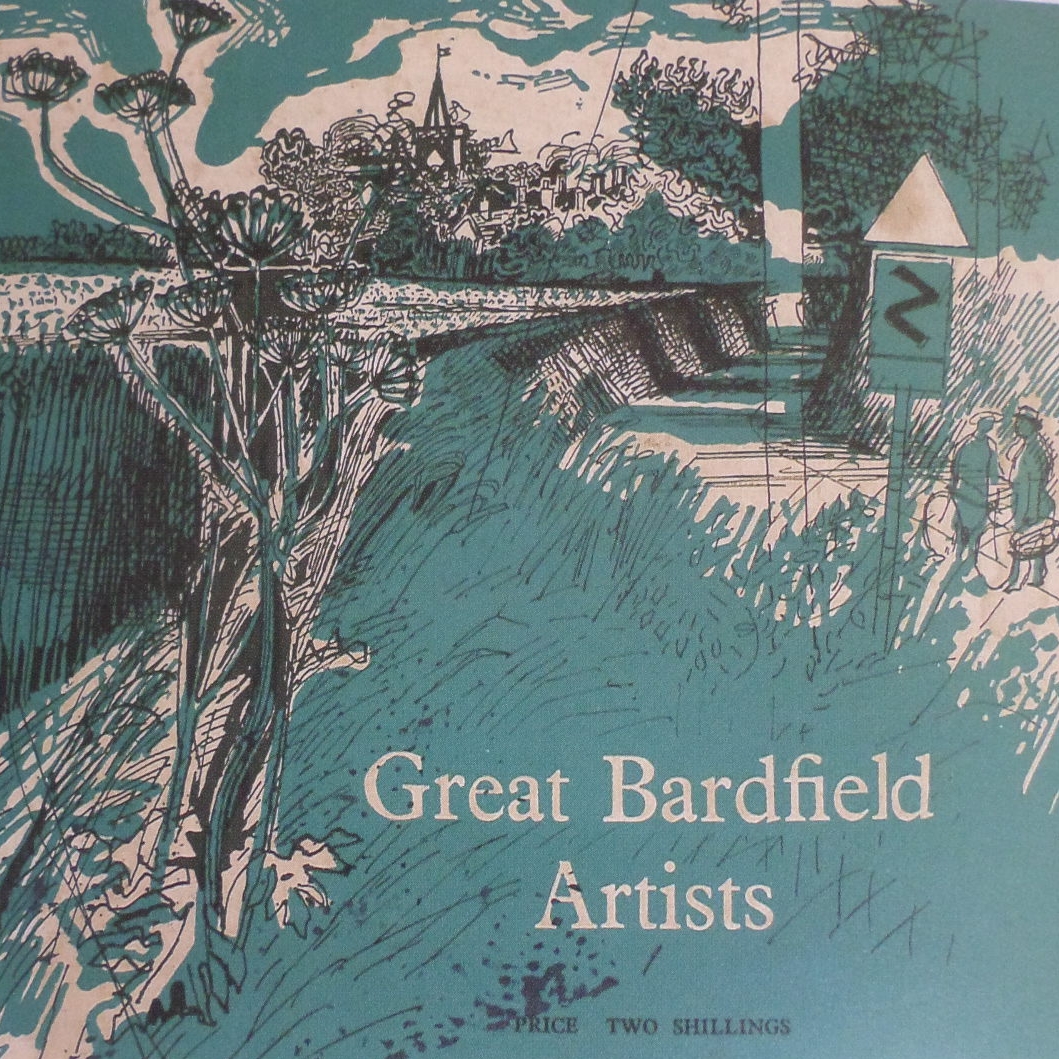
The three other images of Cow Parsley that spring to mind when talking about Walter Hoyle are the ones shown below and the first depicts a pen and ink called 'The road to Finchingfield' which is held by the Fry Gallery . The second is a photograph of Walter Hoyle and his wife Denise which depicts him sketching a vase of dried flowers with the foremost plant being Cow Parsley.  Finally , there is the distinctive blue cover for the catalogue produced by Hoyle for the 1957/58 national tour of the Great Bardfield Artists exhibition and yes, you guessed it, the image is a reproduction of the pen and ink ' The road to Finchingfield'. 

So this little plant, often considered a weed, held a special place in the hearts of the Bardfield artists , especially Walter Hoyle, and it can be spotted in many other works. It has a wonderful texture, creamy colour and an architectural structure that lends itself to the design work and muralists of the Modern British period. So this Spring, when you are out in the countryside, stop for a moment and consider its beauty and if it suddenly appears in your garden give it a chance and let it flourish like John Aldridge and Walter Hoyle did back in the 1950's.

Please do contact us if you are thinking of buying or indeed selling work by the Great Bardfield Artists , particularly Walter Hoyle , John Aldridge and Sheila Robinson.

Enjoy Spring 2018 - it is just round the corner!


Harry Becker - Hertfordshire, Horses & Hardship

It was the period that Harry Becker spent at the Bushey School of Art in Hertfordshire, under the guidance of painter Hubert von Herkomer, that seems to have reinforced Becker's interest in social realism, the downtrodden farmer labouring underclasses and his ability as an equine artist.

Harry Becker trained at some of the best establishments in Paris and Antwerp where he was first exposed to painting scenes of manual farm labour on Dutch farms and to the techniques of 'belle peinture'  and 'plein air' by Carolus-Duran. But it was back in Hertfordshire that these skills were further developed ready to be honed out in the fields. Hertfordshire introduced Becker to two significant women painters , the first was Lucy Kemp-Welch who is one of our favourites here at Blondes Fine Art and is considered to be one of our finest equine artists. The other was Georgina Waddington who was also a talented artist and fell in love with Harry Becker, marrying in 1902 at the age of 35 years. So clearly Hertfordshire had a significant role in the life of Becker.

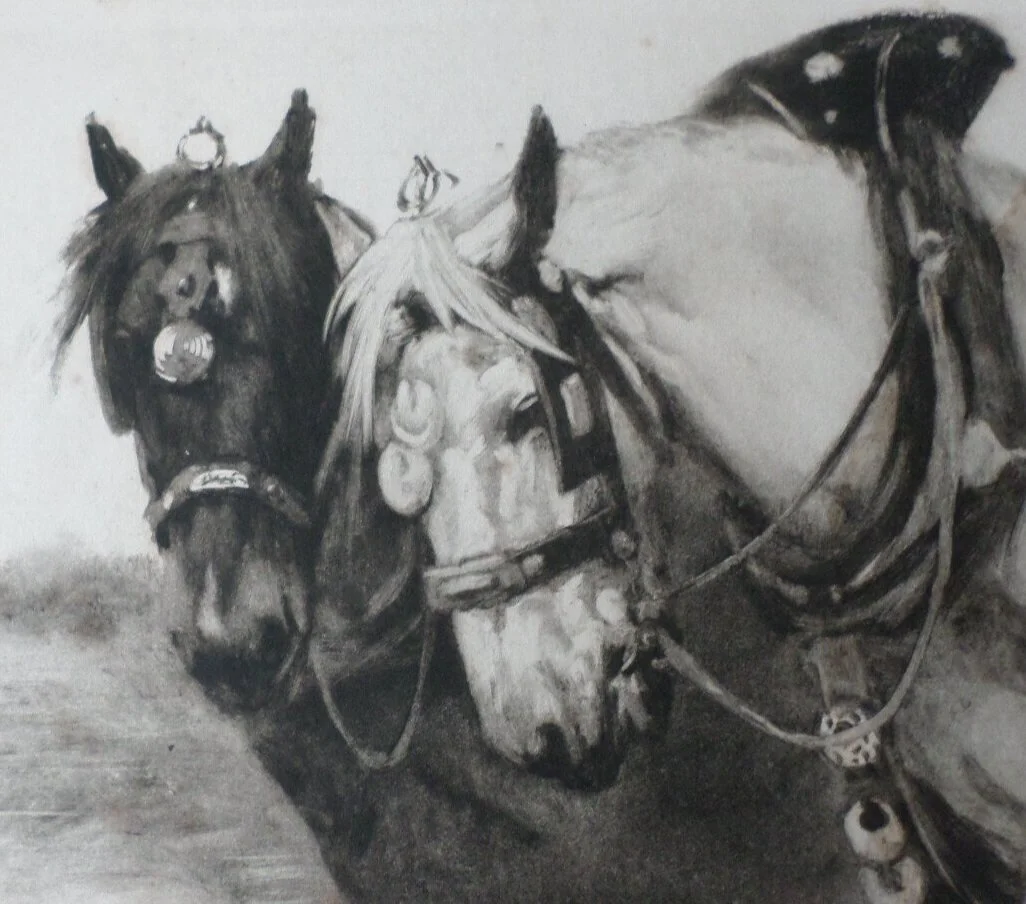
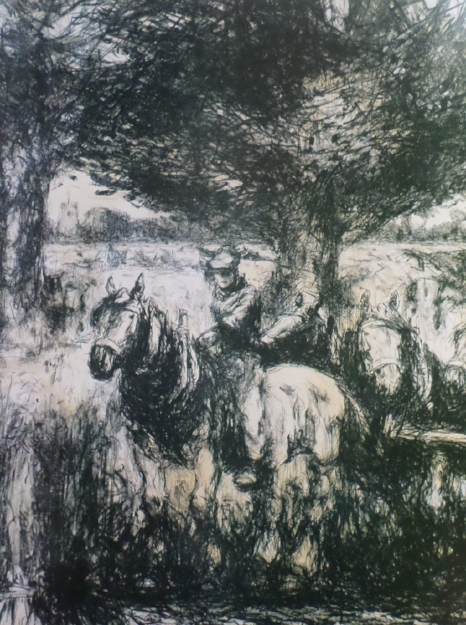
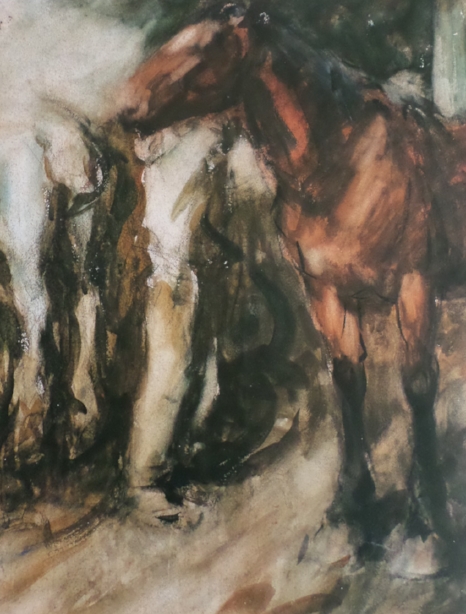
His love of animals became a growing part of his artistic portfolio as he painted the working dray horses and bus horses in West London near his home. He lived close by  the stables for the bus horses and produced a series of paintings in body colour on paper of a particular pair of horses, a grey and bay being groomed and cared for in the stable. These are illustrated on pages 62 -65 of the book 'Becker' by David Thompson and we are particularly proud to have the one shown below in our personal collection of work by Harry Becker together with the huge (40 x 48") lithograph depicting 'The Binder Team'. Also shown below.

Becker is without question a fine artist whose ability to depict working horses is in line with those skills of Luck Kemp-Welch,  but where his experiences differ are in his personal knowledge of hardship. Becker turned his back on London and the capitals art scene in favour of his native East Anglia. During the first world war times were hard , particularly for those working the land in Suffolk. Women , while the men were away, took to the land from about 1915 and Becker was there working in the fields with them depicting their contribution. Becker was commissioned to produce posters shown on the London underground that encouraged travel to the countryside and to work on the land. It is also slightly ironic that his suspicious sketching at the edge of fields resulted in him being arrested on more than one occasion only to be released when they realised that he was not a German spy.

Becker lived in poverty together with the farm workers and was very much accepted as one of their own. His depiction of rural Suffolk in the period from 1912 - 1928 is a unique record of the landscape, animals and farming folk who endured great hardship to just scrape a livelihood and his status as an outstanding artist continues to grow. We are great fans of his work and currently have a number of outstanding oils and watercolours available for sale so do please contact us to arrange to view or just to chat Becker!

Mark Ponting - Blondes Fine Art

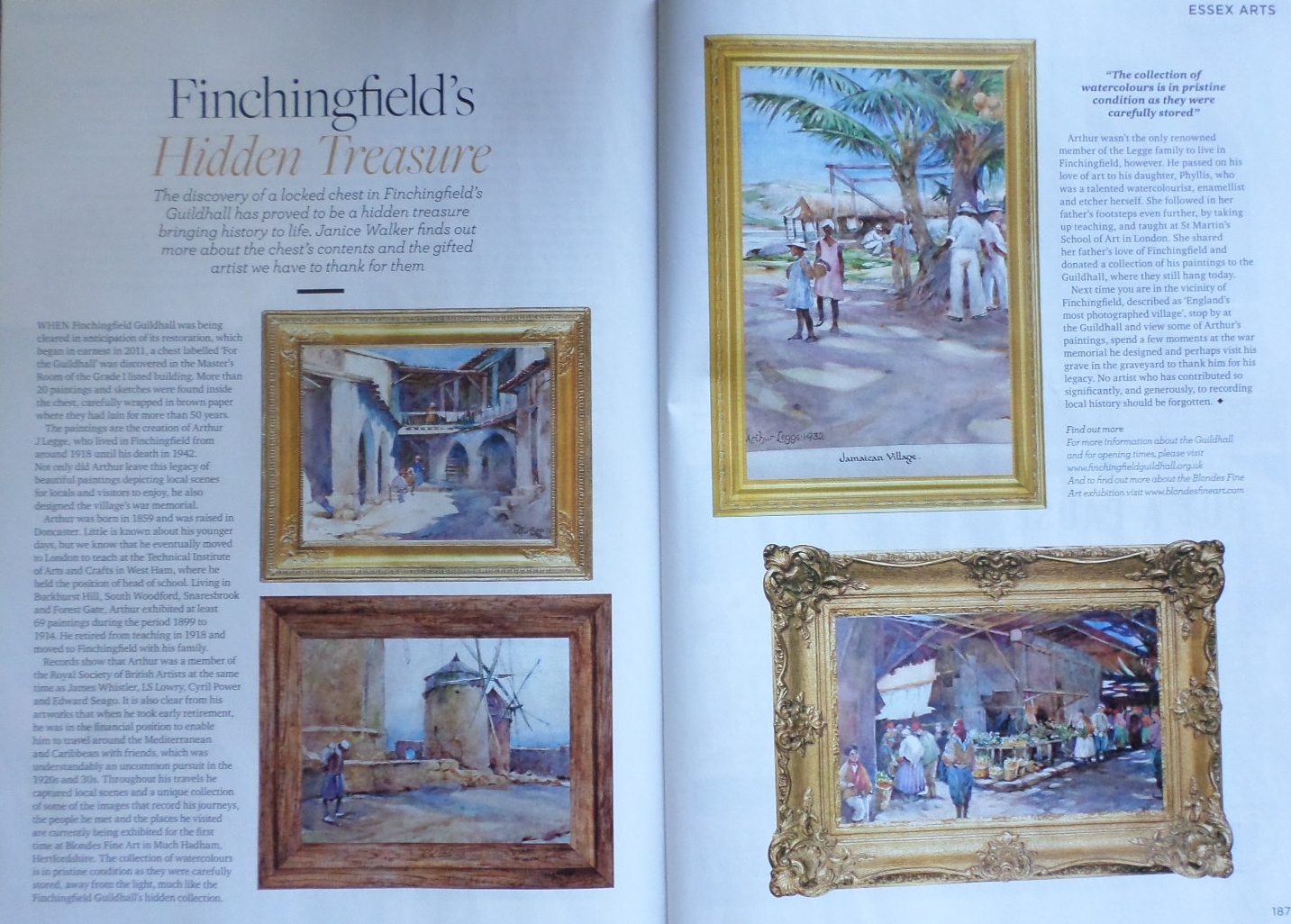
Arthur Legge - Finchingfield's Hidden Treasure

We are delighted to have been featured in this months - January 2018 - edition of Essex Life , who have focused on our collection of work by Arthur Legge.

We currently have a large collection of his work for sale and Essex Life have featured his links to his home town of Finchingfield in Essex.

Pick up a copy today or just click HERE to visit the Arthur Legge collection 


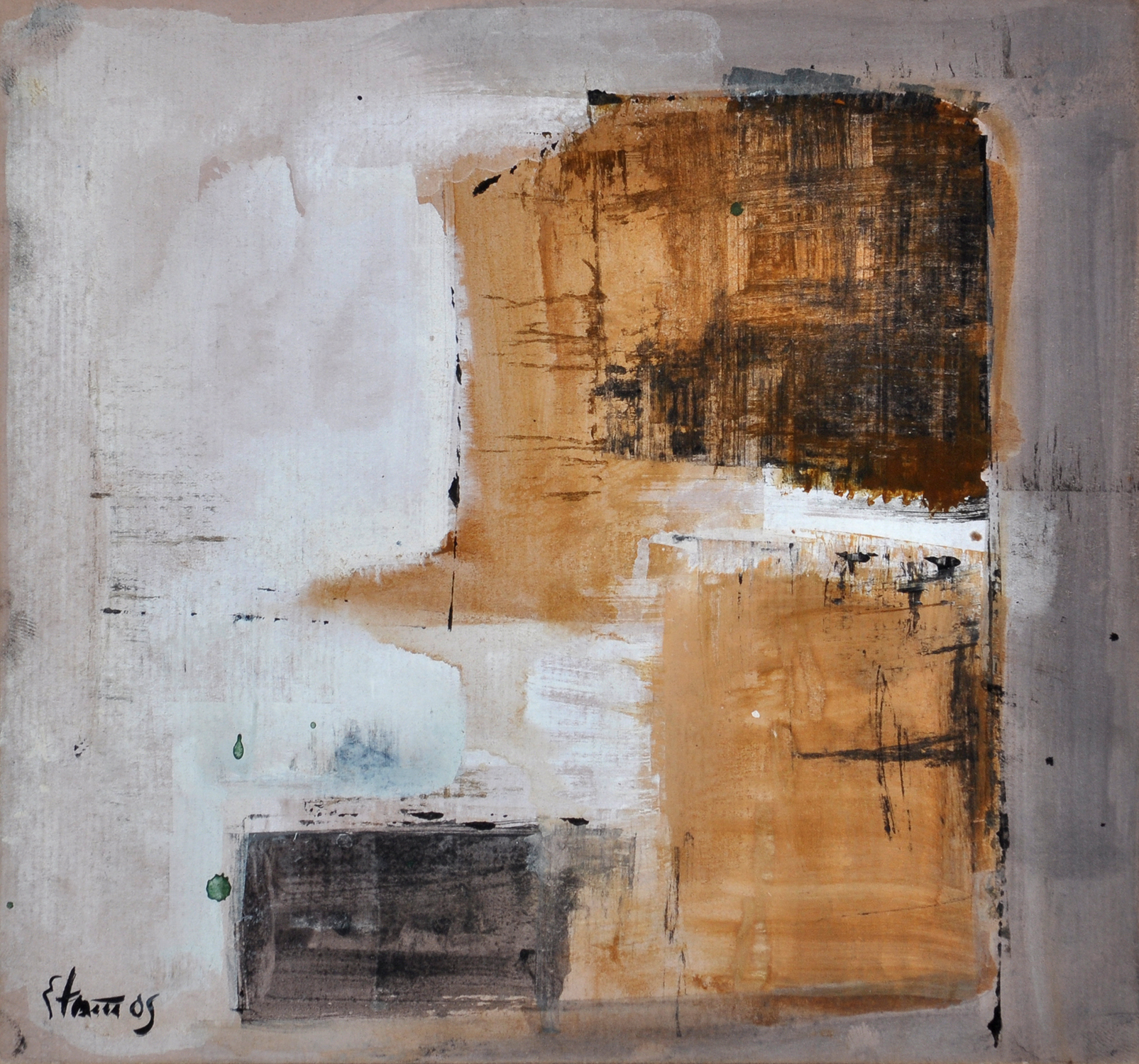
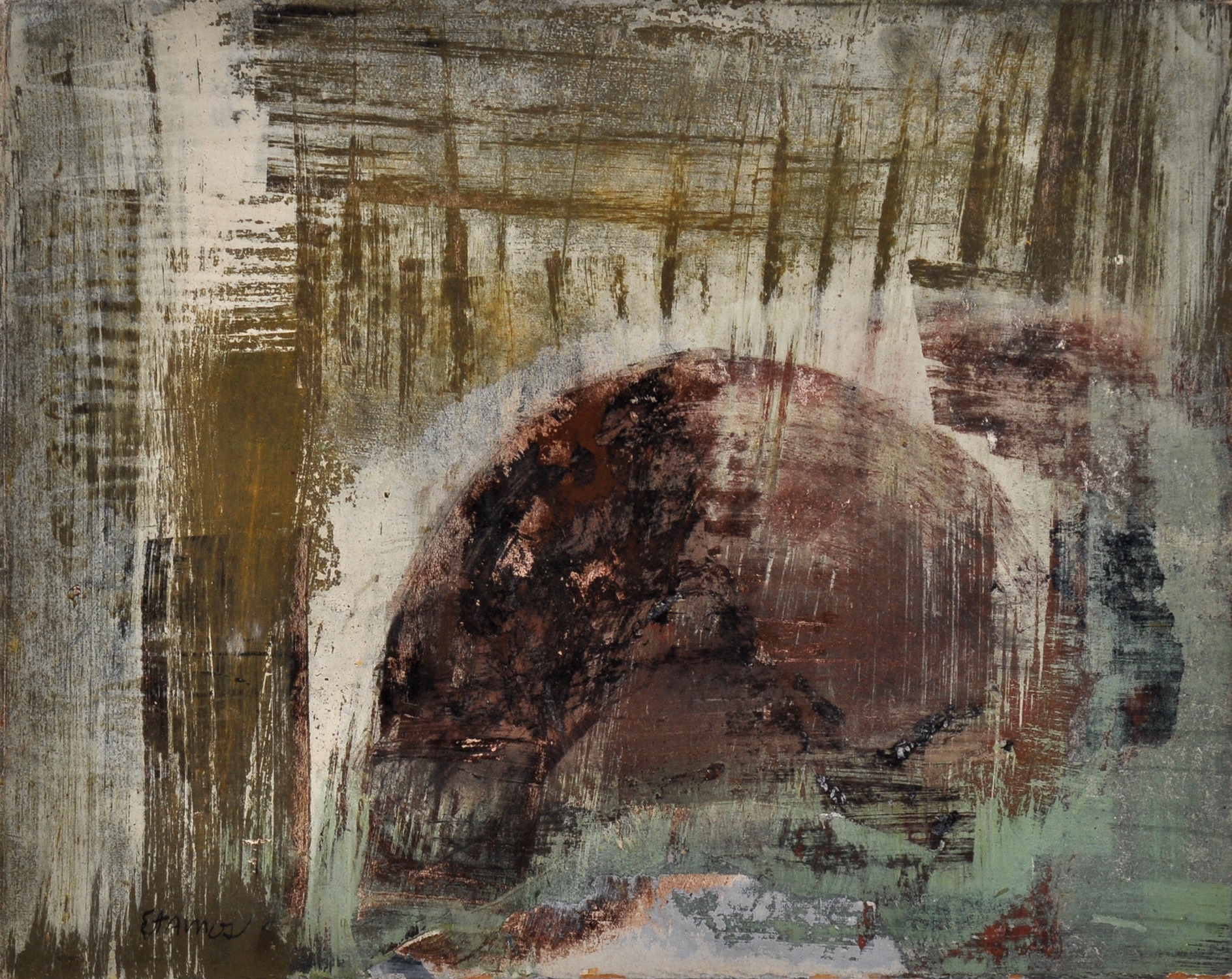
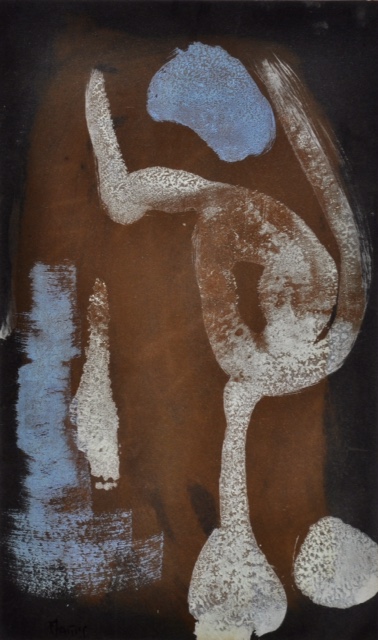
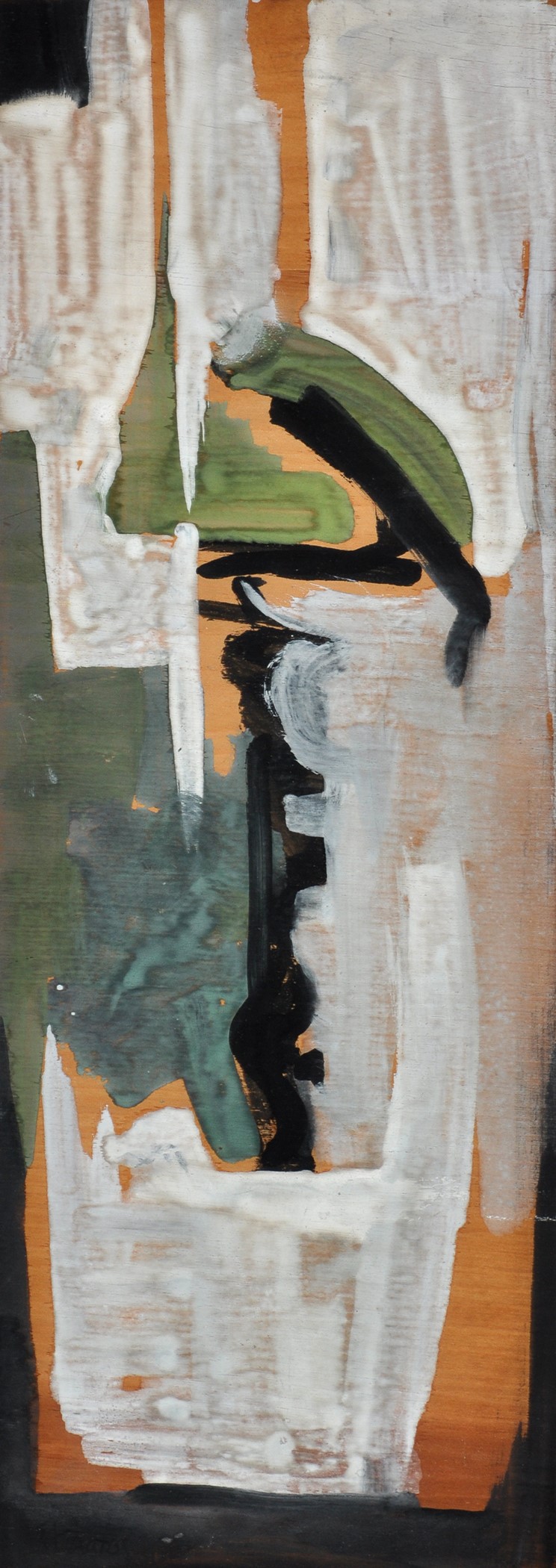
Theodoros Stamos work for sale

Theodoros Stamos - the early years.

Theodoros Stamos was always interested in the effects achieved directly with colour, texture and abstract composition. He first experimented with Surrealism and the biomorphic forms that so interested Gottlieb, Baziotes and Rothko; then with just as much exuberance he went on in the fifties to immerse himself in Abstract Expressionism - and all of this was done at an age when most artists are still just leaving collage.

Theodoros Stamos was New Yorker , born and bred. He was born of Greek parents on East Eighteen Street in 1922 and lived in the city for most of his life. His parents had no artistic background and it was a photograph of a work by Jacob Epstein - one of his monsters- Stamos recalls copying onto a portable child's blackboard that is his first recollection of any artistic tendency at the age of about 8 years. Six years later at the age of 14 years he won a scholarship to attend the American Artists School where he was encouraged by Joe Soloman, who was part of a group known as "The Ten" which included Rothko, Gottlieb and Louis Schanker. Soloman also introduced him to the work of Arthur Dove and there is little doubt that his work from the 1930's influenced Stamos's work of the early 1940's. In addition he saw, and was influenced by the work of Paul Klee and Milton Avery.

Incredibly, Stamos held his first one man show when he was jut 20 years of age. In 1943 at the Wakefield Gallery run at the time by Betty Parsons, and when she moved on to become director of the Mortimer Brandt Gallery contemporary section she put on another show for Stamos in 1945. So, she was clearly a fan of his work and it is of little surprise that when she set up her own gallery in 1947 Theodoros Stamos was one of the first exhibitions. It is perhaps interesting to note that Barnett Newman was also one of the string of artists attached to the new gallery as was Hedda Sterne, Hofmann, Still and many others. Many of the artists employed similar styles and imagery which originated from nature and particularly the sea and it was a leading critic of the time , Lawrence Alloway, who gave these painters a collective name of Biomorphic Painters.

It was for the first show of Stamos that Barnett Newman wrote the following by way of introducing his work to the New York art world.

"The work of Theodoros Stamos, subtle and sensuous as it is, reveals an attitude toward nature that is closer to true communion. His ideographs capture the moment of totemic affinity with the rock and the mushroom, the crayfish and the seaweed.......one might say that instead of going to the rock he comes out of it...........
Stamos is able therefore, to catch not only the glow of an object in all its splendour but its inner life and all its dramatic implications of terror and mystery . In doing so he makes clear the important difference between the sense of nature and the act of worship."

After his 1947 exhibition he travelled to Europe and visited France , Italy and Greece. We, here at Blondes Fine Art in Hertfordshire , England, have two pieces by Stamos from this period that are currently offered for sale. Both are in excellent condition and come from a private European collection  originally purchased from Turske Fine Art in Zurich. Both work are clearly signed and one tiled and dated. The two other pieces available are a little later, one from 1949 a Y Band series work , where he utilises abstract Y-like bands to create a powerful composition using transparent and iridescent metallic paints. This painting is almost calligraphic in quality and similar to a number of works produced by Stamos during this period of the late 1940's. Finally,  we have a lovely work on board which is influenced by his interest in the oriental although undated it is from the early 1950's and similar stylistically to a number of his Teahouse series of works.

Please do contact us for more information about the available works.