Eduardo Paolozzi plasterwork for sale
Read moreArtist Eduardo Paolozzi and his Essex roots!
Eduardo Paolozzi is quite rightly considered to be one of Scotland's greatest artists as he was born and bred there, to Italian parents who ran an ice cream shop. However , after studies at Edinburgh Collage of Art he moved to the Slade school of art where he met two key people who changed the course of the art world for ever. It was his friendship with William Turnbull and particularly Nigel Henderson that led to the formation of the Independent Group who shared a modernist vision and embraced mass culture.
Paolozzi studied around the globe but when he came to settle down where did he choose? Yes, Essex of course.
In 1954 he moved there with his wife Freda and travelled to London to teach and work. They lived in a row of cottages at Landermere Quay which is a tiny smugglers haven on the coast of Essex near the village of Thorpe-le-Soken in the Essex marshes. The Hendersons bought the smugglers pub the Kings Head and the cottages called Gull cottages and the rest is history as between them Henderson and Paolozzi formed Hammer Prints and ran the venture from the pub . Sounds like a great plan to me......... See image of the building today.
So there we have it another bit of easily overlooked art history which makes Eduardo Paolozzi one of Essex's greatest artists!
Another interesting art fact is that living in the same cottages at the same time was Basil Spence later to be knighted as he was the architect who built Coventry Cathedral and the etched windows were designed and made by John Hutton another great artist who lived- Yes, you guessed it- in the same line of cottages. Small world isn't it!

It always seems strange to me that the most modern art of the popular culture was actually rooted in the remote Essex countryside but that was just out of necessity as the property prices made the area affordable and is the reason why such greats as John Armstrong, Bawden, The Two Roberts and countless other great artists settled in Essex particularly in the post war period.
So forget your preconceived ideas of Essex and embrace its wonderful Art heritage as it gave us Eduardo Paolozzi !
We here at Blondes Fine Art, located on the borders of Essex and Hertfordshire, currently have a number of works by Eduardo Paolozzi for sale and have just acquired a lovely collection of plaster maquette's from the studio of the Artist. Keep an eye on the website as they will be added soon.
Mark & Mel
Arthur J Legge RBA British Watercolours for sale

Arthur Legge was a local Essex based artist about whom I knew nothing until quite recently. We recently acquired the most original portfolio of his work which had been kept in darkened conditions to the extent that when we viewed the work it looked like they could have been painted last week. It was at this point that the old "detective" in me decided that Arthur Legge and his watercolours were just to good to go forgotten to the rest of the world and I decided to do some research . Where do you start ? Google , of course.
I was however surprised that there was little information other than a few auction records that showed that his work had been sold in the London rooms for £600-£700 for smaller works and a larger piece at £1800. So clearly he was a fine artist and a member of the RBA who appears to have exhibited regularly in the early part of the 1900's. So how has he been forgotten ? I guess that fact that British watercolours have gone out of favour and are only know starting to see an increase in interest does account for some of the reason but actually I really cannot explain it other than to say he appears to have been a reserved chap, a family man with a wife and daughters who had financial means and enjoyed travelling the world in his later life.
In his working life he lived in South Essex and East London , teaching art in the Art School and exhibiting his work on a regular basis in London. No dramas, no high life , no scandal and then a retirement to Finchingfield in North Essex with his wife and daughters in 1918 having purchased a house there some ten years previous. It was whilst researching him on the internet that I found an entry about a collection of his watercolours that had been found in a trunk when the Guildhall was renovated some ten years ago and decided to contact the community to find out more.
Finchingfield is close to Great Bardfield , which as most will know is famous for its artist community so I was even more surprised that I had not heard of this local artist before, particularly as he painted the Windmill in Bardfield and local rural farming scenes in a similar fashion and time to Harry Becker - another of our favourites here at Blondes.
After a few emails I made arrangements to see Dez Fahy at the Guildhall who agreed to show me the work they had in the Guildhall collection. None was framed and many rolled so I was concerned about there condition but I need not have been as they were in superb condition and the fact that they had not been displayed meant the colours were strong . The subjects varied from local scenes, portraits of his daughter and rural farm labouring activity but all were accomplished and completed by an artist who should be much better known. So having seen these watercolours and showed mine to Des and the others there to assist, I was then given more information than I had expected as they had done research on the Legge family and told me the following information.
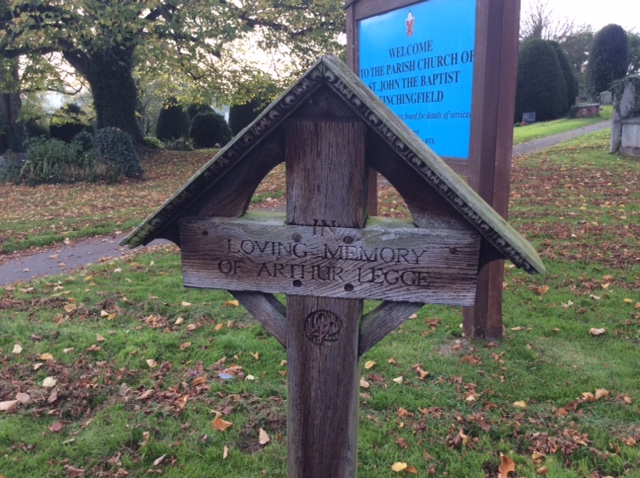
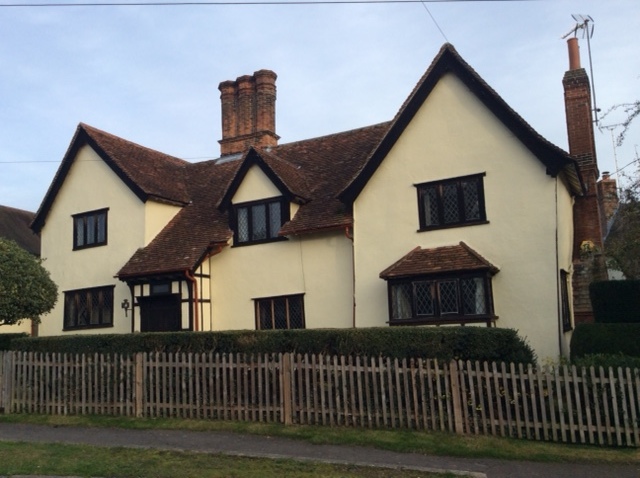
Arthur Legge was born in 1859 and died 1942 he lived with his family in a large house at the rear of the churchyard called Cabbaches , a fine medieval house. He was buried in the graveyard in Finchingfield church but before he died designed the war memorial in the village. It appears from talking to those that knew one of his daughters that he also carved some stunning work which is still in his house together with panelling that he purchased from another local house when being converted into a butchers shop. Indeed the records of the house purchase , for the sum of £200, still exist as do the family tree that shows his wife was originally from Steeple Bumpstead and that one of is daughters married a local farmer and his relatives still farm land between Great Bardfield and Finchingfield.
So I am most grateful to the Finchingfield community for sharing this information and feel that it is necessary to find out a little more about this very good artist. What I still do not know is anything about his travels. How and why did he travel abroad in the 1920/30s and can anone out there help fill in some gaps? In a effort to find out more I went home via "Between the lines" the book shop in Great Bardfield to have a coffee with the village sage and author, Janet Dyson who also knew little about the artist. So there it will stay for the moment and should anything else come to light I will be sure to post another blog .
Please, please do spend a moment looking at the 30 plus watercolours that we have posted as an on line exhibition . They are all for sale and are of locations around the world that we would think nothing of travelling to on holiday today but in the 1920's this must have been an unusual and expensive event - No Ryan Air back then!
They are great value for money so treat yourself for Christmas and bring back those summer holiday memories by purchasing a watercolour by Arthur Legge.
John Thompson - Northern Artist - For Sale
I really have neglected the blog and this lazy Sunday with an extra hour gained by the clock change seems like the best day to start to make amends. We can always find reasons and excuses such as working in Germany and Portugal recently in my case, but actually I have missed the time to "chat art". So after much deliberation I have decided to go back to my childhood roots for the first of what I hope can be more regular blogs in the run up to Christmas. To start us off this one is about the Northern artist John Thompson.
John Thompson was born in Oldham and is essentially self-taught save for a few years studies of life drawing classes , John Thompson painted groups of figures, cloth capped and anonymous, that loom, loiter and cannot stop reminding you of Lowry. He is quite rightly compared to other, better known northern artists such as Theodore Major, Harold Riley and the man himself, L. S. Lowry. This recognition took time to develop, but in the last 7 years of his life John enjoyed enormous success.
I am myself a Lancashire lad having been born in Morecambe before slowly migrating south with my fathers job, so it is not a real surprise that I have an affinity with Northern art and John Thompson is one of the best. It was a few years ago in the mid 1990's and on a wet afternoon that we were wandering around a mill in Uppermill which had lots of small areas filled with crafts, antiques and artists and came across John Thompson in a room filled with his paintings. John Thompson was beginning to find some recognition at this time for his very individual work particularly of his “groups of working men”. We left about 3 hours later having talked about painting, the art world and John’s life. We nearly purchased one of his group series and this is still a regret that we did not. I do remember that he even said that he would be happy split the cost into multiple payments on postdated cheques as he said he still liked the idea of receiving a wage from his job. Wish I had agreed!

John Thompson's work is now widely collected both at home and abroad. He has had successful one man shows in Manchester and Dublin and in 2002 three of his paintings were purchased by the House of Lords in London and are now hanging in the Committee Rooms.
A book on his life and work – “Do you like ’em then” was published in March 2006 and he has been the subject of features on Channel 4 and Granada TV.
This recognition, particularly for his group portraits of working men, has taken time to develop, but is thoroughly deserved. The image available now at Blondes Fine Art is in great condition and a sure fire investment for the future, so do contact us for further details .
Harold Septimus Power painting for sale

This Harold Septimus Power oil on canvas is available for sale and is a wonderful example of the artists popular heavy working horses paintings. Please enquire for details.
Harold Septimus Power was not an artist familiar to me until 2015 when I visited the Bushey Museum to view the magnificent work of Lucy Kemp-Welch. At the end of a line of paintings I was taken by a painting of two plough horses which I assumed to be by Miss Kemp-Welch, but when I examined the label it read as follows " The Artist is Harold Septimus Power "Ploughing" This is a print from an old painting by the Australian artist who spent some time in Bushey from 1907." It was from this point that I became interested in this artist and began to find out just how highly regarded he had been.
Harold Septimus Power (1877-1951), artist, was born on 31 December 1877 at Dunedin, New Zealand, son of Peter Power, English-born hatter, and his Scottish wife Jane, née Amers. At the age of 14, Power ran away from home to pursue a career as an artist. He developed a passion for drawing animals, especially horses, and found jobs that involved contact with animals. While working for a carriage painter, he painted studies of animal heads on butcher's delivery vans, and later on he worked as a veterinarian's assistant.
After some art training in Melbourne he exhibited in 1899 with the Melbourne Art Club, winning both animal and landscape sections. Soon after, he moved to Adelaide where he worked as an illustrator for the Observer, the Register, the Critic and other papers he also painted in the Adelaide hills with Hans Heysen. In 1904 he was the first Australian artist to be commissioned by the trustees of the National Art Gallery of South Australia to paint an animal picture ('After the day's toil') for 100 guineas. On 17 September he married Isabel Laura Butterworth (d.1935).
In 1905-07 Power studied at the Académie Julian, Paris, then in 1907 settled in London, becoming a member of the Royal Institute of Painters in Oils and the Society of Animal Painters, and exhibiting at the Royal Academy of Arts. His first one-man exhibition at the Guild Hall, Melbourne, in June 1913 displayed oils and watercolours of rural landscapes, used as backdrops for scenes of equine splendour and hunting which were to remain popular with both the local and international public and critics for the next thirty years. It was here that he exhibited Stag Hunt Exmoor which had been hung in the Royal Academy's exhibition in 1911 and it was purchased by the National gallery of Victoria. Power had another successful exhibition in Adelaide the following year and then returned to England in 1914.
The oil painting on canvas that we have for sale here at Blondes Fine Art in Hertfordshire was purchased direct from the artist by a Hertfordshire collector and it has remained in the family by decent and has never left Hertfordshire , remaining here for the past century . It is signed lower left and in its original artists frame . Although undated it is believed to have been purchased between 1910 and 1915, which is the period when the artist was really making a name from himself in London.
The outbreak of the First World War found Power in England. At the age of thirty-seven he was an established artist who specialised in, but was not limited to, animal subjects, principally horses. He was a competent draughtsman; and though best known for his oil paintings, he could work successfully in watercolour. Executed in the academic tradition with frequent romantic overtones, his work eschewed any modern influences and intellectual qualities. Technically proficient, he could be relied upon to make a picture both pleasing and effecting a “satisfactory realism” (J S MacDonald 1958), well-qualified to enter upon arguably the most significant phase of his career.
From London, Power followed the Australian Imperial Force (AIF) from the disastrous Gallipoli campaign of 1915 to the battlefields of the Western Front during 1916-17. In the early years of the war he completed Anzacs (1915, National Gallery of Victoria) and The enemy in sight (1916, Art Gallery of New South Wales). On 3 September 1917, he was appointed an official war artist by the Australian High Commissioner and attached to the AIF with the honorary rank of lieutenant. He crossed to France, making a second trip in August 1918, in the company of another appointee, Fred Leist, and C.E.W. Bean, Australia’s official war correspondent, and spent his first evening in Hazebrouck huddled with them in the cellar of a house as the Germans bombed the town. The terms of Power’s appointment obliged him to make at least twenty-five sketches for the Commonwealth; he delivered roughly seven more, a gift to the “Australian Nation”, as he explained to the Australian High Commission (letter, 20 November 1918). These sketches are mostly drawings and watercolours and contain only a few small oil pictures. According to Jean Campbell (1983, pg 113), Power’s “vigour and strength” are seen at their best in his war watercolours, for example, Going into action (1917). His skills as an animal painter were also apparent in such paintings as 'The First Divisional Artillery goes into action before Ypres July 31st 1917' which was acclaimed at the Royal Academy in 1919.
Commencing in July 1918, Power was commissioned first by the Commonwealth and later by the Australian War Memorial to paint a number of battle pictures and military scenes depicting significant events in which the AIF and the Australian Light Horse had been involved. This work occupied him throughout the 1920s and late into the 1930s and includes First Australian Division Artillery going into the 3rd Battle of Ypres (1919) and Saving the guns at Robecq (1920), both action paintings focusing on horses and artillery. The battle pictures and scenes are imaginative reconstructions which Power meticulously researched with guidance from Bean to ensure, so far as possible, their historical accuracy.
Power’s several visits to Australia during the 1920s were long enough for him to carry out other official commissions. In 1922, he was commissioned to make a large mural for the Melbourne Public Library, depicting the Eastern and Western Fronts and the finished work, War, comprising three panels with an overall length of 15.2 metres, was installed in 1924. In 1927, the Commonwealth commissioned him to paint a picture of the outside ceremony for the opening of Parliament House, Opening of Federal Parliament at Canberra, 9 May 1927 (1928). Power was also active in art circles, becoming a member of the Australian Watercolour Institute (1926-28) and exhibiting in its first exhibition at Horden’s Gallery in 1924. He was associated with the establishment of the new Melbourne Art Club in 1933; and was a foundation member of the deeply conservative Australian Academy of Art (1937-46).
Throughout the 1930s Power painted steadily and exhibited regularly, sticking closely to his chosen idiom, and this continued during the 1940s. He enjoyed enormous popularity and his work commanded consistently high prices, even during the Depression. Equine and other animal subjects dominate the canvases of these decades with occasional portraits and numerous flower pieces. He held his final exhibition in Melbourne in 1949.
A peculiar form of deafness had afflicted Power from an early age, creating an impediment in his social life. To C.E.W. Bean, the artist presented as shy and intensely nervous, and his heart went out to “this lovable man”. In spite of his disability, Middleton claims that Power was a cheerful man who enjoyed entertaining friends at home, and revelled in telling stories about the experiences in his life.
Power died of cancer in Melbourne on 3 January 1951, aged seventy-three, and was buried in Brighton Cemetery. He was survived by his second wife and two sons, one from each marriage. On his death, Louis McCubbin, a long-time director of the Art Gallery of South Australia, himself an official war artist of the First World War, perhaps accurately summed up Power’s achievement: “His abilities particularly fitted him to be a painter of war subjects such as charging horses… He was outstanding as an animal painter – the most important Australia has produced in this field” (Argus, 4 January 1951). A small retrospective exhibition was held in 1985 at Trevor Bussell Fine Art Gallery, a Sydney suburban gallery. The Australian War Memorial holds by far the largest collection of Power’s works (roughly fifty-four); otherwise he is thinly if widely represented in Australia’s public collections.
Art Wanted ! - Are you selling an Inherited or your own Art collection?
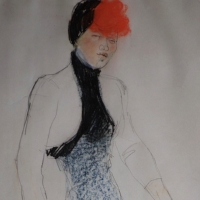
Here at Blondes Fine Art we have recently helped some friends and clients' families to achieve the best value for art work they wanted to sell. Shown above are just 3 examples of work that we have purchased from private clients in the past 4 weeks. So why did they trust us to give them the highest price possible?
People sell collections for many reasons , a change of circumstances, to fund a new life adventure or perhaps you have the difficult role of distributing the wealth of a loved ones estate.
So are you thinking of selling up and sailing around the world ? What if you've suddenly become a collector not quite by choice? Maybe one day you get a call: a loved one has died and left you with their beloved painting, or a whole house full of art. What next?
If it is the latter then one of the first steps, of course, is to decide whether or not you want to keep it. Do you like the paintings or sculptures? Do you dislike the work, but love the family history tied to it? Do you like the work, but have a feeling it could be really valuable and, honestly, would rather have the money to buy something else. Do you not really have an opinion on the work, but think it may have value for a museum, art school, or historian? If you've thought it over and settled on any of the options that lead to disposing of the work, read on.
Of course, a solicitor will be involved and they usually have a close working relationship with auction houses and will advise that the best course of action, for you to get fair value for the items, is to consign to auction. But is it ? The decision is for the individual but before you take this advice perhaps you should know the facts.
It might help to begin with, to create a catalogue of the works. This can be done by you personally , the solicitor or may have already been done by your relative. Hopefully, there will be a lot of information that was already prepared but some things you'll want to know are the artist's name, titles of the work, dates when the work was created, whether or not the work has been exhibited and where, and the provenance (or history of ownership) of the piece. Take a photograph of each piece and organise everything so that someone looking into the collection can have all of the information they'd need about each work easily available in one place.
If you don't have much information and don't know much about art to determine these things yourself, or if it simply sounds too tedious, you can always hire someone else to do this for you. You may also want to ask a gallery that has knowledge of the artists concerned as they may do this for you free of charge and make sure the works are stored properly since their condition is an important factor of their value.
Once you have a better idea on the collection, do some research on the artists and works you've inherited. Most professional galleries should be able to give you advice or just get on to the web and google the artist. You will be amazed what you can find out.
Deciding Where the Collection Should Go
If it's determined that the collection has a decent value (either financially or intellectually), there are three main options to choose from: putting it up for auction, selling it to an art dealer, or gifting it to a museum or other academic collection.
Auction Versus Gallery:
Auction
Typically, works sell for much less at an auction than with a gallery - usually 1/3rd of the true value and to add insult to injury the auction house will charge you about 30 - 40% of the hammer price for the privilege of selling it for you . So you end up with a fraction of the value of the item. The truth is that their are many low level art dealers who are termed "runners" who attend all of the auction houses and buy work up at these low values only to sell it to a gallery a few days later for a significant profit. The art business is a strangely secret world where items are bought for a few hundred pounds at auction and can sell the next month in a Mayfair gallery for hundreds of thousands and the people who loose out are those who inherited the goods and consign to auction expecting to get fair value.
So why do solicitors advise clients to sell at auction ? The simple answer is they are just taking the easy route and are no more an expert on art than you are. It is the easy way for them to work, but they are potentially losing you a significant amount of money.
Gallery/Dealer
If you're now leaning towards a gallery, go on-line and find dealers that specialise in the artist, region, or period your collection represents. Look for a gallery that sells similar work to what you have and is successful at doing so. Also pick up the phone and talk to them to get a good idea of how friendly they seem. Go to visit them - any professional dealer or gallerist will be happy to spend time helping you and you should expect to see some genuine interest in the work you are selling. Discuss with them your own research and tell them the price you think they are worth and why you think so. Expect them to be able to justify any valuation they give you.
Consignment Versus Selling it Outright: If you're working with a dealer, you'll likely have the option of either selling the work directly to them or giving it to them on consignment, which means you'll be loaning the work to them without getting any money upfront and then getting a portion of the proceeds if/when the piece sells. If it's consigned the dealer won't have as much pressure to sell it if they didn't pay any money for it already, and it's possible it'll be pushed aside and never sold, so selling it outright typically gets you the better deal.
Donating
If your works have high intellectual value, either because of their importance in art history or their place in local social history, you may want to contact museums, schools, or historians to see if they'd be interested in accepting the collection as a gift. Not only will you get the satisfaction of contributing to cultural and historical preservation, but it's also considered a tax deductible charitable donation. No matter what path you choose there are going to be tax issues to take into consideration, so it's always a good idea to involve a solicitor that specialises in managing estates, but if you decide to donate your collection these concerns get even more convoluted. To help you through the donating process legal assistance may be wise and if you engage with a gallery or dealer they may also be able to broker a payment to you for the collection as the museums can apply for lottery art fund and heritage grants.
So , is this straight forward? Is getting fair value easy? .........Clearly not, but do not just consign to auction without attempting to make contact with a specialist dealer . They will have much greater knowledge on the artwork than the auction house and you will be surprised at the good value they will give for the collection.
Trust your judgement not to the luck of the day of the auction.
If this article has raised any issues or thoughts then please do contact us here at Blondes Fine Art. We are a small family run gallery and art dealership based in Hertfordshire , England but with clients across the world.
We care about people, our reputation and our professionalism so if your circumstances have changed and you are looking to realise the cash from your much loved collection or you have the unenviable task of managing the estate of a loved one please do contact either Melanie or Mark for a chat. We pride ourselves in being approachable, but above all discreet and value our clients privacy. This and the fact that we pay the very highest prices possible and give free, honest advice is why people come to us.
Check out our 'about' pages to find out a little more about us. We look forward to hearing from you.
Harry Becker - Wanted
Harry Becker is an artist who is of particular interest to us here at Blondes Fine Art.
Did your father or grandfather know Harry Becker ?
Are you related to the brothers that played in Beckers home and allowed by Georgina to choose paintings after his death?
Did you move to remote Scotland and now looking to sell your collection?
If you have inherited work by Harry Becker, other Bushey School of Art artists, or have been told that an unsigned work is by this artist and are a little unsure, then please do contact us and we will help where ever possible.
He was a fine artist and we are genuinely enthusiastic about acquiring new work for the gallery. We will pay the best price we possibly can and have a very up to date feel of the current market in his original work. We - Melanie and I - work from our private "stable yard gallery" in Hertfordshire close to the Henry Moore House & Garden , where Melanie also works. We offer a friendly , professional and honest service that you can trust.
Harry Becker originals are Wanted right now so contact us and we will help you realise the best price.
Mark Ponting
Blondes Fine Art
Info@blondesfineart.com
mobile number 07519639386
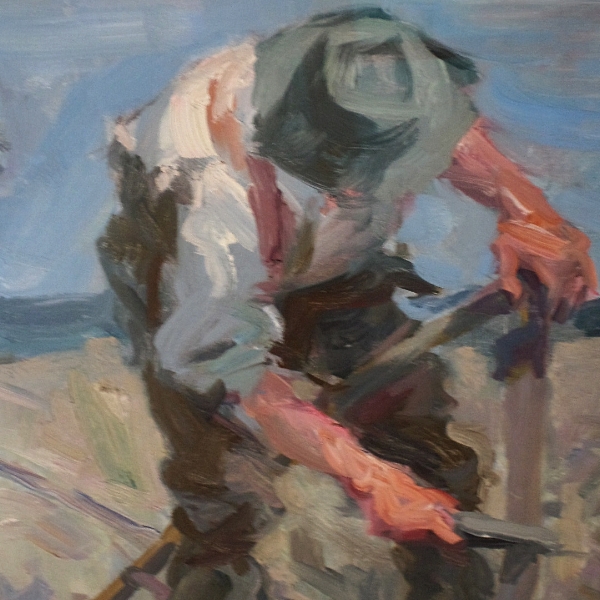
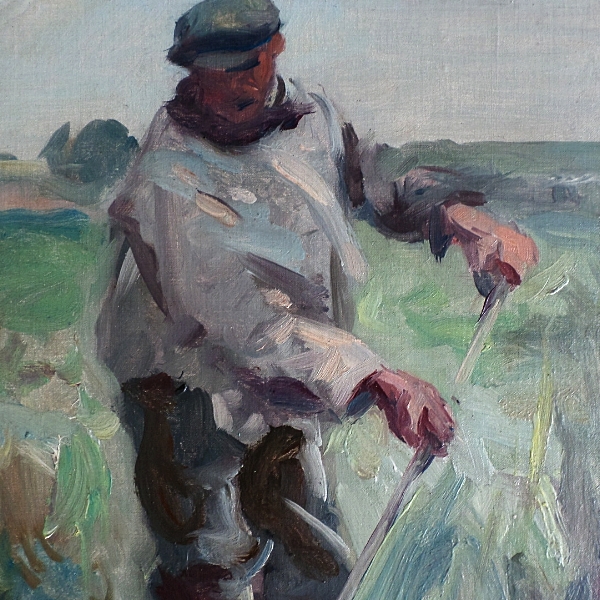
Merlyn Evans - 1960's abstract paintings
Merlyn Evans wrote in the introduction to his exhibition at the Marlborough Gallery in March 1968 .....
' By temperament and preference, I have been from the early age of seventeen an abstract painter'
He was precociously gifted as a student at the Glasgow School of Art and then Royal College of Art in London and exhibited at the Royal Scottish Academy on 1930 and 31. He was influenced by Surrealism in the 1930's and also Mondrian . Evans temperament combined passion and philosophical speculation and argument, and he was well read in psychology, philosophy, politics and the history and techniques of art. He was also profoundly affected by Modernist literature and poetry, a lover of music and player of jazz piano and trumpet. He married the concert pianist Marjorie Few in 1950 I think it is interesting that his abstract work seems to have started in the late 1950's with a series of work entitled The Orchestra. These derived from studies made from the box at the Festival Hall and were an attempt to depict the ensemble of the orchestra as a crowd.
The theme of crowd and its complex form and process continued to fascinate Merlyn Evans and drove him to produce the vast Waterloo Station Series in 1963.
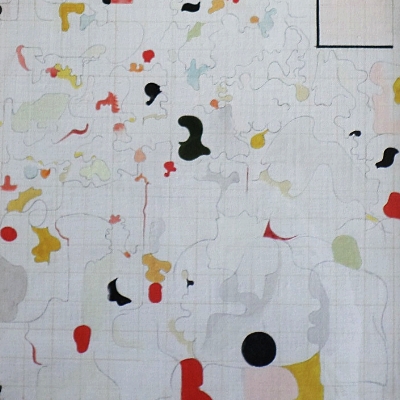
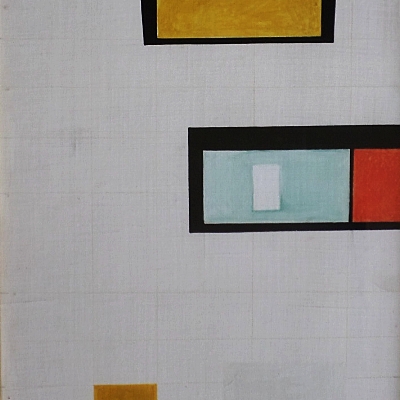
His final work consisted of four tall sections of nine feet by four but what we have here at Blondes Fine Art in Hertfordshire are two of the studies that he painted at the station over a period of years. These recorded, what he termed 'direct from nature'. The final work was too big to be hung in the gallery rooms of Tunnard and Roberts where Evans exhibited in October 1963, and was displayed instead in the studio, a disused church in Fleet Road, Hampstead, which was also large enough to house his huge presses. ( see image below of Evans in front of the huge panels )
Merlyn Evans had after returning from the war, learnt etching and aquatint and became a master intaglio printmaker and he is still considered to be one of the Modern British 'greats' in this particular field.
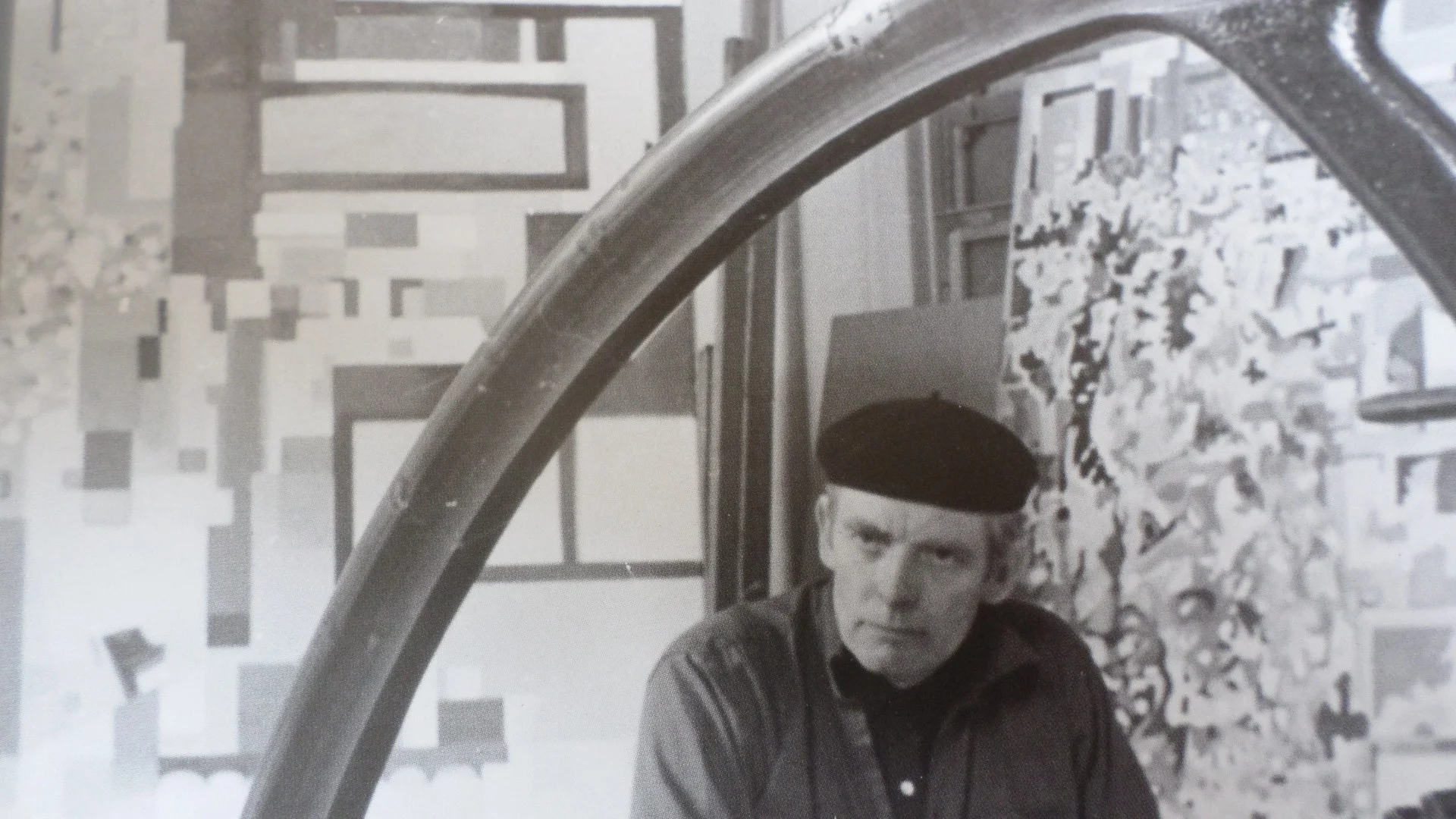
The sequence of panels in the Waterloo Series is also interesting as it suggests a musical process of complication to simplicity, with overlapping transitions from the figurative to the geometric. Panels one and three where described by Evans as 'figurative with a controlled degree of representation. Everything is on the move. ' In panel one the crowd is clearly seen as a collection of individuals, massing at rush hour into spaces between the booths and advertising hoardings. In panel three there is more of a merging into one mass. Panel two gives a cinematic shot of the stations static properties with the crowd in the foreground while the transition to abstraction is complete in the final panel which shows the station reduced to purely geometric forms. It seems that Evans wanted to articulate the disconcerting vision of the modern city of London with its human masses in contrast to the stark modern architecture.
The pair of works available here are for panels three and four and come from the personal collection of the great British composer Malcolm Arnold. His work is hard to find and rarely available other than in a few St James, London galleries so please do contact us to arrange a viewing or for more information about these works.
Walter Hoyle - Great Bardfield Artist - Etchings for sale
Walter Hoyle was greatly influenced by his friend Edward Bawden and , together with Sheila Robinson , they are my favourite Bardfield printmakers. Indeed both worked very closely with Bawden on a number of projects both in the UK and abroad. Walter Hoyle worked together with Bawden and Robinson on the mural for the RCA's Lion and Unicorn Pavilion at the 1951 Festival of Britain on the South Bank in London and upon its completion he holidayed with Bawden in Sicily where they both painted daily.
It was shortly after their return from this trip that Walter Hoyle moved to Great Bardfield. In the early 1960s he really concentrated on printmaking. He was teaching at Cambridge School of Art , set up a print studio and launched 'Cambridge Print Edition' to produce limited editions of artists' prints. It was at this point that he produced a series of prints depicting Cambridge Colleges that was published by Editions Alecto. The Cambridge Colleges were 10 Linocuts made in 1965-6 and were sold in a portfolio box set. These were shown in an exhibition 'Zodiac Paintings and Cambridge Prints ' at Savage Gallery , London 1966.
A short time later Hoyle made a series of prints based on his paintings on the zodiac and were produced by Editions Alectro as the ' Planet Series' . These seem to have disappeared over the decades and rarely now come to the market for some reason. They were complicated works and he experimented with paper, techniques and inks producing for cutting edge material.

' Bright Star ' 1969
There is no doubt that the years spent in Great Bardfield were an important part of Walter Hoyles life . Moving to Essex and Cambridgeshire allowed him to raise a family and to develop as an artist while mixing with other like minded individuals. Unlike some of the other artists in Bardfield his work developed greatly over the years, creating new images that challenged his previous work. As a result I think his work is more varied than others but perhaps less distinctive and recognisable than other Bardfield artists. Having said this it also makes his work more interesting and individual, as he adapted his practise in response to where ever he was at the time . We here at Blondes Fine Art currently have two lovely Etchings available for purchase.
He married Denise Hoyle who was of French birth and spent the later part of his life living between Hastings and Dieppe until he died in 2000.
John Bratby - Sunflower oil painting - Wanted
John Bratby is one of our most well known artists who was one of the group of famous 'Kitchen sink' artists.
He is particularly known for his large vibrant images of yellow sunflowers from the 1960's /70s and we are currently looking to buy a work in good condition with good provenance. the cash is waiting for the right work so please do contact us if you are looking to sell.
Bratby’s fame was, in his time, the equivalent of Damien Hirst or Tracey Emin. Everyone knew who John Bratby was. A supercharged realist-cum-expressionist, Bratby piled up the paint in mounds of impasto that threatened to topple off his pictures. Bratby epitomised the mid-Fifties British rebellion against pretension and the class system.
In the Sixties he produced intense, psychedelic portraits of international stars such as Paul McCartney and David Frost, wrote existentialist novels and painted a notorious mural of the crucifixion with his own flabby torso on the cross.In the Seventies he turned to the Right, politically, was elected to the Royal Academy of Arts and then tried, unsuccessfully, to paint the portrait of Idi Amin. He also completed perhaps the worst-ever group painting of the Royal Family purely for publicity .
There had been no one like John Bratby, but after his death only Charles Saatchi remained a champion of his.
All this said we here at Blondes Fine Art are looking to purchase . Contact us now on 07519639386
URSULA McCANNELL painting for sale -The Spanish influence.

This work was purchased new from the 1977 RA Summer exhibition and is accompanied by a letter from the Artist.
"It's fairly easy to discover how writers like George Orwell or WH Auden or Laurie Lee reacted to the Spanish crisis, and I have to say that 'As I walked out one Midsummer Morning' by Laurie Lee has to be one of my favourite reads. But what Britain's painters and sculptors did is less well known."
The people of London were troubled by the growing tension in Europe in the run up to World War II in the late 1930s, British artists reacted to the Spanish Civil War and the great crisis in European politics in the period before World War Two.The artists mostly supported the Republican side, which had been ejected from power by General Franco. Most of the artists are now dead and indeed the youngest - Ursula McCannell - recently passed away but before she did she was interviewed about what she could recall of the Spain she encountered as a teenager in 1936
Ursula McCannell's paintings were inspired by the suffering she saw when her family visited Spain in the 1930s. McCannell was 13 at the time. Her father was Otway McCannell, a painter and teacher. As with many intellectual British families in the 1930s there was much discussion at home of the growing crisis in Madrid. She remembers her father worrying about the pressure the Republican government was under from the Nationalists under General Franco. Later in the war he would plot the two sides' changing fortunes on a big map of Spain, despairing as the Republicans lost control. Ursula recalled ,"Every Thursday we had Left Book Club meetings at our house and there would be people talking about Spain and politics. In truth, when we went to Torremolinos in 1936, it was partly to stay with a school friend. But I remember the suffering of the local people clearly. The sense of unease was obvious, even to a young person like me."
One of McCannell's paintings from this period is Family of Beggars. "I didn't paint or sketch in Torremolinos, which in those days was just a sleepy little village and totally unlike how it is now. I started the paintings when we got back to England. There were quite a lot of them but I sold some. In fact the beggars were outside the cathedral at Malaga. They were a pathetic sight but my parents thought I ought to see everything.When we got back I was interviewed by newspapers including the Daily Mail. They were fascinated that a 13-year-old had painted pictures of the Spanish poor. I wasn't painting the conflict as such, but they said I'd portrayed the suffering of refugees well. You couldn't help being moved." McCannell was among the last artistic witnesses to the crisis of Spanish politics in the 1930s.
The visit to Spain just before the Spanish Civil War and the experience had a profound and continuing effect on her work.Themes that she developed at this time, the atmosphere of unease and the depiction of people at the edge of society remained with her for ever. The influence of Spain continued during the 1960's and 70's when her family took their holidays in Cadaques , in Northern Spain. Cadaques was a beautiful village on the Catalan coast where Picasso spent a summer in 1910 and it was where Dali, Duchamp and Man Ray all had homes. McCannell painted the older inhabitants of the village , who had survived life in body but not spirit, the textures of the old plastered walls and the peeling whitewash paint textures that are mirrored in the haunted faces and twisted hands of the village dwellers.
McCannell continued to paint in Spain when in 1963 together with her husband she purchased a house in Cadaques. The influence of this country on her work was always there in her work and gives it a unique feel. It was while painting in Spain at this time that she started to explore new ways of applying paint and I was lucky to recently view one of these works where sand had been mixed with the oil to give a unique texture.Unfortunately, it is now often found to have been subject to a degree of paint loss. All this said the work I examined was 18 x 12 inch and depicted the Farm House near their home in Cadaques, a lovely image that made a very healthy sum even at a small provincial auction, confirming that her work is still very popular and indeed the hardest thing is finding one available to purchase.In 2016 a retrospective exhibition of works by Ursula McCannell took place at the Fosse Gallery in Stow-on-the-Wold where there were around 30 works, mostly oil on canvas apart from a small selection of drawings, dating from the 1980s and 1990s with some available to purchase, prices range from £950 for the drawings and up to £15,000 for the oils.
We are very pleased to be able to offer the fabulous work that we currently have from the RA Summer exhibition of 1977.
Cllifford Ellis painting for sale - 'The forgotten abstracts'

Clifford Ellis is not someone that immediately comes to mind when you think about the St Ives group or even the wider Modern British Art movement of the 1950's but he is someone that we all need to re evaluate.
Over the years Clifford and his wife Rosemary worked together on the book jackets for the famous 'New Naturalist' series but also produced a number of lesser well known , linear abstract prints influenced by their friends William Scott, Henry Cliffe and Howard Hodgkin. They also decorated tiles, made ceramics, produced mosaics and posters for London Transport, Shell BP and the Post Office. They were also responsible for the cartoon which they designed for the entrance hall for The British Pavilion at the Paris International exhibition in 1937.
In 1936, Clifford Ellis took up a position at Bath Tech college and was appointed Head of the Art school two years later. They came to know many artists, including Paul Ashford, Lord Methuen who had himself studied under Walter Sickert and the Ellises also became acquainted with Sickert when he and his wife visited Methuen at Corsham Court in Wiltshire.
During the war the Bath Academy of Art moved to Corsham Court at Lord Methuen's invitation. The Ellises continued to engage with many talented young artists who came to teach at Corsham, a significant number would become key figures in the history of Modern British Art. These included William Scott, Kenneth Armitage, Terry Frost, Peter Lanyon and Howard Hodgkin, to name just a few.
Clfford Ellis was clearly influenced by their work and produced a number of abstract work much of which went unknown and unexhibited , remaining in the family possession until recently released . The work available here is on board and in perfect condition having been safely stored by his daughter. It has undergone a lite clean by a professional conservator , untitled but signed with initials and dated lower left, this work is perfect and ready to hang.
Contact us for further details.
Jo Taylor Artist - Horse paintings for sale
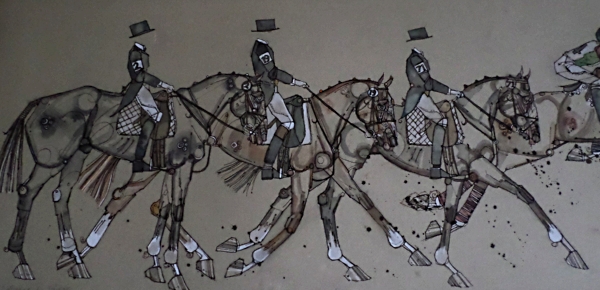
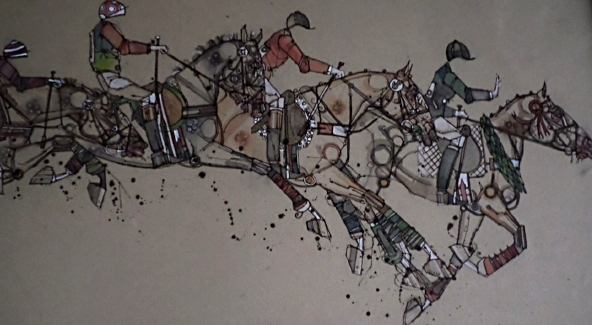
Jo Taylor is the choice for my first blog for Blondes Fine Art. Yes, I am joining my husband, Mark, in the Gallery on a full time basis and I have chosen these early pieces by Jo Taylor about which to wax lyrical.
The way we all relate to the horse is massively different from each other but in my case my passion for horses stems all the way back to childhood. Who would have predicted that in my middle age I would still spend several hours every day with one of these majestic creatures? Our now elderly lad is still with us and owes us nothing but we as a family owe him a great deal.Toby, our daughter's horse was a talented show jumper but particularly excelled in eventing. He quite literally brought our family together as we all established our roles within his routine... driver, groom, trainer and rider.The subject matter of these paintings by Jo Taylor resonates strongly and brings back memories of days spent watching at Burghley and Blenheim horse trials; conversations of aspirations and ambitions; Pony club and riding out with the hunt. Some dreams were achieved but many remained in the dream stage.
Jo Taylor's relationship also started at an early age. Born in Lancashire in 1969 she grew to be an accomplished horse woman and would often be spotted riding the fells followed by her trusty greyhound who has also been the subject matter of some of her work. In the late 1980's and early 90's Jo studied at the Leeds Metropolitan University, coincidentally the chosen place of study for our daughter who has made this Yorkshire town her home ever since.In the years that followed Jo became the artist in residence at The University of Liverpool in the department of Veterinary Science. Although Jo already possessed an instinctive and accurate knowledge of the physiology of the horse and was already producing work which demonstrated this through her unique and somewhat abstract style, her residency enabled her to develop an even greater understanding of the animal's anatomy, a talent rarely seen and only in work produced by the greats such as Stubbs.
Always drawing from real life Jo's passion has taken her all over the world.
These pieces are examples of Jo's work from the early 1990's. Their simplicity and complexity sit comfortably together. The blend of the three Eventing disciplines and the perfect flow of the animals are aesthetically pleasing and thought provoking all at once. The horses appear anatomically correct but we can see through them, muscle and tendon exposed. The riders are donned appropriately but they have no features. How can these images be abstract and almost scientific at the same time? In short I am mesmerised by Jo's unique approach and her ability to bring the horse to life in a way I have not seen before.
They say that if you are privileged enough to spend time with this almost mythical creature they somehow get under your skin. In my opinion Jo Taylor has reversed this phrase and when looking at her horses I feel I am seeing under their skin. It's powerful. When I discovered this artist I half halted, momentarily spooked and then my emotions reared. She is a very talented artist and in these examples uses geometric shapes to enhance the horse, splashes of ink to represent the mud splashing and the colour of the riders and horses attire to bring the whole composition to life.
Jo has gone on, in more recent times, to depict her equine subjects with a streaming fluency on often huge sheets of paper capturing the shapes and movement from the tautness of reined back impatience to the flow of an effortless pace. In Jo's work the viewer feels the relationship between horse and human. She went on to do exactly the same with the Bull and the primal theatre of the Bull ring. Its huge dark mass become almost a landscape of muscle. Jo captures the shapes and patterns and energy of these creatures with the same passion as the horse. She adds collage , and lets paint stream to accentuate the movement and bulk.
So its seems that whatever the subject and medium Jo Taylor is now a highly skilled and highly acclaimed artist with great talent and passion. We are very happy to curently hod three subjects by her from the early period of her practise so please contact us for more information.
Mark Hearld - Collage and Ceramics For Sale
Mark Hearld is, as any of you who follow our blog pages will already know, an artist of immense talent and someone who features in our own personal art collection. He loves to create and has over the years been equally as happy making marks in oil paint, lino, print, collage, wood, and ceramics. We are delighted to have some of his very recent ceramic work available to buy and think that they offer remarkable value while they are sure to become collectors items of the future.
Mark Hearld's first ceramics were decorated blanks in a ceramic cafe where he decorated bisqueware which then went for its final firing in much the same way that the great painters from the potteries worked in the 20th century. He went on to explore the use of scraffiti and slip trailing before collaborating with the great master potter , Terry Shone in Whitby.

Mark Hearld Ceramic Horse
In more recent times Mark Hearld has worked with a low volume pottery producer in Stoke on Trent . This came about when he was initially away in Berlin for a few days with Emily Sutton and they came across an old wooden horse that had wheels on its base and had been a child's toy. It was for sale in a flea market so , being the great collectors that they are, it was purchased and came home to York and then onto the potteries to be the model for a mould. The rest is history as Mark has now produced a small number of his ceramic horses in a hand full of batches each individually decorated by him and are of such great proportion that they make a feature and talking point in whichever room they are located. We here at Blondes Fine Art love the simplicity of form and nobleness of stance which when combined with Mark's decorative verve makes them a must have item.
The most recent output by Mark, in Stoke on Trent, are a new series of slipware platters which have been hand produced in small numbers and have designs inspired by his recent visit to the USA with birds such as the Blue Jay featuring strongly. Mark Hearld will continue to produce great work in all mediums and we very much look forward to seeing his latest output, a ceramic cockerel, which is still in the design stage. But for now we are delighted to be able to offer a selection of ceramic and other work by Mark Hearld and if you check out his artist page here at Blondes Fine Art you will find a few gems still available to purchase. Don't miss out !
Peter Biegel - Sporting Art
Peter Biegel is one of finest equine artists and Blondes Fine Art are delighted to have acquired two fabulous oil paintings dating from the 1960's.
The smallest work is an oil sketch on board and has a real period quality about it and a very American feel due to the denim clothes worn by the lad. It has its original gallery label attached verso and details of its later sale in the 1990's to raise funds for the injured jockey fund. It is really nice piece that would fit well into any equine lovers home.

Peter Biegel and his wife Dora were actually regular visitors to the United States and would go for a month every year to paint. They first went out in the 1960's to paint for Barry Ryan at Normandy Farm, Kentucky . Their host was an equine art lover and had works by Herring , Munnings and many others but was quoted in a magazine, Thoroughbred of California , as saying that Peter Biegel was' the best painter of the horse today'. Biegels work is still much admired in the U.S.A. and a draw for many a collector.
It is also fitting that these works that we currently have available were both later sold for the benefit of the Injured Jockey Fund. Many charities benefited from Peter Biegel's generosity but it was the Injured Jockey fund that benefited to the tune of one hundred thousand pounds on a number of occasions from the sales of reproduced images in the form of Christmas cards.
Please do view our new Sporting Art pages and contact us is there is anything that you are particularly looking for.
Gwilym Prichard - Welsh artist of painterly form
Gwilym Prichard - or Pri(t)chard as he signed his work in his earlier life - is much less well recognised than some of his contemporary Welsh artists from the same post war period.

For me one of the absolute joys of being a Fine Art dealer is that I can indulge my passion for art on a daily basis by sourcing and purchasing the work that I personally enjoy. It matters little to me if a particular artist has been 'over looked' by the mainstream Art community , and indeed I see it as a distinct advantage when looking to find new gems. The early work of Gwilym Prichard is perhaps one such example. He is well known in Wales but much less so elsewhere and I am always interested to hear from private clients who have his work from the 1950s and 1960s and are considering selling. I buy his work because it resonates with me emotionally, it has such vibrancy in texture and palette, yet communicates the bleak Anglesey landscape in a way that is hard to find anywhere else.
As a child my sister and I would visit Anglesey on a regular basis to see 'Uncle Ivor' and to explore the wildlife of North and South Stack , watch the rock climbers navigate the cliffs and to search for Adders and Bee orchids on the sand dunes. They were , from my recollections, days of extreme weather and I recall being burnt from the sun and drowned by the cold rain on the bleak hills. I had , at that time, no knowledge of anyone called Gwilym Prichard and no knowledge of how he was recording my childhood memories at exactly the same time that I was visiting the places he painted. Penmon Priory was a regular subject of his work and often depicted Puffin Island in the background. Actually the bulk of his work was, for sometime focused in a triangle formed by Pentraeth, Penmon and Beaumaris and it was while painting in this area that he really matured as an artist.These were also familiar places to me and I guess that is why his work has such a hold on me . But it is not just the subjects that are important but his painterly style and use of thick slabs of palette - knife and sweeping brush stroke to convey the boulders , buildings and beauty of his native land. In fact his colour and block work reminds me of de Stael.
Gwilym Pritchard was born in 1931 and would keep the spelling of his surname with the 't' until the 1980s when finding that his Great Grandfather had been a Prichard - without the 't'. He had a brother Arthur, who was also a talented artist and he married his childhood sweetheart Claudia Williams who is yet another talented Welsh artist. They lived in Anglesey for much of their early life and it was here , and the images of the local landscape, that gave Prichard the notoriety he deserved. He taught at the local secondary school for 11 years and managed to paint in his spare time building up a steady patronage.
He built up strong ties with leading galleries and was a regular exhibitor from the late 1950's with Royal National Eisteddfod of Wales , Bangor Art Festival and notably with Howard Roberts Gallery, Cardiff for a decade between 1958 - 1969.
In 1956, when private galleries were rare outside London, Howard Roberts established his gallery in the Welsh capital. Roberts was born in Cardiff attended Cardiff College of Art, and taught art at Tiverton High School before returning to the Principality and opening what was to become Wales' most successful commercial gallery. It concentrated mainly as one would expect, on Welsh art but also showed many British artists who included Henry Moore, Ben Nicholson, Barbara Hepworth, Graham Sutherland, Prunella Clough, and Bridget Riley. Welsh artists exhibited included Augustus John, Morland Lewis and Alfred Jones. The gallery was also a considerable force in developing the careers of Kyffin Williams, John Elwyn, Ernest Zobole and Will Roberts amongst many.
However, by 1970, expenditure on new premises, competition from other galleries and rising rents forced the gallery's closure. The work shown above dates from the early 1960s and has a Howard Roberts Gallery label fixed verso. Enquires about this work are welcomed so do not hesitate to contact us here at Blondes Fine Art.
Elizabeth Blackadder flower paintings in oil
Elizabeth Blackadder has had a love of flowers since her childhood but they did not appear significantly in her work until the mid 1970's, when she moved to Fountain Hall Road , which had a large garden . Prior to that period she was however, experimenting in her style and mediums and flowers were a topic that seems to recur.
In 1963 John and Elizabeth moved from their flat into a house in Queens Crescent, on the South side of Edinburgh. They then had for the first time, a small garden which gave her access to a constant supply of flowers and it is in that period that we begin to see them feature in her work. In 1966 she produced a large pen and ink drawing of Lilies which is depicted on page 51 of Duncan Macmillan's book about Elizabeth Blackadder, which has some similarities to the work we, here at Blondes Fine Art, have recently acquired. The work shown below is signed but undated depicts a still life of Lillies in a vase and is I believe from the same mid 1960's period. Interestingly the period, gold, glazed, box frame appears to have been 'borrowed from her husband as it bears his name and the title of one of his works to the back.

During the early 1960's Blackadder lived near Anne Redpath and it was she that helped Blackadder to see the possibilities of still life and as a result she began to experiment in a way that shows a direct link to those still-life flowers of Redpath's. It is also clear that Elizabeth was concentrating on still life in oil and produced a body of work that have a very similar palette to the work shown above. Two such examples are 'Summer' an oil from 1963 and 'Still-Life with Grey Tabletop' an oil from 1965 both of which use the same loose style in greys and yellows. During this period she experimented with approaches and appears to be looking to find a new way of working and her own distinct artistic voice. She did , as we are all well aware, hone her skills in the painting of flowers later in her career but this work offered here , 'Still-life Lilies' in oil, circa 1965 is one of the first serious paintings of this subject matter.
Early oils of flowers by Elizabeth Blackadder are a rare find and this one is delicately painted and of a size that will fit into any home . please contact us if you would like further details or arrange to view the work
Blondes Fine Art Christmas Art Sale - featuring work by Kirsten Wilson.

Blondes Fine Art are a family business selling Modern British Art and are based in Widford near Much Hadham in Hertfordshire. Selling direct to collectors via the internet , we have also exhibited in central London at the 'Works on Paper' and 20/21 fairs.
This year we have decided to open our private gallery to bring quality Fine Art to rural Hertfordshire and will have work by Dame Elizabeth Blackadder RA, Sir John Arnesby-Brown RA, Lucy Kemp-Welch, Harry Becker, John Aldridge RA, John Houston RSA and the current 'Keeper of the RA' Eileen Cooper together with many more, all on show in our converted 'Stable Yard Gallery' .
Most of all, we are delighted to have an exhibition of new work by the highly talented local artist Kirsten Wilson.
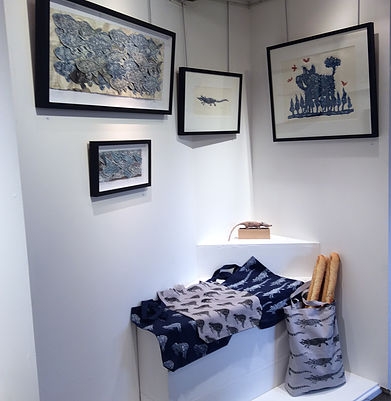
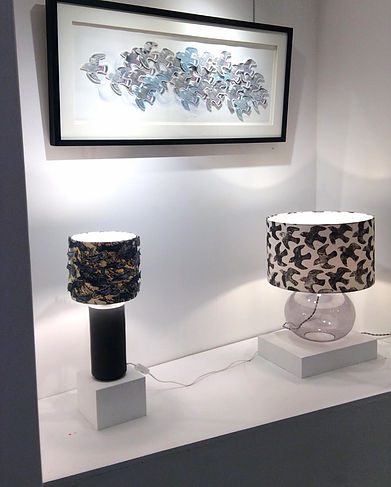
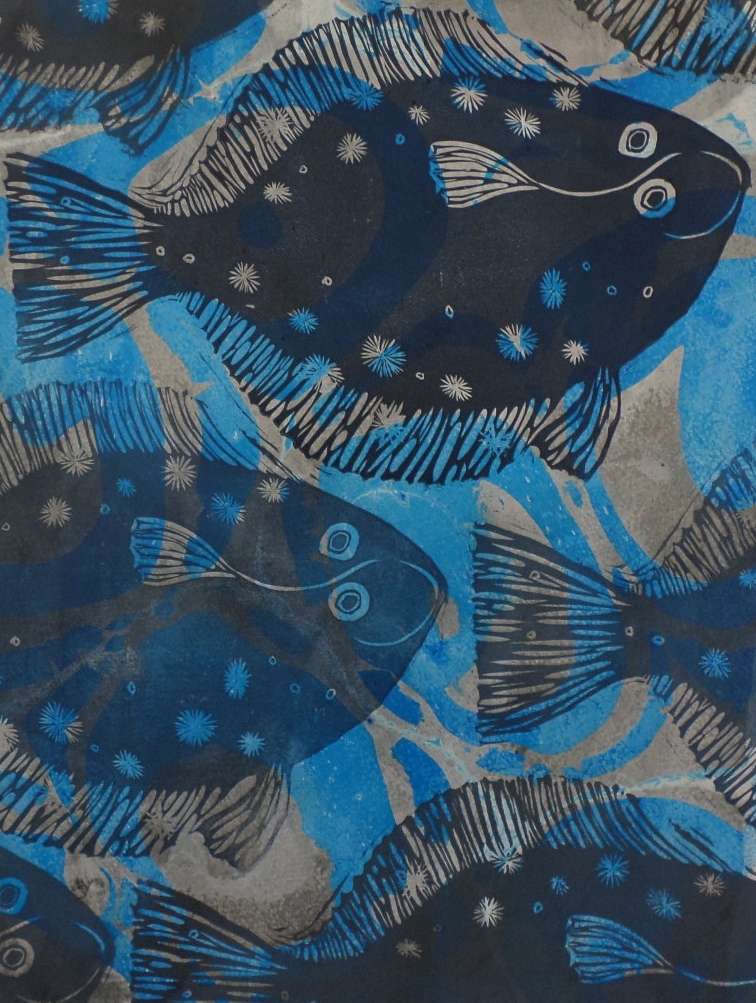
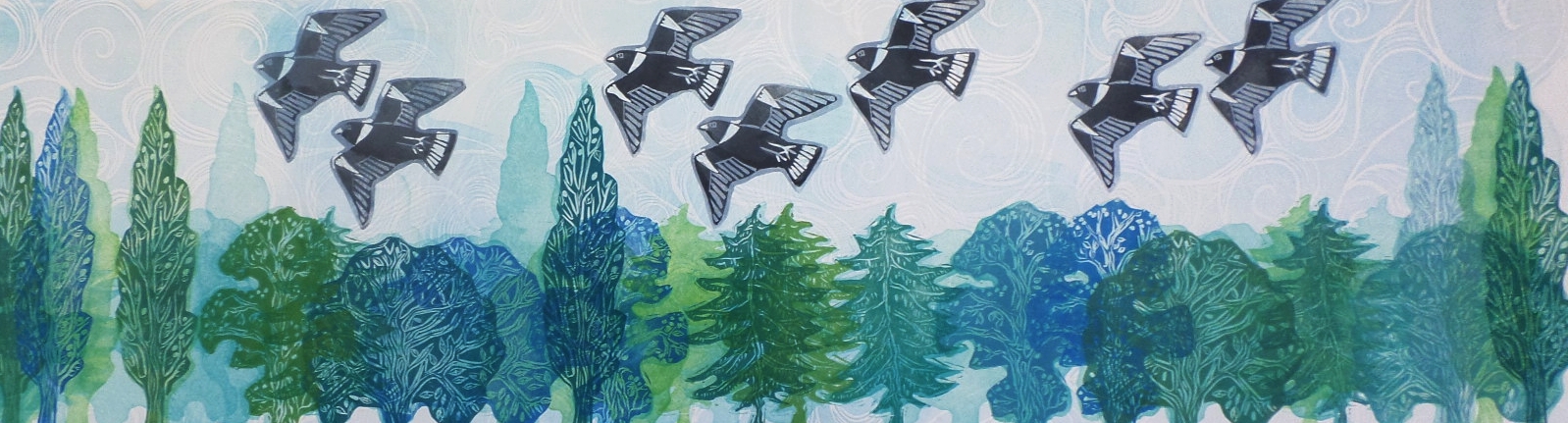
Kirsten Wilson is a graduate in Fine Jewellery Design and Manufacture from Central St Martins College of Art.For several years Kirsten made three dimensional pictures, cards and clocks for retail outlets throughout the world, including John Lewis and also designed and painted back drops for Local Fund raising Events for the Isobel Hospice and Much Hadham Ball. Kirsten was raised in East Hertfordshire attending the local village schools in Widford and Much Hadham and still lives in this lovely rural area with her family. Kirsten has had several children’s books published she works mainly in watercolour and ink, her drawings and paintings are humorous and individual. A more recently Kirsten has discovered a love for Printmaking, especially Lino cut and dry point etching.We are delighted to be able to show her work at our first show in our private 'Stable Yard Gallery' here in Widford and everyone is welcome on the weekend of 26th & 27th November and again on Sunday 4th December or by prior appointment.
We look forward to seeing you.
Fred Cuming RA 'Visual Intelligence' - Painting for sale
Fred Cuming and his use of light and colour have always attracted me to his work and I am extremely happy to have recently acquired a wonderful still life oil on board depicting a vase of flowers. Indeed, the last time I was at Bonhams for a sale, I watched two similar works sell for very good prices and have been searching for some time for the right work to come my way.

One of my occupational hazards is trying to read about three art books at once and at the moment I can recommend two. The first is 'The Visitors Book' which is so visual that I almost feel I was there with Francis Bacon, John Minton, The Roberts, and the rest of the Fitzrovia 'gang' in the drunken post war period of the 1950s. The book is about the lives of Richard Chopping and Denis Wirth-Miller and if you have not heard of them it is a must read book. I know I am digressing and need to focus on Fred Cuming but this is the other book that I am currently consuming. 'Another figure in the landscape' is also a must read if you, like me, love the work of Fred Cuming. He tells us all about his working and influences which I will not rehash here but is a collectors study staple.
So, where is the link between the two , I hear you ask? Well its something I have just read in Fed Cuming's book and its 'Visual Intelligence', which is a phrase I have not heard before. I am a great believer in Emotional Intelligence and much has been written on the benefits of such over IQ for example. He talks about some people having visual acumen far ahead of their fellows, who are open-minded about what they expect to see and do not see art as merely a reproduction process. It is, he says , people with a willingness to become fascinated by the mechanics of just 'seeing' such as film makers and theatre directors, lateral thinkers, people with a commanding, even obsessive, drive and focus.
This made me reflect on Francis Bacon whose work was initially heavily criticised but he continued with his work despite these adverse reviews and also of Wirth-Miller who against the odds became a great , if not under recognised, painter of abstract landscapes. Both men where self taught with little formal training yet their Visual Intelligence was so strong that they succeeded in making a career in art . I think Fred Cuming is correct in his views and some people are just more open to visual stimuli and see and translate emotion in colour and light. Certainly, Cuming is one of these people, his use of colour and light is quite wonderful and he is rightly considered to be the greatest living landscape painter of our time. But, it is not just landscapes where these skills are to be seen and in his conclusion to the book says the following which illustrates this well.
" From my studio shed I see everything transformed by the angle of the light in autumn evenings, a magical half-hour of brilliant gold light against shadows and darker areas. The jam-jar on my window-sill holding dead flowers, thistles and teasels is transmuted into gold, a treasure from the tomb of Tutankhamen. And then as the light fades different shades appear, gold turning to beautiful mauves and browns, dramatic contrasts reduced to subtle harmonies, the explosive sound of a huge orchestra dwindling to a gentle sonata of greys , mauves and pinks'
Now I know why the work of Fred Cuming resonates with me so much, its his Visual Intelligence.
The work shown above is currently for sale.
Julian Trevelyan Prints -Etchings, Aquatints & Lithographs
Julian Trevelyan has left us with some wonderful images that track his life, loves and passions, the earliest days of which can be traced back to his days at Trinity College , Cambridge in the 1930's. He was at this time, interested in Surrealism and eventually, in 1931, gave up the academic life and travelled to Paris where he where he joined S.W. Hayter at Atelier 17 . It was here that he learned his trade as a master printsman. He graduated from line engraving to textures impressed in soft ground etching and aquatint, which became his preferred methodology.
Julian Trevelyan worked at the Royal College of Art between 1955 and 1963, where he became head of the Etching department and influenced the likes of Ackroyd, Hockney and Kitaj. His own personal style, particularly in the 1970's, developed into one of simplification and outlining which resulted in fresh, spontaneous and bold images with the use of little colour. He printed many of his Etchings himself at his Durham Wharf studio in West London , where he had a Kimber press installed in 1964.
The image shown below is a fine example of Julian Trevelyans work from the late 1970's. It is titled 'Farndale' and is an Etching and Aquatint from a single steel plate 35 x 48 cm and dates from 1979. The work only uses one colour -black- and was printed by Trevelyan on Mouldmade, Arches 88 paper sheets 57x76 cm. Interestingly, this was to be an edition of 50 with a run of 5 Artists Proofs but only 10 of the edition were ever produced by him in his lifetime, making this a very sought after and hard to find image. Farndale , itself is located in North Yorkshire and is only a few miles from the farm the Trevelyans bought in 1974 called Hill top Farm in Spaunton, North Yorkshire.

Here in Hertfordshire, Blondes Fine Art continue to strive to source those special works from our greatest artists and if you are looking for a particular 'hard to find' work do please contact us and we will endeavour to help you locate it.
At the time of writing this image by Julian Trevelyan has just been reserved.